

92
M. H. Mahyuddin
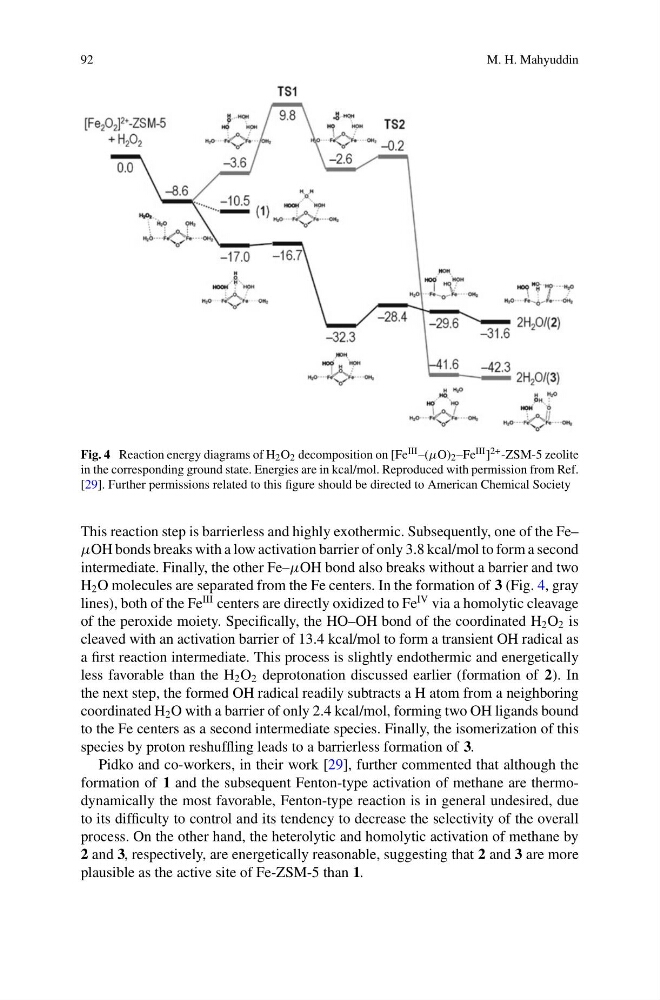
Fig. 4 Reaction energy diagrams of H 2 O 2 decomposition on [Fe III –(μO) 2 –Fe III ] 2+ -ZSM-5 zeolite
in the corresponding ground state. Energies are in kcal/mol. Reproduced with permission from Ref.
[29]. Further permissions related to this figure should be directed to American Chemical Society
This reaction step is barrierless and highly exothermic. Subsequently, one of the Fe–
μOH bonds breaks with a low activation barrier of only 3.8 kcal/mol to form a second
intermediate. Finally, the other Fe–μOH bond also breaks without a barrier and two
H 2 O molecules are separated from the Fe centers. In the formation of 3 (Fig. 4, gray
lines), both of the Fe
III centers are directly oxidized to Fe
IV via a homolytic cleavage
of the peroxide moiety. Specifically, the HO–OH bond of the coordinated H 2 O 2 is
cleaved with an activation barrier of 13.4 kcal/mol to form a transient OH radical as
a first reaction intermediate. This process is slightly endothermic and energetically
less favorable than the H 2 O 2 deprotonation discussed earlier (formation of 2). In
the next step, the formed OH radical readily subtracts a H atom from a neighboring
coordinated H 2 O with a barrier of only 2.4 kcal/mol, forming two OH ligands bound
to the Fe centers as a second intermediate species. Finally, the isomerization of this
species by proton reshuffling leads to a barrierless formation of 3.
Pidko and co-workers, in their work [29], further commented that although the
formation of 1 and the subsequent Fenton-type activation of methane are thermodynamically the most favorable, Fenton-type reaction is in general undesired, due
to its difficulty to control and its tendency to decrease the selectivity of the overall
process. On the other hand, the heterolytic and homolytic activation of methane by
2 and 3, respectively, are energetically reasonable, suggesting that 2 and 3 are more
plausible as the active site of Fe-ZSM-5 than 1.
M. H. Mahyuddin
Fig. 4 Reaction energy diagrams of H 2 O 2 decomposition on [Fe III –(μO) 2 –Fe III ] 2+ -ZSM-5 zeolite
in the corresponding ground state. Energies are in kcal/mol. Reproduced with permission from Ref.
[29]. Further permissions related to this figure should be directed to American Chemical Society
This reaction step is barrierless and highly exothermic. Subsequently, one of the Fe–
μOH bonds breaks with a low activation barrier of only 3.8 kcal/mol to form a second
intermediate. Finally, the other Fe–μOH bond also breaks without a barrier and two
H 2 O molecules are separated from the Fe centers. In the formation of 3 (Fig. 4, gray
lines), both of the Fe
III centers are directly oxidized to Fe
IV via a homolytic cleavage
of the peroxide moiety. Specifically, the HO–OH bond of the coordinated H 2 O 2 is
cleaved with an activation barrier of 13.4 kcal/mol to form a transient OH radical as
a first reaction intermediate. This process is slightly endothermic and energetically
less favorable than the H 2 O 2 deprotonation discussed earlier (formation of 2). In
the next step, the formed OH radical readily subtracts a H atom from a neighboring
coordinated H 2 O with a barrier of only 2.4 kcal/mol, forming two OH ligands bound
to the Fe centers as a second intermediate species. Finally, the isomerization of this
species by proton reshuffling leads to a barrierless formation of 3.
Pidko and co-workers, in their work [29], further commented that although the
formation of 1 and the subsequent Fenton-type activation of methane are thermodynamically the most favorable, Fenton-type reaction is in general undesired, due
to its difficulty to control and its tendency to decrease the selectivity of the overall
process. On the other hand, the heterolytic and homolytic activation of methane by
2 and 3, respectively, are energetically reasonable, suggesting that 2 and 3 are more
plausible as the active site of Fe-ZSM-5 than 1.