

Oxidative Activation of Metal-Exchanged Zeolite …
91
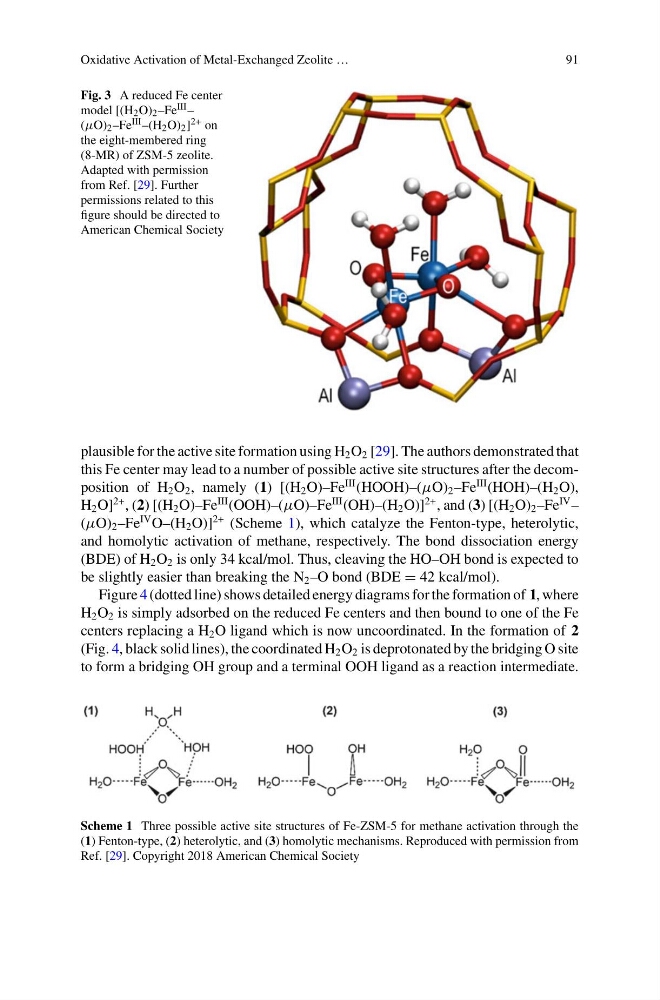
Fig. 3 A reduced Fe center
model [(H 2 O) 2 –Fe III –
(μO) 2 –Fe III –(H 2 O) 2 ] 2+ on
the eight-membered ring
(8-MR) of ZSM-5 zeolite.
Adapted with permission
from Ref. [29]. Further
permissions related to this
figure should be directed to
American Chemical Society
plausible for the active site formation using H 2 O 2 [29]. The authors demonstrated that
this Fe center may lead to a number of possible active site structures after the decomposition of H 2 O 2 , namely (1) [(H 2 O)–Fe
III (HOOH)–(μO) 2 –Fe
III (HOH)–(H 2 O),
H 2 O]
2+ , (2) [(H 2 O)–Fe
III (OOH)–(μO)–Fe
III (OH)–(H 2 O)]
2+ , and (3) [(H 2 O) 2 –Fe
IV –
(μO) 2 –Fe
IV O–(H 2 O)]
2+ (Scheme 1), which catalyze the Fenton-type, heterolytic,
and homolytic activation of methane, respectively. The bond dissociation energy
(BDE) of H 2 O 2 is only 34 kcal/mol. Thus, cleaving the HO–OH bond is expected to
be slightly easier than breaking the N 2 –O bond (BDE = 42 kcal/mol).
Figure 4 (dotted line) shows detailed energy diagrams for the formation of 1, where
H 2 O 2 is simply adsorbed on the reduced Fe centers and then bound to one of the Fe
centers replacing a H 2 O ligand which is now uncoordinated. In the formation of 2
(Fig. 4, black solid lines), the coordinated H 2 O 2 is deprotonated by the bridging O site
to form a bridging OH group and a terminal OOH ligand as a reaction intermediate.
Scheme 1 Three possible active site structures of Fe-ZSM-5 for methane activation through the
(1) Fenton-type, (2) heterolytic, and (3) homolytic mechanisms. Reproduced with permission from
Ref. [29]. Copyright 2018 American Chemical Society
91
Fig. 3 A reduced Fe center
model [(H 2 O) 2 –Fe III –
(μO) 2 –Fe III –(H 2 O) 2 ] 2+ on
the eight-membered ring
(8-MR) of ZSM-5 zeolite.
Adapted with permission
from Ref. [29]. Further
permissions related to this
figure should be directed to
American Chemical Society
plausible for the active site formation using H 2 O 2 [29]. The authors demonstrated that
this Fe center may lead to a number of possible active site structures after the decomposition of H 2 O 2 , namely (1) [(H 2 O)–Fe
III (HOOH)–(μO) 2 –Fe
III (HOH)–(H 2 O),
H 2 O]
2+ , (2) [(H 2 O)–Fe
III (OOH)–(μO)–Fe
III (OH)–(H 2 O)]
2+ , and (3) [(H 2 O) 2 –Fe
IV –
(μO) 2 –Fe
IV O–(H 2 O)]
2+ (Scheme 1), which catalyze the Fenton-type, heterolytic,
and homolytic activation of methane, respectively. The bond dissociation energy
(BDE) of H 2 O 2 is only 34 kcal/mol. Thus, cleaving the HO–OH bond is expected to
be slightly easier than breaking the N 2 –O bond (BDE = 42 kcal/mol).
Figure 4 (dotted line) shows detailed energy diagrams for the formation of 1, where
H 2 O 2 is simply adsorbed on the reduced Fe centers and then bound to one of the Fe
centers replacing a H 2 O ligand which is now uncoordinated. In the formation of 2
(Fig. 4, black solid lines), the coordinated H 2 O 2 is deprotonated by the bridging O site
to form a bridging OH group and a terminal OOH ligand as a reaction intermediate.
Scheme 1 Three possible active site structures of Fe-ZSM-5 for methane activation through the
(1) Fenton-type, (2) heterolytic, and (3) homolytic mechanisms. Reproduced with permission from
Ref. [29]. Copyright 2018 American Chemical Society