

90
M. H. Mahyuddin
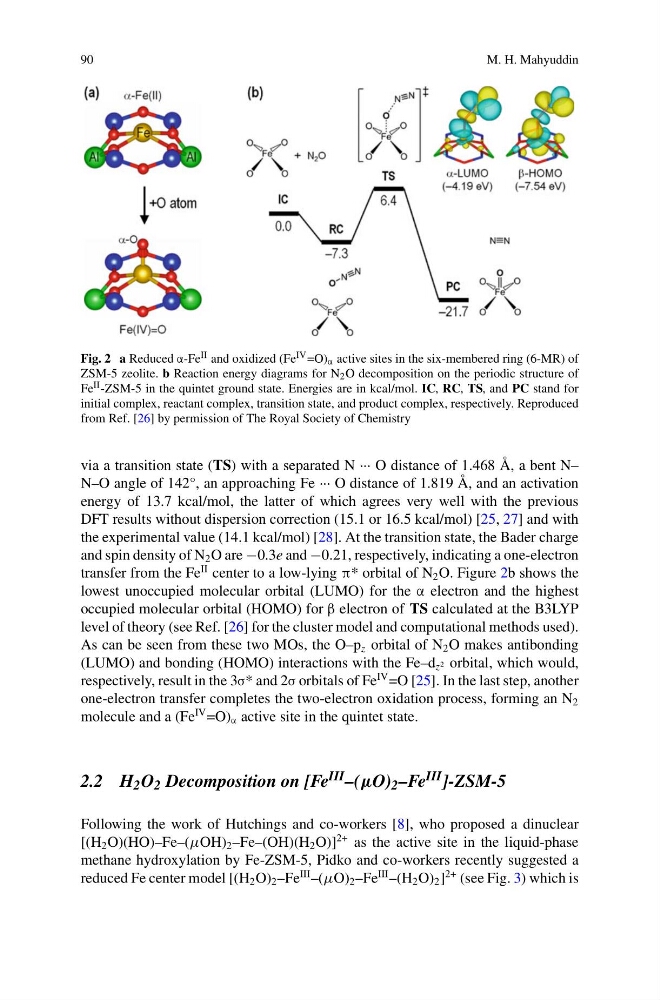
Fig. 2 a Reduced α-Fe II and oxidized (Fe IV =O) α active sites in the six-membered ring (6-MR) of
ZSM-5 zeolite. b Reaction energy diagrams for N 2 O decomposition on the periodic structure of
Fe II -ZSM-5 in the quintet ground state. Energies are in kcal/mol. IC, RC, TS, and PC stand for
initial complex, reactant complex, transition state, and product complex, respectively. Reproduced
from Ref. [26] by permission of The Royal Society of Chemistry
via a transition state (TS) with a separated N ··· O distance of 1.468 Å, a bent N–
N–O angle of 142°, an approaching Fe ··· O distance of 1.819 Å, and an activation
energy of 13.7 kcal/mol, the latter of which agrees very well with the previous
DFT results without dispersion correction (15.1 or 16.5 kcal/mol) [25, 27] and with
the experimental value (14.1 kcal/mol) [28]. At the transition state, the Bader charge
and spin density of N 2 O are −0.3e and −0.21, respectively, indicating a one-electron
transfer from the Fe
II center to a low-lying π* orbital of N 2 O. Figure 2b shows the
lowest unoccupied molecular orbital (LUMO) for the α electron and the highest
occupied molecular orbital (HOMO) for β electron of TS calculated at the B3LYP
level of theory (see Ref. [26] for the cluster model and computational methods used).
As can be seen from these two MOs, the O–p z orbital of N 2 O makes antibonding
(LUMO) and bonding (HOMO) interactions with the Fe–d z 2 orbital, which would,
respectively, result in the 3σ* and 2σ orbitals of Fe
IV =O [25]. In the last step, another
one-electron transfer completes the two-electron oxidation process, forming an N 2
molecule and a (Fe
IV =O) α active site in the quintet state.
2.2 H 2 O 2 Decomposition on [Fe III –(µO) 2 –Fe III ]-ZSM-5
Following the work of Hutchings and co-workers [8], who proposed a dinuclear
[(H 2 O)(HO)–Fe–(μOH) 2 –Fe–(OH)(H 2 O)]
2+ as the active site in the liquid-phase
methane hydroxylation by Fe-ZSM-5, Pidko and co-workers recently suggested a
reduced Fe center model [(H 2 O) 2 –Fe
III –(μO) 2 –Fe
III –(H 2 O) 2 ]
2+ (see Fig. 3) which is
M. H. Mahyuddin
Fig. 2 a Reduced α-Fe II and oxidized (Fe IV =O) α active sites in the six-membered ring (6-MR) of
ZSM-5 zeolite. b Reaction energy diagrams for N 2 O decomposition on the periodic structure of
Fe II -ZSM-5 in the quintet ground state. Energies are in kcal/mol. IC, RC, TS, and PC stand for
initial complex, reactant complex, transition state, and product complex, respectively. Reproduced
from Ref. [26] by permission of The Royal Society of Chemistry
via a transition state (TS) with a separated N ··· O distance of 1.468 Å, a bent N–
N–O angle of 142°, an approaching Fe ··· O distance of 1.819 Å, and an activation
energy of 13.7 kcal/mol, the latter of which agrees very well with the previous
DFT results without dispersion correction (15.1 or 16.5 kcal/mol) [25, 27] and with
the experimental value (14.1 kcal/mol) [28]. At the transition state, the Bader charge
and spin density of N 2 O are −0.3e and −0.21, respectively, indicating a one-electron
transfer from the Fe
II center to a low-lying π* orbital of N 2 O. Figure 2b shows the
lowest unoccupied molecular orbital (LUMO) for the α electron and the highest
occupied molecular orbital (HOMO) for β electron of TS calculated at the B3LYP
level of theory (see Ref. [26] for the cluster model and computational methods used).
As can be seen from these two MOs, the O–p z orbital of N 2 O makes antibonding
(LUMO) and bonding (HOMO) interactions with the Fe–d z 2 orbital, which would,
respectively, result in the 3σ* and 2σ orbitals of Fe
IV =O [25]. In the last step, another
one-electron transfer completes the two-electron oxidation process, forming an N 2
molecule and a (Fe
IV =O) α active site in the quintet state.
2.2 H 2 O 2 Decomposition on [Fe III –(µO) 2 –Fe III ]-ZSM-5
Following the work of Hutchings and co-workers [8], who proposed a dinuclear
[(H 2 O)(HO)–Fe–(μOH) 2 –Fe–(OH)(H 2 O)]
2+ as the active site in the liquid-phase
methane hydroxylation by Fe-ZSM-5, Pidko and co-workers recently suggested a
reduced Fe center model [(H 2 O) 2 –Fe
III –(μO) 2 –Fe
III –(H 2 O) 2 ]
2+ (see Fig. 3) which is