

Oxidative Activation of Metal-Exchanged Zeolite …
89
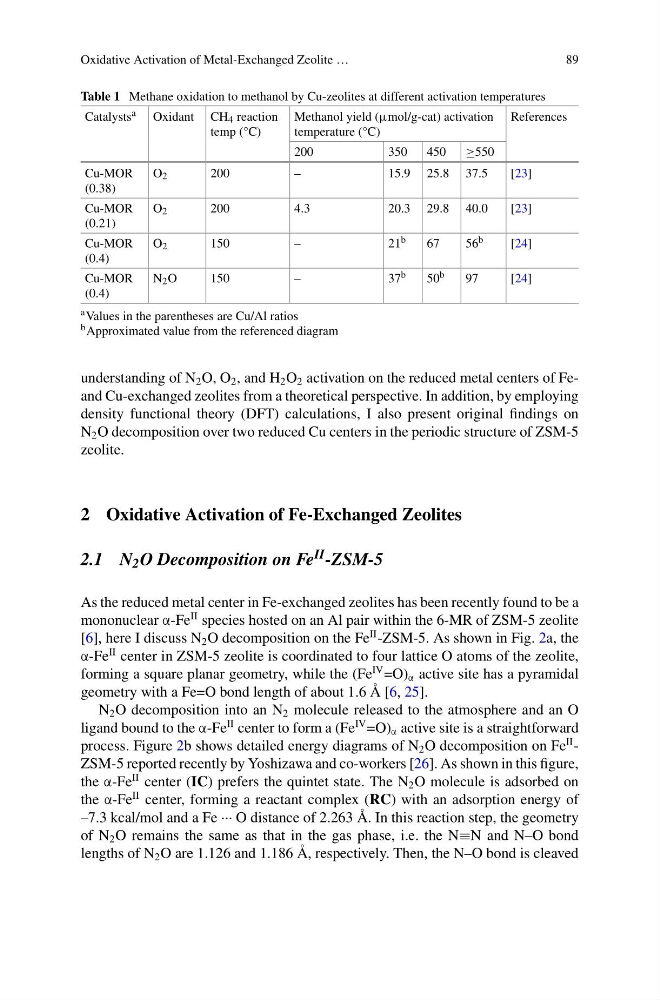
Table 1 Methane oxidation to methanol by Cu-zeolites at different activation temperatures
Catalysts a Oxidant CH 4 reaction
temp (°C)
Methanol yield (μmol/g-cat) activation
temperature (°C)
References
200
350
450
≥550
Cu-MOR
(0.38)
O 2
200
–
15.9 25.8 37.5
[23]
Cu-MOR
(0.21)
O 2
200
4.3
20.3 29.8 40.0
[23]
Cu-MOR
(0.4)
O 2
150
–
21 b
67
56 b
[24]
Cu-MOR
(0.4)
N 2 O
150
–
37 b
50 b
97
[24]
a Values in the parentheses are Cu/Al ratios
b Approximated value from the referenced diagram
understanding of N 2 O, O 2 , and H 2 O 2 activation on the reduced metal centers of Feand Cu-exchanged zeolites from a theoretical perspective. In addition, by employing
density functional theory (DFT) calculations, I also present original findings on
N 2 O decomposition over two reduced Cu centers in the periodic structure of ZSM-5
zeolite.
2 Oxidative Activation of Fe-Exchanged Zeolites
2.1 N 2 O Decomposition on Fe II -ZSM-5
As the reduced metal center in Fe-exchanged zeolites has been recently found to be a
mononuclear α-Fe
II species hosted on an Al pair within the 6-MR of ZSM-5 zeolite
[6], here I discuss N 2 O decomposition on the Fe
II -ZSM-5. As shown in Fig. 2a, the
α-Fe
II center in ZSM-5 zeolite is coordinated to four lattice O atoms of the zeolite,
forming a square planar geometry, while the (Fe
IV =O) α active site has a pyramidal
geometry with a Fe=O bond length of about 1.6 Å [6, 25].
N 2 O decomposition into an N 2 molecule released to the atmosphere and an O
ligand bound to the α-Fe
II center to form a (Fe
IV =O) α active site is a straightforward
process. Figure 2b shows detailed energy diagrams of N 2 O decomposition on Fe
II -
ZSM-5 reported recently by Yoshizawa and co-workers [26]. As shown in this figure,
the α-Fe
II center (IC) prefers the quintet state. The N 2 O molecule is adsorbed on
the α-Fe
II center, forming a reactant complex (RC) with an adsorption energy of
–7.3 kcal/mol and a Fe ··· O distance of 2.263 Å. In this reaction step, the geometry
of N 2 O remains the same as that in the gas phase, i.e. the N≡N and N–O bond
lengths of N 2 O are 1.126 and 1.186 Å, respectively. Then, the N–O bond is cleaved
89
Table 1 Methane oxidation to methanol by Cu-zeolites at different activation temperatures
Catalysts a Oxidant CH 4 reaction
temp (°C)
Methanol yield (μmol/g-cat) activation
temperature (°C)
References
200
350
450
≥550
Cu-MOR
(0.38)
O 2
200
–
15.9 25.8 37.5
[23]
Cu-MOR
(0.21)
O 2
200
4.3
20.3 29.8 40.0
[23]
Cu-MOR
(0.4)
O 2
150
–
21 b
67
56 b
[24]
Cu-MOR
(0.4)
N 2 O
150
–
37 b
50 b
97
[24]
a Values in the parentheses are Cu/Al ratios
b Approximated value from the referenced diagram
understanding of N 2 O, O 2 , and H 2 O 2 activation on the reduced metal centers of Feand Cu-exchanged zeolites from a theoretical perspective. In addition, by employing
density functional theory (DFT) calculations, I also present original findings on
N 2 O decomposition over two reduced Cu centers in the periodic structure of ZSM-5
zeolite.
2 Oxidative Activation of Fe-Exchanged Zeolites
2.1 N 2 O Decomposition on Fe II -ZSM-5
As the reduced metal center in Fe-exchanged zeolites has been recently found to be a
mononuclear α-Fe
II species hosted on an Al pair within the 6-MR of ZSM-5 zeolite
[6], here I discuss N 2 O decomposition on the Fe
II -ZSM-5. As shown in Fig. 2a, the
α-Fe
II center in ZSM-5 zeolite is coordinated to four lattice O atoms of the zeolite,
forming a square planar geometry, while the (Fe
IV =O) α active site has a pyramidal
geometry with a Fe=O bond length of about 1.6 Å [6, 25].
N 2 O decomposition into an N 2 molecule released to the atmosphere and an O
ligand bound to the α-Fe
II center to form a (Fe
IV =O) α active site is a straightforward
process. Figure 2b shows detailed energy diagrams of N 2 O decomposition on Fe
II -
ZSM-5 reported recently by Yoshizawa and co-workers [26]. As shown in this figure,
the α-Fe
II center (IC) prefers the quintet state. The N 2 O molecule is adsorbed on
the α-Fe
II center, forming a reactant complex (RC) with an adsorption energy of
–7.3 kcal/mol and a Fe ··· O distance of 2.263 Å. In this reaction step, the geometry
of N 2 O remains the same as that in the gas phase, i.e. the N≡N and N–O bond
lengths of N 2 O are 1.126 and 1.186 Å, respectively. Then, the N–O bond is cleaved