

88
M. H. Mahyuddin
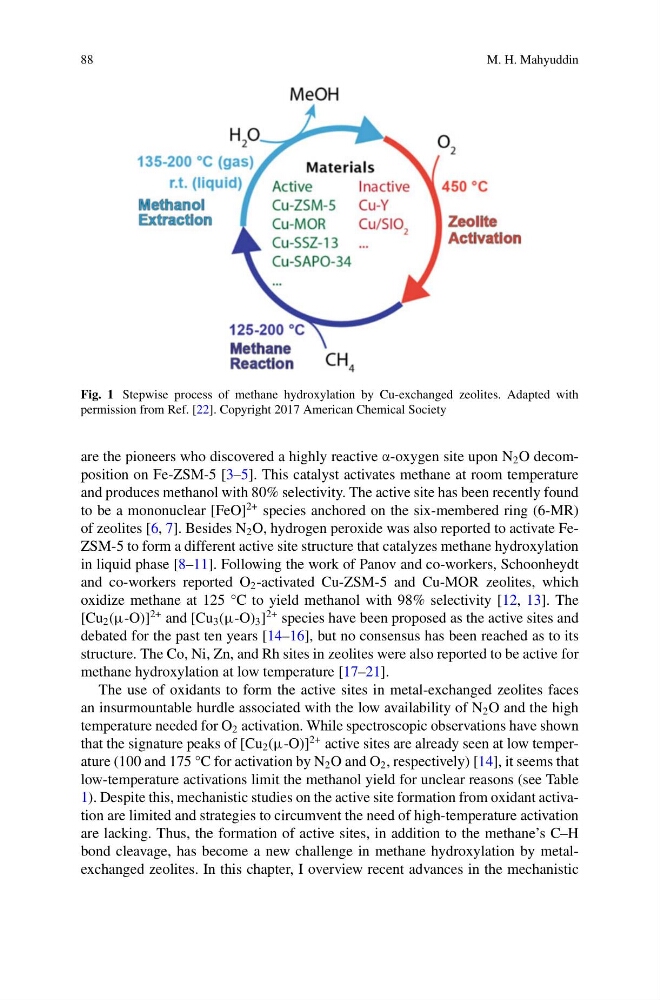
Fig. 1 Stepwise process of methane hydroxylation by Cu-exchanged zeolites. Adapted with
permission from Ref. [22]. Copyright 2017 American Chemical Society
are the pioneers who discovered a highly reactive α-oxygen site upon N 2 O decomposition on Fe-ZSM-5 [3–5]. This catalyst activates methane at room temperature
and produces methanol with 80% selectivity. The active site has been recently found
to be a mononuclear [FeO]
2+ species anchored on the six-membered ring (6-MR)
of zeolites [6, 7]. Besides N 2 O, hydrogen peroxide was also reported to activate FeZSM-5 to form a different active site structure that catalyzes methane hydroxylation
in liquid phase [8–11]. Following the work of Panov and co-workers, Schoonheydt
and co-workers reported O 2 -activated Cu-ZSM-5 and Cu-MOR zeolites, which
oxidize methane at 125 °C to yield methanol with 98% selectivity [12, 13]. The
[Cu 2 (μ-O)]
2+ and [Cu 3 (μ-O) 3 ]
2+ species have been proposed as the active sites and
debated for the past ten years [14–16], but no consensus has been reached as to its
structure. The Co, Ni, Zn, and Rh sites in zeolites were also reported to be active for
methane hydroxylation at low temperature [17–21].
The use of oxidants to form the active sites in metal-exchanged zeolites faces
an insurmountable hurdle associated with the low availability of N 2 O and the high
temperature needed for O 2 activation. While spectroscopic observations have shown
that the signature peaks of [Cu 2 (μ-O)]
2+ active sites are already seen at low temperature (100 and 175 °C for activation by N 2 O and O 2 , respectively) [14], it seems that
low-temperature activations limit the methanol yield for unclear reasons (see Table
1). Despite this, mechanistic studies on the active site formation from oxidant activation are limited and strategies to circumvent the need of high-temperature activation
are lacking. Thus, the formation of active sites, in addition to the methane’s C–H
bond cleavage, has become a new challenge in methane hydroxylation by metalexchanged zeolites. In this chapter, I overview recent advances in the mechanistic
M. H. Mahyuddin
Fig. 1 Stepwise process of methane hydroxylation by Cu-exchanged zeolites. Adapted with
permission from Ref. [22]. Copyright 2017 American Chemical Society
are the pioneers who discovered a highly reactive α-oxygen site upon N 2 O decomposition on Fe-ZSM-5 [3–5]. This catalyst activates methane at room temperature
and produces methanol with 80% selectivity. The active site has been recently found
to be a mononuclear [FeO]
2+ species anchored on the six-membered ring (6-MR)
of zeolites [6, 7]. Besides N 2 O, hydrogen peroxide was also reported to activate FeZSM-5 to form a different active site structure that catalyzes methane hydroxylation
in liquid phase [8–11]. Following the work of Panov and co-workers, Schoonheydt
and co-workers reported O 2 -activated Cu-ZSM-5 and Cu-MOR zeolites, which
oxidize methane at 125 °C to yield methanol with 98% selectivity [12, 13]. The
[Cu 2 (μ-O)]
2+ and [Cu 3 (μ-O) 3 ]
2+ species have been proposed as the active sites and
debated for the past ten years [14–16], but no consensus has been reached as to its
structure. The Co, Ni, Zn, and Rh sites in zeolites were also reported to be active for
methane hydroxylation at low temperature [17–21].
The use of oxidants to form the active sites in metal-exchanged zeolites faces
an insurmountable hurdle associated with the low availability of N 2 O and the high
temperature needed for O 2 activation. While spectroscopic observations have shown
that the signature peaks of [Cu 2 (μ-O)]
2+ active sites are already seen at low temperature (100 and 175 °C for activation by N 2 O and O 2 , respectively) [14], it seems that
low-temperature activations limit the methanol yield for unclear reasons (see Table
1). Despite this, mechanistic studies on the active site formation from oxidant activation are limited and strategies to circumvent the need of high-temperature activation
are lacking. Thus, the formation of active sites, in addition to the methane’s C–H
bond cleavage, has become a new challenge in methane hydroxylation by metalexchanged zeolites. In this chapter, I overview recent advances in the mechanistic