

82
M. H. Mahyuddin et al.
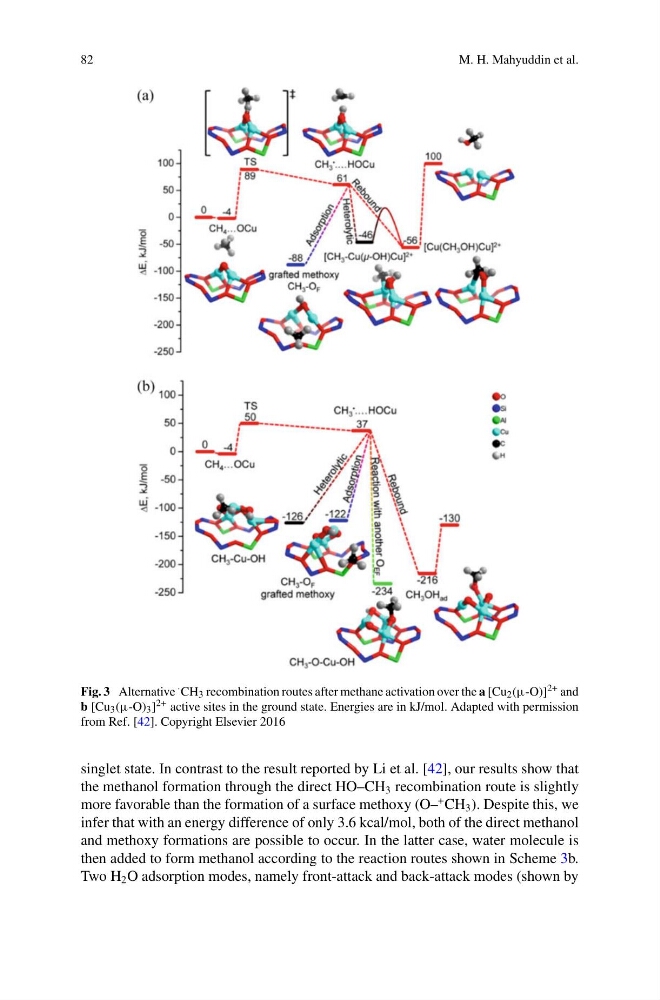
Fig. 3 Alternative · CH 3 recombination routes after methane activation over the a [Cu 2 (μ-O)] 2+ and
b [Cu 3 (μ-O) 3 ] 2+ active sites in the ground state. Energies are in kJ/mol. Adapted with permission
from Ref. [42]. Copyright Elsevier 2016
singlet state. In contrast to the result reported by Li et al. [42], our results show that
the methanol formation through the direct HO–CH 3 recombination route is slightly
more favorable than the formation of a surface methoxy (O–
+ CH 3 ). Despite this, we
infer that with an energy difference of only 3.6 kcal/mol, both of the direct methanol
and methoxy formations are possible to occur. In the latter case, water molecule is
then added to form methanol according to the reaction routes shown in Scheme 3b.
Two H 2 O adsorption modes, namely front-attack and back-attack modes (shown by
M. H. Mahyuddin et al.
Fig. 3 Alternative · CH 3 recombination routes after methane activation over the a [Cu 2 (μ-O)] 2+ and
b [Cu 3 (μ-O) 3 ] 2+ active sites in the ground state. Energies are in kJ/mol. Adapted with permission
from Ref. [42]. Copyright Elsevier 2016
singlet state. In contrast to the result reported by Li et al. [42], our results show that
the methanol formation through the direct HO–CH 3 recombination route is slightly
more favorable than the formation of a surface methoxy (O–
+ CH 3 ). Despite this, we
infer that with an energy difference of only 3.6 kcal/mol, both of the direct methanol
and methoxy formations are possible to occur. In the latter case, water molecule is
then added to form methanol according to the reaction routes shown in Scheme 3b.
Two H 2 O adsorption modes, namely front-attack and back-attack modes (shown by