

Mechanistic Understanding of Methane …
83
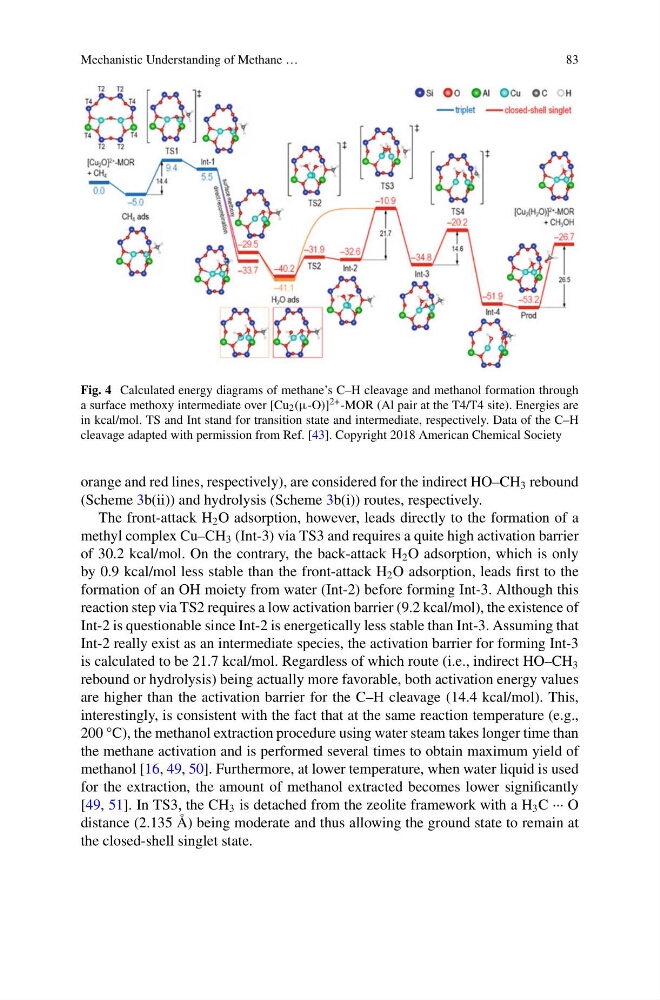
Fig. 4 Calculated energy diagrams of methane’s C–H cleavage and methanol formation through
a surface methoxy intermediate over [Cu 2 (μ-O)] 2+ -MOR (Al pair at the T4/T4 site). Energies are
in kcal/mol. TS and Int stand for transition state and intermediate, respectively. Data of the C–H
cleavage adapted with permission from Ref. [43]. Copyright 2018 American Chemical Society
orange and red lines, respectively), are considered for the indirect HO–CH 3 rebound
(Scheme 3b(ii)) and hydrolysis (Scheme 3b(i)) routes, respectively.
The front-attack H 2 O adsorption, however, leads directly to the formation of a
methyl complex Cu–CH 3 (Int-3) via TS3 and requires a quite high activation barrier
of 30.2 kcal/mol. On the contrary, the back-attack H 2 O adsorption, which is only
by 0.9 kcal/mol less stable than the front-attack H 2 O adsorption, leads first to the
formation of an OH moiety from water (Int-2) before forming Int-3. Although this
reaction step via TS2 requires a low activation barrier (9.2 kcal/mol), the existence of
Int-2 is questionable since Int-2 is energetically less stable than Int-3. Assuming that
Int-2 really exist as an intermediate species, the activation barrier for forming Int-3
is calculated to be 21.7 kcal/mol. Regardless of which route (i.e., indirect HO–CH 3
rebound or hydrolysis) being actually more favorable, both activation energy values
are higher than the activation barrier for the C–H cleavage (14.4 kcal/mol). This,
interestingly, is consistent with the fact that at the same reaction temperature (e.g.,
200 °C), the methanol extraction procedure using water steam takes longer time than
the methane activation and is performed several times to obtain maximum yield of
methanol [16, 49, 50]. Furthermore, at lower temperature, when water liquid is used
for the extraction, the amount of methanol extracted becomes lower significantly
[49, 51]. In TS3, the CH 3 is detached from the zeolite framework with a H 3 C ··· O
distance (2.135 Å) being moderate and thus allowing the ground state to remain at
the closed-shell singlet state.
83
Fig. 4 Calculated energy diagrams of methane’s C–H cleavage and methanol formation through
a surface methoxy intermediate over [Cu 2 (μ-O)] 2+ -MOR (Al pair at the T4/T4 site). Energies are
in kcal/mol. TS and Int stand for transition state and intermediate, respectively. Data of the C–H
cleavage adapted with permission from Ref. [43]. Copyright 2018 American Chemical Society
orange and red lines, respectively), are considered for the indirect HO–CH 3 rebound
(Scheme 3b(ii)) and hydrolysis (Scheme 3b(i)) routes, respectively.
The front-attack H 2 O adsorption, however, leads directly to the formation of a
methyl complex Cu–CH 3 (Int-3) via TS3 and requires a quite high activation barrier
of 30.2 kcal/mol. On the contrary, the back-attack H 2 O adsorption, which is only
by 0.9 kcal/mol less stable than the front-attack H 2 O adsorption, leads first to the
formation of an OH moiety from water (Int-2) before forming Int-3. Although this
reaction step via TS2 requires a low activation barrier (9.2 kcal/mol), the existence of
Int-2 is questionable since Int-2 is energetically less stable than Int-3. Assuming that
Int-2 really exist as an intermediate species, the activation barrier for forming Int-3
is calculated to be 21.7 kcal/mol. Regardless of which route (i.e., indirect HO–CH 3
rebound or hydrolysis) being actually more favorable, both activation energy values
are higher than the activation barrier for the C–H cleavage (14.4 kcal/mol). This,
interestingly, is consistent with the fact that at the same reaction temperature (e.g.,
200 °C), the methanol extraction procedure using water steam takes longer time than
the methane activation and is performed several times to obtain maximum yield of
methanol [16, 49, 50]. Furthermore, at lower temperature, when water liquid is used
for the extraction, the amount of methanol extracted becomes lower significantly
[49, 51]. In TS3, the CH 3 is detached from the zeolite framework with a H 3 C ··· O
distance (2.135 Å) being moderate and thus allowing the ground state to remain at
the closed-shell singlet state.