

66
T. Yumura et al.
1 TS2(m)
1 TS1(m)
1 TS2(m)
3 TS1(m)
2 . 0 6 1
1 R(m)
0
16.6
3.9
Oxo complex + CH 4
Triplet
11.2
3 Int(m)
1 Int(m)
3 Int(m)
1 P(m)
1 P(m)
1 Int(m)
3 R(m)
3 Rad(m)
3.9
2.6
18.8
Singlet
3 TS1(m)
3 R(m)
3.7
3 Rad(m)
1 Rad(m)
1 Rad(m)
2.023
2.042
1.970
1.847
2 .4 9 8
2 .0 9 1
2 .0
6 4
1 .9 9 8
1 .8 4 1
1.1 84
1.32 1
2 .0 6 6
1 .9
6 4
1 .8 6 5
0 .9 7 1
3.323
2.0 48
2.0 73
2.227 1.842
2 .0 6 0
2 .0 6 2
1 .9 6 4
1. 86 7
3.423
0.971
4 .4
1 6
1 .9 2 5
1.948
1.958
1.830
0.976
1.976
3.774
2.074
2.052
1.838
2.002
1.927
1.932
3.551
2.227
1.423
Cu-C = 3.787
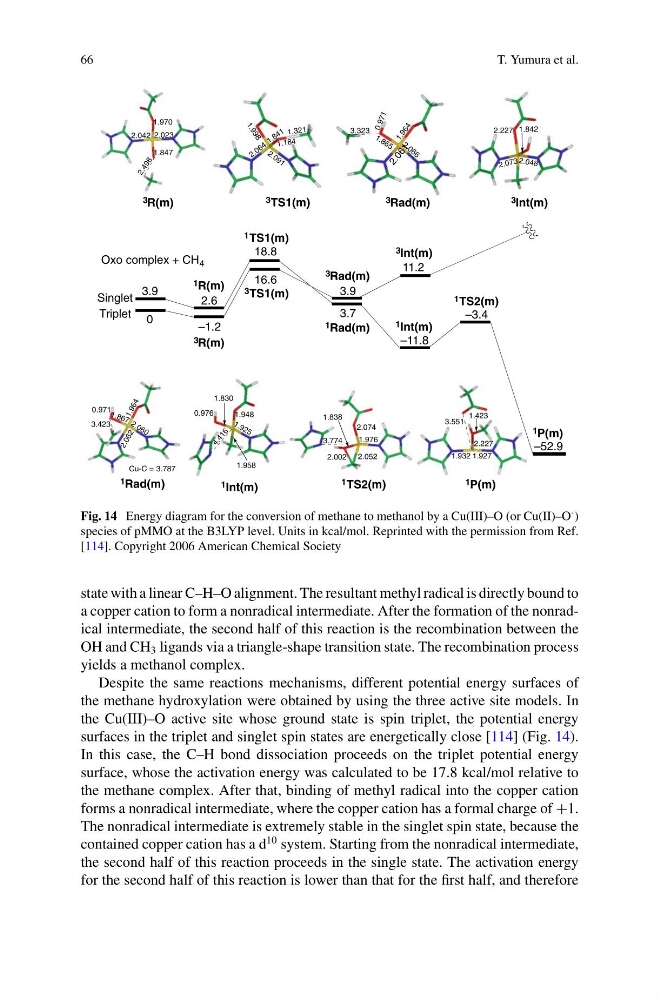
Fig. 14 Energy diagram for the conversion of methane to methanol by a Cu(III)–O (or Cu(II)–O · )
species of pMMO at the B3LYP level. Units in kcal/mol. Reprinted with the permission from Ref.
[114]. Copyright 2006 American Chemical Society
state with a linear C–H–O alignment. The resultant methyl radical is directly bound to
a copper cation to form a nonradical intermediate. After the formation of the nonradical intermediate, the second half of this reaction is the recombination between the
OH and CH 3 ligands via a triangle-shape transition state. The recombination process
yields a methanol complex.
Despite the same reactions mechanisms, different potential energy surfaces of
the methane hydroxylation were obtained by using the three active site models. In
the Cu(III)–O active site whose ground state is spin triplet, the potential energy
surfaces in the triplet and singlet spin states are energetically close [114] (Fig. 14).
In this case, the C–H bond dissociation proceeds on the triplet potential energy
surface, whose the activation energy was calculated to be 17.8 kcal/mol relative to
the methane complex. After that, binding of methyl radical into the copper cation
forms a nonradical intermediate, where the copper cation has a formal charge of +1.
The nonradical intermediate is extremely stable in the singlet spin state, because the
contained copper cation has a d
10 system. Starting from the nonradical intermediate,
the second half of this reaction proceeds in the single state. The activation energy
for the second half of this reaction is lower than that for the first half, and therefore
T. Yumura et al.
1 TS2(m)
1 TS1(m)
1 TS2(m)
3 TS1(m)
2 . 0 6 1
1 R(m)
0
16.6
3.9
Oxo complex + CH 4
Triplet
11.2
3 Int(m)
1 Int(m)
3 Int(m)
1 P(m)
1 P(m)
1 Int(m)
3 R(m)
3 Rad(m)
3.9
2.6
18.8
Singlet
3 TS1(m)
3 R(m)
3.7
3 Rad(m)
1 Rad(m)
1 Rad(m)
2.023
2.042
1.970
1.847
2 .4 9 8
2 .0 9 1
2 .0
6 4
1 .9 9 8
1 .8 4 1
1.1 84
1.32 1
2 .0 6 6
1 .9
6 4
1 .8 6 5
0 .9 7 1
3.323
2.0 48
2.0 73
2.227 1.842
2 .0 6 0
2 .0 6 2
1 .9 6 4
1. 86 7
3.423
0.971
4 .4
1 6
1 .9 2 5
1.948
1.958
1.830
0.976
1.976
3.774
2.074
2.052
1.838
2.002
1.927
1.932
3.551
2.227
1.423
Cu-C = 3.787
Fig. 14 Energy diagram for the conversion of methane to methanol by a Cu(III)–O (or Cu(II)–O · )
species of pMMO at the B3LYP level. Units in kcal/mol. Reprinted with the permission from Ref.
[114]. Copyright 2006 American Chemical Society
state with a linear C–H–O alignment. The resultant methyl radical is directly bound to
a copper cation to form a nonradical intermediate. After the formation of the nonradical intermediate, the second half of this reaction is the recombination between the
OH and CH 3 ligands via a triangle-shape transition state. The recombination process
yields a methanol complex.
Despite the same reactions mechanisms, different potential energy surfaces of
the methane hydroxylation were obtained by using the three active site models. In
the Cu(III)–O active site whose ground state is spin triplet, the potential energy
surfaces in the triplet and singlet spin states are energetically close [114] (Fig. 14).
In this case, the C–H bond dissociation proceeds on the triplet potential energy
surface, whose the activation energy was calculated to be 17.8 kcal/mol relative to
the methane complex. After that, binding of methyl radical into the copper cation
forms a nonradical intermediate, where the copper cation has a formal charge of +1.
The nonradical intermediate is extremely stable in the singlet spin state, because the
contained copper cation has a d
10 system. Starting from the nonradical intermediate,
the second half of this reaction proceeds in the single state. The activation energy
for the second half of this reaction is lower than that for the first half, and therefore