

Enzymatic Methane Hydroxylation: sMMO and pMMO
67
17.6
12.5
2 TS1(d)
2 R(d)
2 Rad(d)
2 Int(d)
2 TS2(d)
2 TS2(d)
2 Rad(d)
2 TS1(d)
2 P(d)
2 Int(d)
2 R(d)
2 P(d)
0
21.5
Oxo complex + CH 4
Doublet
1 .9 7 2
1.9 92
2.136
2 .6 1 3
2.829
1.132
1.396
1 .9
8 5
2 .0
2 7
1 .9 1 7
1 .8
7 1
1 .9
1 8
1 .8 6 8
2.739
2
.0
6
3
2 .0
5 8
1 .8
7 0
1 .8 4 6
2 .0 5 9
2 .1 1 2
2 .1 1 8
2 .0
0 6
2 .0 2 3
1 .9 8 8
3 .8
3 4
1 .8 8 2
2.009
2.735
2 .0 6 5
2 .0 5 9
1 .9
7 6
1 .8
6 8
1 .9 7 5
1 .9
1 8
1 .8
0 5
1 .9 3 2
1. 88 4 1. 77 9
2.748
2
.0
5
7
2 .0
3 8
3.717
1 .7 9 0
1 .9 2 0
2.067
1.940
1 .9 0 0
1. 86 9
2.09 3
3.141
2. 11 2
3. 90 6
3.11 0
1 .9
1 7
2 .0 1 2
1 .7 8 7
1.797
1.898
2 .1
3 5
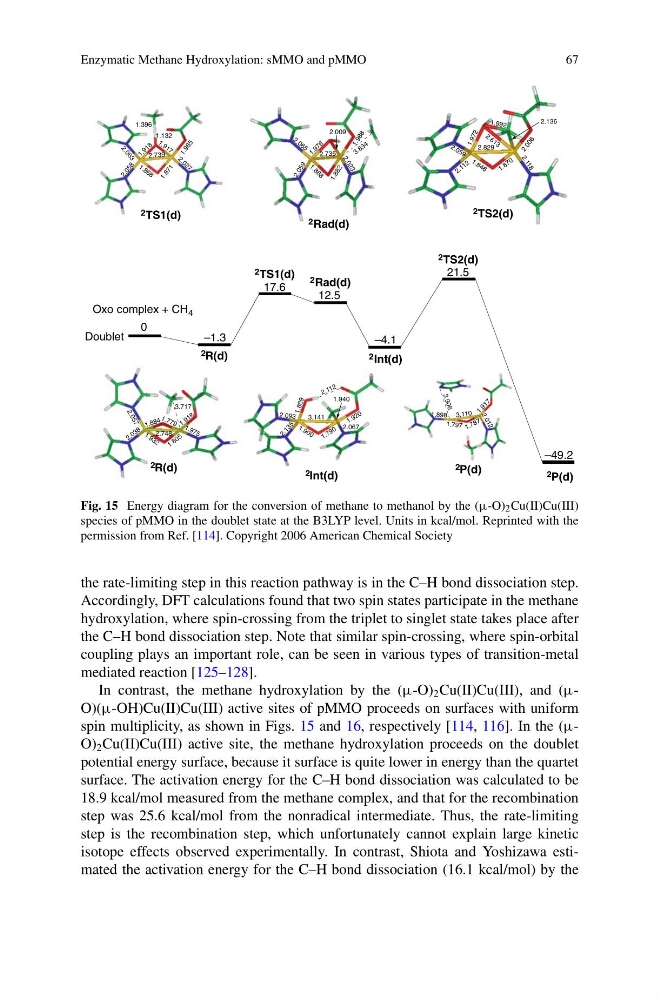
Fig. 15 Energy diagram for the conversion of methane to methanol by the (μ-O) 2 Cu(II)Cu(III)
species of pMMO in the doublet state at the B3LYP level. Units in kcal/mol. Reprinted with the
permission from Ref. [114]. Copyright 2006 American Chemical Society
the rate-limiting step in this reaction pathway is in the C–H bond dissociation step.
Accordingly, DFT calculations found that two spin states participate in the methane
hydroxylation, where spin-crossing from the triplet to singlet state takes place after
the C–H bond dissociation step. Note that similar spin-crossing, where spin-orbital
coupling plays an important role, can be seen in various types of transition-metal
mediated reaction [125–128].
In contrast, the methane hydroxylation by the (μ-O) 2 Cu(II)Cu(III), and (μO)(μ-OH)Cu(II)Cu(III) active sites of pMMO proceeds on surfaces with uniform
spin multiplicity, as shown in Figs. 15 and 16, respectively [114, 116]. In the (μO) 2 Cu(II)Cu(III) active site, the methane hydroxylation proceeds on the doublet
potential energy surface, because it surface is quite lower in energy than the quartet
surface. The activation energy for the C–H bond dissociation was calculated to be
18.9 kcal/mol measured from the methane complex, and that for the recombination
step was 25.6 kcal/mol from the nonradical intermediate. Thus, the rate-limiting
step is the recombination step, which unfortunately cannot explain large kinetic
isotope effects observed experimentally. In contrast, Shiota and Yoshizawa estimated the activation energy for the C–H bond dissociation (16.1 kcal/mol) by the
67
17.6
12.5
2 TS1(d)
2 R(d)
2 Rad(d)
2 Int(d)
2 TS2(d)
2 TS2(d)
2 Rad(d)
2 TS1(d)
2 P(d)
2 Int(d)
2 R(d)
2 P(d)
0
21.5
Oxo complex + CH 4
Doublet
1 .9 7 2
1.9 92
2.136
2 .6 1 3
2.829
1.132
1.396
1 .9
8 5
2 .0
2 7
1 .9 1 7
1 .8
7 1
1 .9
1 8
1 .8 6 8
2.739
2
.0
6
3
2 .0
5 8
1 .8
7 0
1 .8 4 6
2 .0 5 9
2 .1 1 2
2 .1 1 8
2 .0
0 6
2 .0 2 3
1 .9 8 8
3 .8
3 4
1 .8 8 2
2.009
2.735
2 .0 6 5
2 .0 5 9
1 .9
7 6
1 .8
6 8
1 .9 7 5
1 .9
1 8
1 .8
0 5
1 .9 3 2
1. 88 4 1. 77 9
2.748
2
.0
5
7
2 .0
3 8
3.717
1 .7 9 0
1 .9 2 0
2.067
1.940
1 .9 0 0
1. 86 9
2.09 3
3.141
2. 11 2
3. 90 6
3.11 0
1 .9
1 7
2 .0 1 2
1 .7 8 7
1.797
1.898
2 .1
3 5
Fig. 15 Energy diagram for the conversion of methane to methanol by the (μ-O) 2 Cu(II)Cu(III)
species of pMMO in the doublet state at the B3LYP level. Units in kcal/mol. Reprinted with the
permission from Ref. [114]. Copyright 2006 American Chemical Society
the rate-limiting step in this reaction pathway is in the C–H bond dissociation step.
Accordingly, DFT calculations found that two spin states participate in the methane
hydroxylation, where spin-crossing from the triplet to singlet state takes place after
the C–H bond dissociation step. Note that similar spin-crossing, where spin-orbital
coupling plays an important role, can be seen in various types of transition-metal
mediated reaction [125–128].
In contrast, the methane hydroxylation by the (μ-O) 2 Cu(II)Cu(III), and (μO)(μ-OH)Cu(II)Cu(III) active sites of pMMO proceeds on surfaces with uniform
spin multiplicity, as shown in Figs. 15 and 16, respectively [114, 116]. In the (μO) 2 Cu(II)Cu(III) active site, the methane hydroxylation proceeds on the doublet
potential energy surface, because it surface is quite lower in energy than the quartet
surface. The activation energy for the C–H bond dissociation was calculated to be
18.9 kcal/mol measured from the methane complex, and that for the recombination
step was 25.6 kcal/mol from the nonradical intermediate. Thus, the rate-limiting
step is the recombination step, which unfortunately cannot explain large kinetic
isotope effects observed experimentally. In contrast, Shiota and Yoshizawa estimated the activation energy for the C–H bond dissociation (16.1 kcal/mol) by the