

Enzymatic Methane Hydroxylation: sMMO and pMMO
65
Glu75
His48
His72
Gln404
1. 93 1
1. 93 1
4 . 2 8 1
Glu75
His48
His72
Gln404
1 . 8 4 3
2.197
2 .0 7 8
2.186
1 .2 9 7
1.2 50
O-O = 2.405
2
.
0
3
0
2 .0 2 4
2.757
1. 90 21 .7 6 2
1 .9
3 3
1 .8
0 4
1 .9 9 8
1 .9
7 2
1.243
1.335
His33
His137
His139
Glu35
His33
His137
His139
Glu35
2.038
2.474
2 .0 6 1
2 .2 6 6
1 .9 7 2
1. 30 1
1.250
(a)
(b)
(c)
(d)
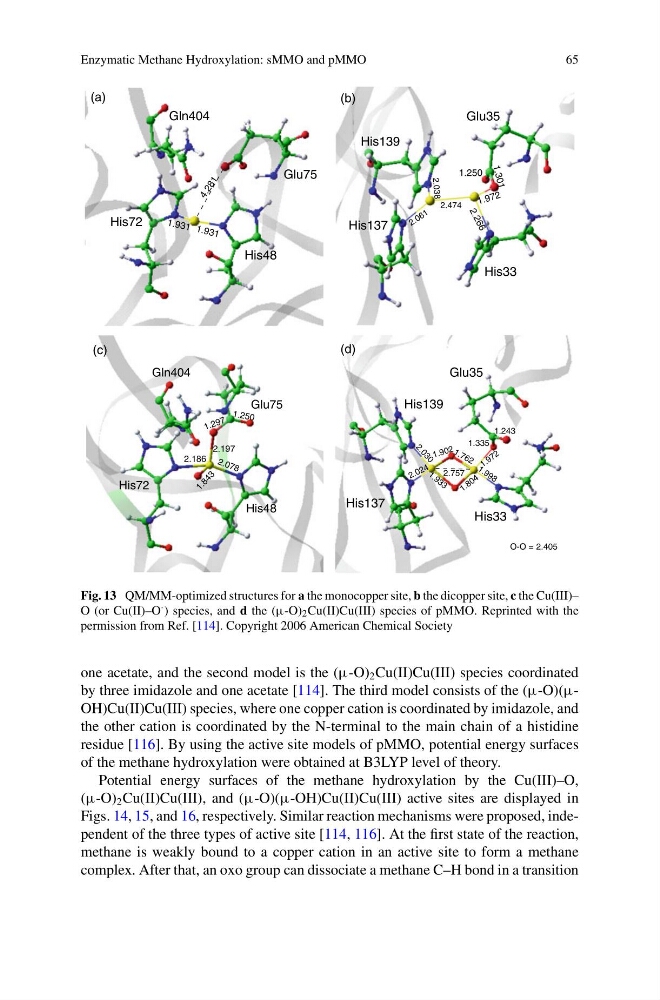
Fig. 13 QM/MM-optimized structures for a the monocopper site, b the dicopper site, c the Cu(III)–
O (or Cu(II)–O · ) species, and d the (μ-O) 2 Cu(II)Cu(III) species of pMMO. Reprinted with the
permission from Ref. [114]. Copyright 2006 American Chemical Society
one acetate, and the second model is the (μ-O) 2 Cu(II)Cu(III) species coordinated
by three imidazole and one acetate [114]. The third model consists of the (μ-O)(μOH)Cu(II)Cu(III) species, where one copper cation is coordinated by imidazole, and
the other cation is coordinated by the N-terminal to the main chain of a histidine
residue [116]. By using the active site models of pMMO, potential energy surfaces
of the methane hydroxylation were obtained at B3LYP level of theory.
Potential energy surfaces of the methane hydroxylation by the Cu(III)–O,
(μ-O) 2 Cu(II)Cu(III), and (μ-O)(μ-OH)Cu(II)Cu(III) active sites are displayed in
Figs. 14, 15, and 16, respectively. Similar reaction mechanisms were proposed, independent of the three types of active site [114, 116]. At the first state of the reaction,
methane is weakly bound to a copper cation in an active site to form a methane
complex. After that, an oxo group can dissociate a methane C–H bond in a transition
65
Glu75
His48
His72
Gln404
1. 93 1
1. 93 1
4 . 2 8 1
Glu75
His48
His72
Gln404
1 . 8 4 3
2.197
2 .0 7 8
2.186
1 .2 9 7
1.2 50
O-O = 2.405
2
.
0
3
0
2 .0 2 4
2.757
1. 90 21 .7 6 2
1 .9
3 3
1 .8
0 4
1 .9 9 8
1 .9
7 2
1.243
1.335
His33
His137
His139
Glu35
His33
His137
His139
Glu35
2.038
2.474
2 .0 6 1
2 .2 6 6
1 .9 7 2
1. 30 1
1.250
(a)
(b)
(c)
(d)
Fig. 13 QM/MM-optimized structures for a the monocopper site, b the dicopper site, c the Cu(III)–
O (or Cu(II)–O · ) species, and d the (μ-O) 2 Cu(II)Cu(III) species of pMMO. Reprinted with the
permission from Ref. [114]. Copyright 2006 American Chemical Society
one acetate, and the second model is the (μ-O) 2 Cu(II)Cu(III) species coordinated
by three imidazole and one acetate [114]. The third model consists of the (μ-O)(μOH)Cu(II)Cu(III) species, where one copper cation is coordinated by imidazole, and
the other cation is coordinated by the N-terminal to the main chain of a histidine
residue [116]. By using the active site models of pMMO, potential energy surfaces
of the methane hydroxylation were obtained at B3LYP level of theory.
Potential energy surfaces of the methane hydroxylation by the Cu(III)–O,
(μ-O) 2 Cu(II)Cu(III), and (μ-O)(μ-OH)Cu(II)Cu(III) active sites are displayed in
Figs. 14, 15, and 16, respectively. Similar reaction mechanisms were proposed, independent of the three types of active site [114, 116]. At the first state of the reaction,
methane is weakly bound to a copper cation in an active site to form a methane
complex. After that, an oxo group can dissociate a methane C–H bond in a transition