

62
T. Yumura et al.
Q + CH 4
Q-CH 4
TS1
IM
TS2
0.0
4.2
6.5
11.9
23.5
14.4
14.6
20.2
16.6
-54.1
-46.0
HS-AF
25.4
HS-FM
Fe
Fe
O
O
CH 3
H
CH 4
Fe
Fe
O
O
CH 3
H
Fe
Fe
O
O
H 3 C
H
Fe
Fe
O
O
H 3 C
H
Fe
Fe
O
O
Fe
Fe
O
O
Product
complex
Fe
Fe
O
O
O
O
O
O
O
O
C
C
N
NH
HN
N
CH 3
O
CH 3
O
H
H
H 3 C
O
CH 3
CH 3
CH 3
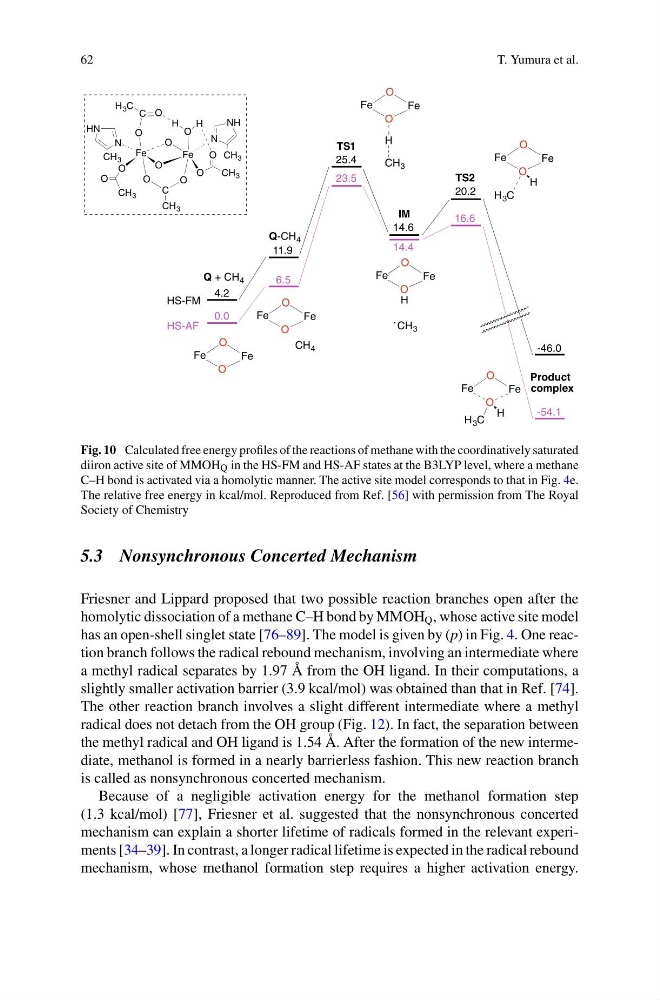
Fig. 10 Calculated free energy profiles of the reactions of methane with the coordinatively saturated
diiron active site of MMOH Q in the HS-FM and HS-AF states at the B3LYP level, where a methane
C–H bond is activated via a homolytic manner. The active site model corresponds to that in Fig. 4e.
The relative free energy in kcal/mol. Reproduced from Ref. [56] with permission from The Royal
Society of Chemistry
5.3 Nonsynchronous Concerted Mechanism
Friesner and Lippard proposed that two possible reaction branches open after the
homolytic dissociation of a methane C–H bond by MMOH Q , whose active site model
has an open-shell singlet state [76–89]. The model is given by (p) in Fig. 4. One reaction branch follows the radical rebound mechanism, involving an intermediate where
a methyl radical separates by 1.97 Å from the OH ligand. In their computations, a
slightly smaller activation barrier (3.9 kcal/mol) was obtained than that in Ref. [74].
The other reaction branch involves a slight different intermediate where a methyl
radical does not detach from the OH group (Fig. 12). In fact, the separation between
the methyl radical and OH ligand is 1.54 Å. After the formation of the new intermediate, methanol is formed in a nearly barrierless fashion. This new reaction branch
is called as nonsynchronous concerted mechanism.
Because of a negligible activation energy for the methanol formation step
(1.3 kcal/mol) [77], Friesner et al. suggested that the nonsynchronous concerted
mechanism can explain a shorter lifetime of radicals formed in the relevant experiments [34–39]. In contrast, a longer radical lifetime is expected in the radical rebound
mechanism, whose methanol formation step requires a higher activation energy.
T. Yumura et al.
Q + CH 4
Q-CH 4
TS1
IM
TS2
0.0
4.2
6.5
11.9
23.5
14.4
14.6
20.2
16.6
-54.1
-46.0
HS-AF
25.4
HS-FM
Fe
Fe
O
O
CH 3
H
CH 4
Fe
Fe
O
O
CH 3
H
Fe
Fe
O
O
H 3 C
H
Fe
Fe
O
O
H 3 C
H
Fe
Fe
O
O
Fe
Fe
O
O
Product
complex
Fe
Fe
O
O
O
O
O
O
O
O
C
C
N
NH
HN
N
CH 3
O
CH 3
O
H
H
H 3 C
O
CH 3
CH 3
CH 3
Fig. 10 Calculated free energy profiles of the reactions of methane with the coordinatively saturated
diiron active site of MMOH Q in the HS-FM and HS-AF states at the B3LYP level, where a methane
C–H bond is activated via a homolytic manner. The active site model corresponds to that in Fig. 4e.
The relative free energy in kcal/mol. Reproduced from Ref. [56] with permission from The Royal
Society of Chemistry
5.3 Nonsynchronous Concerted Mechanism
Friesner and Lippard proposed that two possible reaction branches open after the
homolytic dissociation of a methane C–H bond by MMOH Q , whose active site model
has an open-shell singlet state [76–89]. The model is given by (p) in Fig. 4. One reaction branch follows the radical rebound mechanism, involving an intermediate where
a methyl radical separates by 1.97 Å from the OH ligand. In their computations, a
slightly smaller activation barrier (3.9 kcal/mol) was obtained than that in Ref. [74].
The other reaction branch involves a slight different intermediate where a methyl
radical does not detach from the OH group (Fig. 12). In fact, the separation between
the methyl radical and OH ligand is 1.54 Å. After the formation of the new intermediate, methanol is formed in a nearly barrierless fashion. This new reaction branch
is called as nonsynchronous concerted mechanism.
Because of a negligible activation energy for the methanol formation step
(1.3 kcal/mol) [77], Friesner et al. suggested that the nonsynchronous concerted
mechanism can explain a shorter lifetime of radicals formed in the relevant experiments [34–39]. In contrast, a longer radical lifetime is expected in the radical rebound
mechanism, whose methanol formation step requires a higher activation energy.