

Enzymatic Methane Hydroxylation: sMMO and pMMO
61
Fe
O
Fe
O
CH 4
Fe
O
Fe
O
H
CH 3
CH 3
Fe
O
Fe
O
H
Methyl radical
Intermediate
H 3 C
Fe
O
Fe
O
H
H
Fe
O
Fe
O
H 3 C
Methanol
complex
TS1
TS2
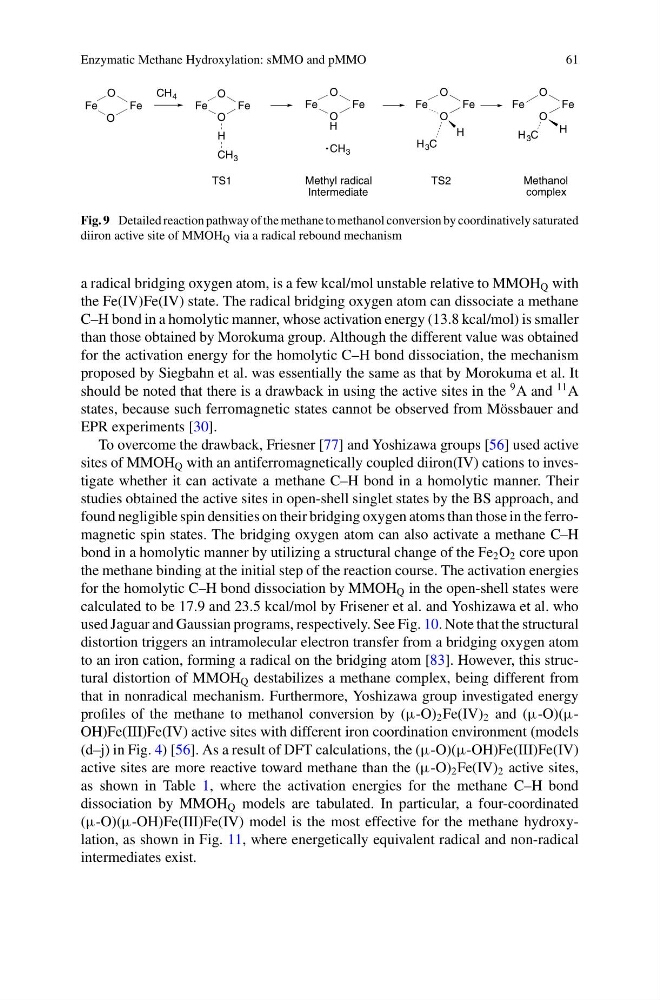
Fig. 9 Detailed reaction pathway of the methane to methanol conversion by coordinatively saturated
diiron active site of MMOH Q via a radical rebound mechanism
a radical bridging oxygen atom, is a few kcal/mol unstable relative to MMOH Q with
the Fe(IV)Fe(IV) state. The radical bridging oxygen atom can dissociate a methane
C–H bond in a homolytic manner, whose activation energy (13.8 kcal/mol) is smaller
than those obtained by Morokuma group. Although the different value was obtained
for the activation energy for the homolytic C–H bond dissociation, the mechanism
proposed by Siegbahn et al. was essentially the same as that by Morokuma et al. It
should be noted that there is a drawback in using the active sites in the
9 A and
11 A
states, because such ferromagnetic states cannot be observed from Mössbauer and
EPR experiments [30].
To overcome the drawback, Friesner [77] and Yoshizawa groups [56] used active
sites of MMOH Q with an antiferromagnetically coupled diiron(IV) cations to investigate whether it can activate a methane C–H bond in a homolytic manner. Their
studies obtained the active sites in open-shell singlet states by the BS approach, and
found negligible spin densities on their bridging oxygen atoms than those in the ferromagnetic spin states. The bridging oxygen atom can also activate a methane C–H
bond in a homolytic manner by utilizing a structural change of the Fe 2 O 2 core upon
the methane binding at the initial step of the reaction course. The activation energies
for the homolytic C–H bond dissociation by MMOH Q in the open-shell states were
calculated to be 17.9 and 23.5 kcal/mol by Frisener et al. and Yoshizawa et al. who
used Jaguar and Gaussian programs, respectively. See Fig. 10. Note that the structural
distortion triggers an intramolecular electron transfer from a bridging oxygen atom
to an iron cation, forming a radical on the bridging atom [83]. However, this structural distortion of MMOH Q destabilizes a methane complex, being different from
that in nonradical mechanism. Furthermore, Yoshizawa group investigated energy
profiles of the methane to methanol conversion by (μ-O) 2 Fe(IV) 2 and (μ-O)(μOH)Fe(III)Fe(IV) active sites with different iron coordination environment (models
(d–j) in Fig. 4) [56]. As a result of DFT calculations, the (μ-O)(μ-OH)Fe(III)Fe(IV)
active sites are more reactive toward methane than the (μ-O) 2 Fe(IV) 2 active sites,
as shown in Table 1, where the activation energies for the methane C–H bond
dissociation by MMOH Q models are tabulated. In particular, a four-coordinated
(μ-O)(μ-OH)Fe(III)Fe(IV) model is the most effective for the methane hydroxylation, as shown in Fig. 11, where energetically equivalent radical and non-radical
intermediates exist.
61
Fe
O
Fe
O
CH 4
Fe
O
Fe
O
H
CH 3
CH 3
Fe
O
Fe
O
H
Methyl radical
Intermediate
H 3 C
Fe
O
Fe
O
H
H
Fe
O
Fe
O
H 3 C
Methanol
complex
TS1
TS2
Fig. 9 Detailed reaction pathway of the methane to methanol conversion by coordinatively saturated
diiron active site of MMOH Q via a radical rebound mechanism
a radical bridging oxygen atom, is a few kcal/mol unstable relative to MMOH Q with
the Fe(IV)Fe(IV) state. The radical bridging oxygen atom can dissociate a methane
C–H bond in a homolytic manner, whose activation energy (13.8 kcal/mol) is smaller
than those obtained by Morokuma group. Although the different value was obtained
for the activation energy for the homolytic C–H bond dissociation, the mechanism
proposed by Siegbahn et al. was essentially the same as that by Morokuma et al. It
should be noted that there is a drawback in using the active sites in the
9 A and
11 A
states, because such ferromagnetic states cannot be observed from Mössbauer and
EPR experiments [30].
To overcome the drawback, Friesner [77] and Yoshizawa groups [56] used active
sites of MMOH Q with an antiferromagnetically coupled diiron(IV) cations to investigate whether it can activate a methane C–H bond in a homolytic manner. Their
studies obtained the active sites in open-shell singlet states by the BS approach, and
found negligible spin densities on their bridging oxygen atoms than those in the ferromagnetic spin states. The bridging oxygen atom can also activate a methane C–H
bond in a homolytic manner by utilizing a structural change of the Fe 2 O 2 core upon
the methane binding at the initial step of the reaction course. The activation energies
for the homolytic C–H bond dissociation by MMOH Q in the open-shell states were
calculated to be 17.9 and 23.5 kcal/mol by Frisener et al. and Yoshizawa et al. who
used Jaguar and Gaussian programs, respectively. See Fig. 10. Note that the structural
distortion triggers an intramolecular electron transfer from a bridging oxygen atom
to an iron cation, forming a radical on the bridging atom [83]. However, this structural distortion of MMOH Q destabilizes a methane complex, being different from
that in nonradical mechanism. Furthermore, Yoshizawa group investigated energy
profiles of the methane to methanol conversion by (μ-O) 2 Fe(IV) 2 and (μ-O)(μOH)Fe(III)Fe(IV) active sites with different iron coordination environment (models
(d–j) in Fig. 4) [56]. As a result of DFT calculations, the (μ-O)(μ-OH)Fe(III)Fe(IV)
active sites are more reactive toward methane than the (μ-O) 2 Fe(IV) 2 active sites,
as shown in Table 1, where the activation energies for the methane C–H bond
dissociation by MMOH Q models are tabulated. In particular, a four-coordinated
(μ-O)(μ-OH)Fe(III)Fe(IV) model is the most effective for the methane hydroxylation, as shown in Fig. 11, where energetically equivalent radical and non-radical
intermediates exist.