

Enzymatic Methane Hydroxylation: sMMO and pMMO
63
Q + CH 4
TS1
IM-n
TS2
Product
complex
0.0
2.7
15.3
4.4
2.4
10.8
11.6
-56.8
-55.9
HS-AF
14.3
Fe
Fe
O
O
CH 3
H
Fe
Fe
O
O
CH 3
H
Fe
Fe
O
O
Fe
Fe
O
O
CH 3
H
3.2
5.7
H
H
HS-FM
IM-r
H
IM-n
H
spin-inversion
spin-inversion
Fe
Fe
O
O
CH 3
H
IM-r
H
Fe
Fe
O
O
O
O
O
O
C
C
N
NH
HN
N
CH 3
O
H 3 C
O
CH 3
CH 3
CH 3
H
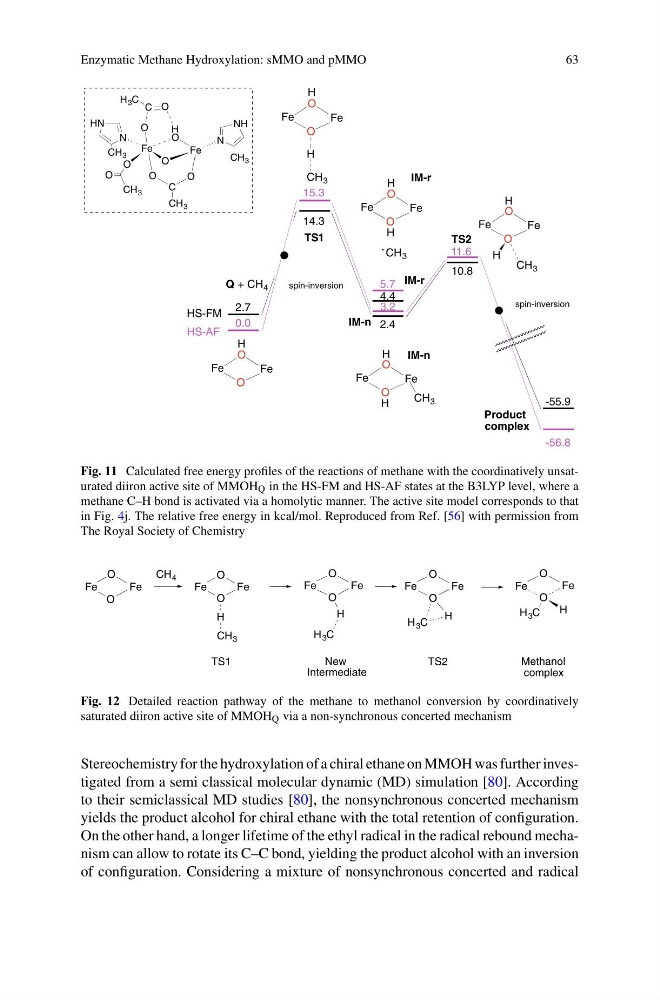
Fig. 11 Calculated free energy profiles of the reactions of methane with the coordinatively unsaturated diiron active site of MMOH Q in the HS-FM and HS-AF states at the B3LYP level, where a
methane C–H bond is activated via a homolytic manner. The active site model corresponds to that
in Fig. 4j. The relative free energy in kcal/mol. Reproduced from Ref. [56] with permission from
The Royal Society of Chemistry
Fe
O
Fe
O
CH 4
Fe
O
Fe
O
H
CH 3
H 3 C
Fe
O
Fe
O
H
New
Intermediate
H
Fe
O
Fe
O
H 3 C
Methanol
complex
H 3 C
Fe
O
Fe
O
H
TS2
TS1
Fig. 12 Detailed reaction pathway of the methane to methanol conversion by coordinatively
saturated diiron active site of MMOH Q via a non-synchronous concerted mechanism
Stereochemistry for the hydroxylation of a chiral ethane on MMOH was further investigated from a semi classical molecular dynamic (MD) simulation [80]. According
to their semiclassical MD studies [80], the nonsynchronous concerted mechanism
yields the product alcohol for chiral ethane with the total retention of configuration.
On the other hand, a longer lifetime of the ethyl radical in the radical rebound mechanism can allow to rotate its C–C bond, yielding the product alcohol with an inversion
of configuration. Considering a mixture of nonsynchronous concerted and radical
63
Q + CH 4
TS1
IM-n
TS2
Product
complex
0.0
2.7
15.3
4.4
2.4
10.8
11.6
-56.8
-55.9
HS-AF
14.3
Fe
Fe
O
O
CH 3
H
Fe
Fe
O
O
CH 3
H
Fe
Fe
O
O
Fe
Fe
O
O
CH 3
H
3.2
5.7
H
H
HS-FM
IM-r
H
IM-n
H
spin-inversion
spin-inversion
Fe
Fe
O
O
CH 3
H
IM-r
H
Fe
Fe
O
O
O
O
O
O
C
C
N
NH
HN
N
CH 3
O
H 3 C
O
CH 3
CH 3
CH 3
H
Fig. 11 Calculated free energy profiles of the reactions of methane with the coordinatively unsaturated diiron active site of MMOH Q in the HS-FM and HS-AF states at the B3LYP level, where a
methane C–H bond is activated via a homolytic manner. The active site model corresponds to that
in Fig. 4j. The relative free energy in kcal/mol. Reproduced from Ref. [56] with permission from
The Royal Society of Chemistry
Fe
O
Fe
O
CH 4
Fe
O
Fe
O
H
CH 3
H 3 C
Fe
O
Fe
O
H
New
Intermediate
H
Fe
O
Fe
O
H 3 C
Methanol
complex
H 3 C
Fe
O
Fe
O
H
TS2
TS1
Fig. 12 Detailed reaction pathway of the methane to methanol conversion by coordinatively
saturated diiron active site of MMOH Q via a non-synchronous concerted mechanism
Stereochemistry for the hydroxylation of a chiral ethane on MMOH was further investigated from a semi classical molecular dynamic (MD) simulation [80]. According
to their semiclassical MD studies [80], the nonsynchronous concerted mechanism
yields the product alcohol for chiral ethane with the total retention of configuration.
On the other hand, a longer lifetime of the ethyl radical in the radical rebound mechanism can allow to rotate its C–C bond, yielding the product alcohol with an inversion
of configuration. Considering a mixture of nonsynchronous concerted and radical