

56
T. Yumura et al.
Fe
Fe
O
O
Fe
Fe
O
O
(µ-O) 2 Fe(IV) 2
Fe
Fe
O
O
H
(µ-O) 2 Fe(IV) 2
(µ-O)(µ-OH)Fe(III)Fe(IV)
Coordinatively saturated diiron model
Coordinatively unsaturated diiron model
Coordinatively saturated diiron model
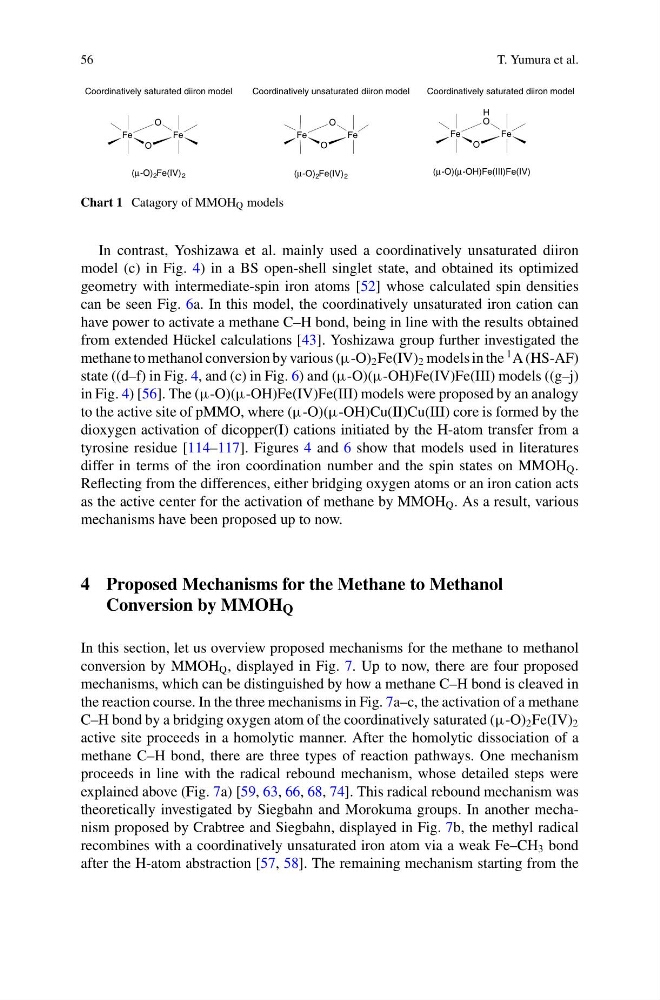
Chart 1 Catagory of MMOH Q models
In contrast, Yoshizawa et al. mainly used a coordinatively unsaturated diiron
model (c) in Fig. 4) in a BS open-shell singlet state, and obtained its optimized
geometry with intermediate-spin iron atoms [52] whose calculated spin densities
can be seen Fig. 6a. In this model, the coordinatively unsaturated iron cation can
have power to activate a methane C–H bond, being in line with the results obtained
from extended Hückel calculations [43]. Yoshizawa group further investigated the
methane to methanol conversion by various (μ-O) 2 Fe(IV) 2 models in the
1 A (HS-AF)
state ((d–f) in Fig. 4, and (c) in Fig. 6) and (μ-O)(μ-OH)Fe(IV)Fe(III) models ((g–j)
in Fig. 4) [56]. The (μ-O)(μ-OH)Fe(IV)Fe(III) models were proposed by an analogy
to the active site of pMMO, where (μ-O)(μ-OH)Cu(II)Cu(III) core is formed by the
dioxygen activation of dicopper(I) cations initiated by the H-atom transfer from a
tyrosine residue [114–117]. Figures 4 and 6 show that models used in literatures
differ in terms of the iron coordination number and the spin states on MMOH Q .
Reflecting from the differences, either bridging oxygen atoms or an iron cation acts
as the active center for the activation of methane by MMOH Q . As a result, various
mechanisms have been proposed up to now.
4 Proposed Mechanisms for the Methane to Methanol
Conversion by MMOH Q
In this section, let us overview proposed mechanisms for the methane to methanol
conversion by MMOH Q , displayed in Fig. 7. Up to now, there are four proposed
mechanisms, which can be distinguished by how a methane C–H bond is cleaved in
the reaction course. In the three mechanisms in Fig. 7a–c, the activation of a methane
C–H bond by a bridging oxygen atom of the coordinatively saturated (μ-O) 2 Fe(IV) 2
active site proceeds in a homolytic manner. After the homolytic dissociation of a
methane C–H bond, there are three types of reaction pathways. One mechanism
proceeds in line with the radical rebound mechanism, whose detailed steps were
explained above (Fig. 7a) [59, 63, 66, 68, 74]. This radical rebound mechanism was
theoretically investigated by Siegbahn and Morokuma groups. In another mechanism proposed by Crabtree and Siegbahn, displayed in Fig. 7b, the methyl radical
recombines with a coordinatively unsaturated iron atom via a weak Fe–CH 3 bond
after the H-atom abstraction [57, 58]. The remaining mechanism starting from the
T. Yumura et al.
Fe
Fe
O
O
Fe
Fe
O
O
(µ-O) 2 Fe(IV) 2
Fe
Fe
O
O
H
(µ-O) 2 Fe(IV) 2
(µ-O)(µ-OH)Fe(III)Fe(IV)
Coordinatively saturated diiron model
Coordinatively unsaturated diiron model
Coordinatively saturated diiron model
Chart 1 Catagory of MMOH Q models
In contrast, Yoshizawa et al. mainly used a coordinatively unsaturated diiron
model (c) in Fig. 4) in a BS open-shell singlet state, and obtained its optimized
geometry with intermediate-spin iron atoms [52] whose calculated spin densities
can be seen Fig. 6a. In this model, the coordinatively unsaturated iron cation can
have power to activate a methane C–H bond, being in line with the results obtained
from extended Hückel calculations [43]. Yoshizawa group further investigated the
methane to methanol conversion by various (μ-O) 2 Fe(IV) 2 models in the
1 A (HS-AF)
state ((d–f) in Fig. 4, and (c) in Fig. 6) and (μ-O)(μ-OH)Fe(IV)Fe(III) models ((g–j)
in Fig. 4) [56]. The (μ-O)(μ-OH)Fe(IV)Fe(III) models were proposed by an analogy
to the active site of pMMO, where (μ-O)(μ-OH)Cu(II)Cu(III) core is formed by the
dioxygen activation of dicopper(I) cations initiated by the H-atom transfer from a
tyrosine residue [114–117]. Figures 4 and 6 show that models used in literatures
differ in terms of the iron coordination number and the spin states on MMOH Q .
Reflecting from the differences, either bridging oxygen atoms or an iron cation acts
as the active center for the activation of methane by MMOH Q . As a result, various
mechanisms have been proposed up to now.
4 Proposed Mechanisms for the Methane to Methanol
Conversion by MMOH Q
In this section, let us overview proposed mechanisms for the methane to methanol
conversion by MMOH Q , displayed in Fig. 7. Up to now, there are four proposed
mechanisms, which can be distinguished by how a methane C–H bond is cleaved in
the reaction course. In the three mechanisms in Fig. 7a–c, the activation of a methane
C–H bond by a bridging oxygen atom of the coordinatively saturated (μ-O) 2 Fe(IV) 2
active site proceeds in a homolytic manner. After the homolytic dissociation of a
methane C–H bond, there are three types of reaction pathways. One mechanism
proceeds in line with the radical rebound mechanism, whose detailed steps were
explained above (Fig. 7a) [59, 63, 66, 68, 74]. This radical rebound mechanism was
theoretically investigated by Siegbahn and Morokuma groups. In another mechanism proposed by Crabtree and Siegbahn, displayed in Fig. 7b, the methyl radical
recombines with a coordinatively unsaturated iron atom via a weak Fe–CH 3 bond
after the H-atom abstraction [57, 58]. The remaining mechanism starting from the