

Enzymatic Methane Hydroxylation: sMMO and pMMO
57
Fe
O
Fe
O
H
H 3 C
Fe
O
Fe
O
CH 4
Fe
O
Fe
O
H
CH 3
CH 3
Fe
O
Fe
CH 3 OH
Fe
O
Fe
CH 3 OH
Fe
O
Fe
O
H
CH 3
CH 3
Fe
O
Fe
CH 3 OH
Fe
O
Fe
HO
CH 3
Fe
O
Fe
CH 3 OH
Fe
O
Fe
O
H
Fe
O
Fe
O
H
(a)
(b)
(d)
(c)
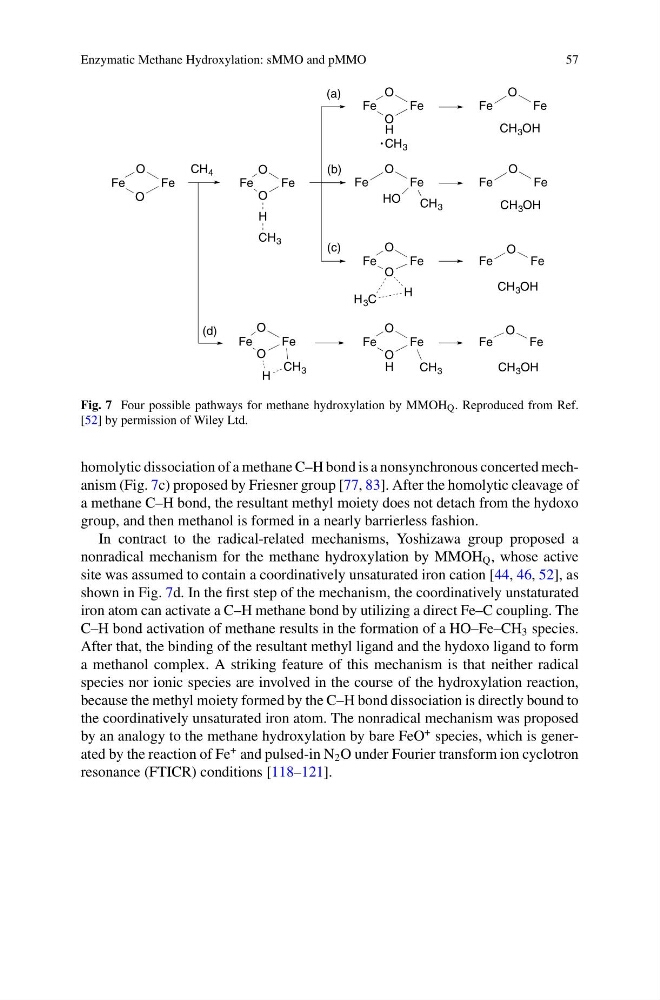
Fig. 7 Four possible pathways for methane hydroxylation by MMOH Q . Reproduced from Ref.
[52] by permission of Wiley Ltd.
homolytic dissociation of a methane C–H bond is a nonsynchronous concerted mechanism (Fig. 7c) proposed by Friesner group [77, 83]. After the homolytic cleavage of
a methane C–H bond, the resultant methyl moiety does not detach from the hydoxo
group, and then methanol is formed in a nearly barrierless fashion.
In contract to the radical-related mechanisms, Yoshizawa group proposed a
nonradical mechanism for the methane hydroxylation by MMOH Q , whose active
site was assumed to contain a coordinatively unsaturated iron cation [44, 46, 52], as
shown in Fig. 7d. In the first step of the mechanism, the coordinatively unstaturated
iron atom can activate a C–H methane bond by utilizing a direct Fe–C coupling. The
C–H bond activation of methane results in the formation of a HO–Fe–CH 3 species.
After that, the binding of the resultant methyl ligand and the hydoxo ligand to form
a methanol complex. A striking feature of this mechanism is that neither radical
species nor ionic species are involved in the course of the hydroxylation reaction,
because the methyl moiety formed by the C–H bond dissociation is directly bound to
the coordinatively unsaturated iron atom. The nonradical mechanism was proposed
by an analogy to the methane hydroxylation by bare FeO
+ species, which is generated by the reaction of Fe
+ and pulsed-in N 2 O under Fourier transform ion cyclotron
resonance (FTICR) conditions [118–121].
57
Fe
O
Fe
O
H
H 3 C
Fe
O
Fe
O
CH 4
Fe
O
Fe
O
H
CH 3
CH 3
Fe
O
Fe
CH 3 OH
Fe
O
Fe
CH 3 OH
Fe
O
Fe
O
H
CH 3
CH 3
Fe
O
Fe
CH 3 OH
Fe
O
Fe
HO
CH 3
Fe
O
Fe
CH 3 OH
Fe
O
Fe
O
H
Fe
O
Fe
O
H
(a)
(b)
(d)
(c)
Fig. 7 Four possible pathways for methane hydroxylation by MMOH Q . Reproduced from Ref.
[52] by permission of Wiley Ltd.
homolytic dissociation of a methane C–H bond is a nonsynchronous concerted mechanism (Fig. 7c) proposed by Friesner group [77, 83]. After the homolytic cleavage of
a methane C–H bond, the resultant methyl moiety does not detach from the hydoxo
group, and then methanol is formed in a nearly barrierless fashion.
In contract to the radical-related mechanisms, Yoshizawa group proposed a
nonradical mechanism for the methane hydroxylation by MMOH Q , whose active
site was assumed to contain a coordinatively unsaturated iron cation [44, 46, 52], as
shown in Fig. 7d. In the first step of the mechanism, the coordinatively unstaturated
iron atom can activate a C–H methane bond by utilizing a direct Fe–C coupling. The
C–H bond activation of methane results in the formation of a HO–Fe–CH 3 species.
After that, the binding of the resultant methyl ligand and the hydoxo ligand to form
a methanol complex. A striking feature of this mechanism is that neither radical
species nor ionic species are involved in the course of the hydroxylation reaction,
because the methyl moiety formed by the C–H bond dissociation is directly bound to
the coordinatively unsaturated iron atom. The nonradical mechanism was proposed
by an analogy to the methane hydroxylation by bare FeO
+ species, which is generated by the reaction of Fe
+ and pulsed-in N 2 O under Fourier transform ion cyclotron
resonance (FTICR) conditions [118–121].