

Enzymatic Methane Hydroxylation: sMMO and pMMO
55
Fe
Fe
O
O
O
O
O
O
O
O
C
C
H
N
NH
HN
N
H
O
H
O
Siegbahn group
H
H
H
O
Fe
Fe
OH 2
O
O
H 2 O
O
O
O
O
NH 2
H 2 N
H
C
C
H
Fe
Fe
O
O
O
O
O
O
O
O
H
C
C
H
N
NH
HN
N
H
O
H
O
Fe
Fe
O
O
O
O
O
O
O
O
HC
C
H
N
NH
HN
N
HC
O
H
O
H
H
O
Fe
Fe
O
O
O
O
O
O
O
O
C
C
N
NH
HN
N
CH 3
O
CH 3
O
H
H
R
O
CH 3
CH 3
R
Fe
Fe
O
O
O
O
O
O
O
O
HC
C
H
N
NH
HN
N
CH
O
C
H
O
H
H
O
Morokuma group
Friesner group
Yoshizawa group
Fe
Fe
O
O
O
O
O
O
O
O
C
C
H
N
NH
HN
N
H
O
H
O
H
H
H
O
1 A
1 A
1 A
9 A
1 A
1.9
0.1
1.6
0.4
1.7
0.4
1.4
4.1
0.8
1.0
3.4
3.6
0.4
0.3
3.5
3.5
0.2
0.3
3.5
0.0
Fe
Fe
O
O
O
O
O
O
O
O
C
C
N
NH
HN
N
CH 3
O
CH 3
O
H
H
H 3 C
O
CH 3
CH 3
CH 3
1 A
3.5
(a)
(b)
(c)
(d)
(e)
9 A
9 A
(f)
(g)
(h)
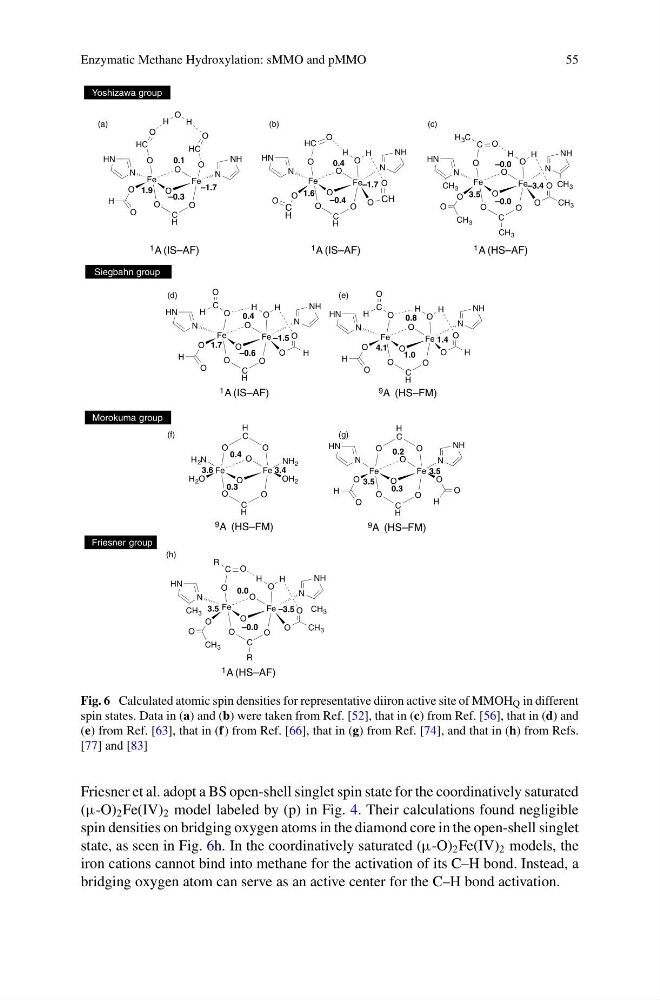
Fig. 6 Calculated atomic spin densities for representative diiron active site of MMOH Q in different
spin states. Data in (a) and (b) were taken from Ref. [52], that in (c) from Ref. [56], that in (d) and
(e) from Ref. [63], that in (f) from Ref. [66], that in (g) from Ref. [74], and that in (h) from Refs.
[77] and [83]
Friesner et al. adopt a BS open-shell singlet spin state for the coordinatively saturated
(μ-O) 2 Fe(IV) 2 model labeled by (p) in Fig. 4. Their calculations found negligible
spin densities on bridging oxygen atoms in the diamond core in the open-shell singlet
state, as seen in Fig. 6h. In the coordinatively saturated (μ-O) 2 Fe(IV) 2 models, the
iron cations cannot bind into methane for the activation of its C–H bond. Instead, a
bridging oxygen atom can serve as an active center for the C–H bond activation.
55
Fe
Fe
O
O
O
O
O
O
O
O
C
C
H
N
NH
HN
N
H
O
H
O
Siegbahn group
H
H
H
O
Fe
Fe
OH 2
O
O
H 2 O
O
O
O
O
NH 2
H 2 N
H
C
C
H
Fe
Fe
O
O
O
O
O
O
O
O
H
C
C
H
N
NH
HN
N
H
O
H
O
Fe
Fe
O
O
O
O
O
O
O
O
HC
C
H
N
NH
HN
N
HC
O
H
O
H
H
O
Fe
Fe
O
O
O
O
O
O
O
O
C
C
N
NH
HN
N
CH 3
O
CH 3
O
H
H
R
O
CH 3
CH 3
R
Fe
Fe
O
O
O
O
O
O
O
O
HC
C
H
N
NH
HN
N
CH
O
C
H
O
H
H
O
Morokuma group
Friesner group
Yoshizawa group
Fe
Fe
O
O
O
O
O
O
O
O
C
C
H
N
NH
HN
N
H
O
H
O
H
H
H
O
1 A
1 A
1 A
9 A
1 A
1.9
0.1
1.6
0.4
1.7
0.4
1.4
4.1
0.8
1.0
3.4
3.6
0.4
0.3
3.5
3.5
0.2
0.3
3.5
0.0
Fe
Fe
O
O
O
O
O
O
O
O
C
C
N
NH
HN
N
CH 3
O
CH 3
O
H
H
H 3 C
O
CH 3
CH 3
CH 3
1 A
3.5
(a)
(b)
(c)
(d)
(e)
9 A
9 A
(f)
(g)
(h)
Fig. 6 Calculated atomic spin densities for representative diiron active site of MMOH Q in different
spin states. Data in (a) and (b) were taken from Ref. [52], that in (c) from Ref. [56], that in (d) and
(e) from Ref. [63], that in (f) from Ref. [66], that in (g) from Ref. [74], and that in (h) from Refs.
[77] and [83]
Friesner et al. adopt a BS open-shell singlet spin state for the coordinatively saturated
(μ-O) 2 Fe(IV) 2 model labeled by (p) in Fig. 4. Their calculations found negligible
spin densities on bridging oxygen atoms in the diamond core in the open-shell singlet
state, as seen in Fig. 6h. In the coordinatively saturated (μ-O) 2 Fe(IV) 2 models, the
iron cations cannot bind into methane for the activation of its C–H bond. Instead, a
bridging oxygen atom can serve as an active center for the C–H bond activation.