

54
T. Yumura et al.
Fe
L
L
Fe
L
L
L
L
L
L
"t 2g "
"e g "
(a)
(b)
(c)
(d)
(e)
5 A
9 A
1 A
1 A
(IS-FM)
(HS-FM)
(IS-AF)
(HS-AF)
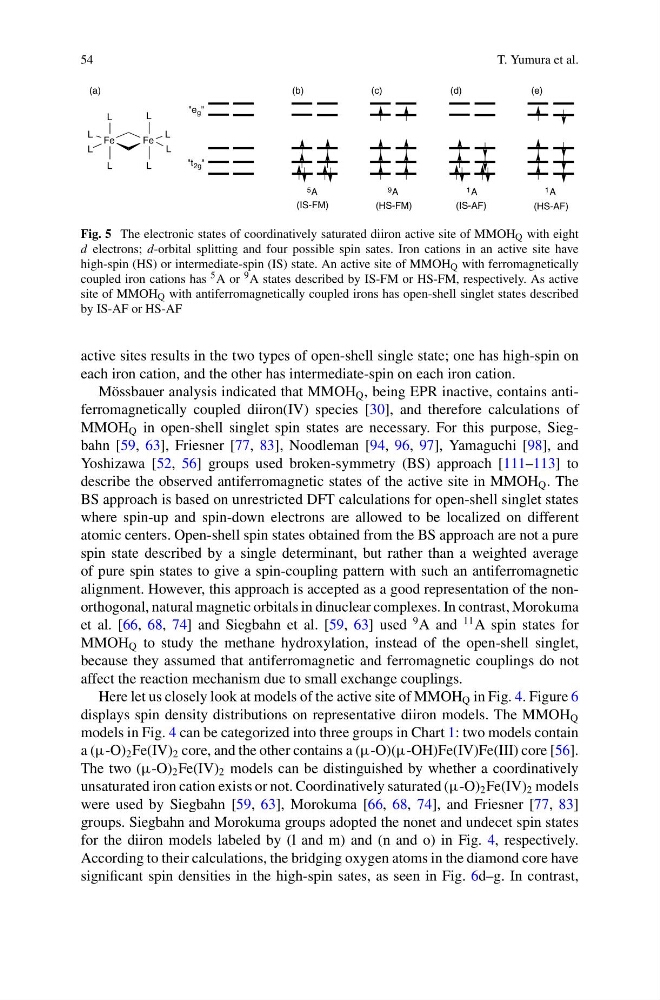
Fig. 5 The electronic states of coordinatively saturated diiron active site of MMOH Q with eight
d electrons; d-orbital splitting and four possible spin sates. Iron cations in an active site have
high-spin (HS) or intermediate-spin (IS) state. An active site of MMOH Q with ferromagnetically
coupled iron cations has 5 A or 9 A states described by IS-FM or HS-FM, respectively. As active
site of MMOH Q with antiferromagnetically coupled irons has open-shell singlet states described
by IS-AF or HS-AF
active sites results in the two types of open-shell single state; one has high-spin on
each iron cation, and the other has intermediate-spin on each iron cation.
Mössbauer analysis indicated that MMOH Q , being EPR inactive, contains antiferromagnetically coupled diiron(IV) species [30], and therefore calculations of
MMOH Q in open-shell singlet spin states are necessary. For this purpose, Siegbahn [59, 63], Friesner [77, 83], Noodleman [94, 96, 97], Yamaguchi [98], and
Yoshizawa [52, 56] groups used broken-symmetry (BS) approach [111–113] to
describe the observed antiferromagnetic states of the active site in MMOH Q . The
BS approach is based on unrestricted DFT calculations for open-shell singlet states
where spin-up and spin-down electrons are allowed to be localized on different
atomic centers. Open-shell spin states obtained from the BS approach are not a pure
spin state described by a single determinant, but rather than a weighted average
of pure spin states to give a spin-coupling pattern with such an antiferromagnetic
alignment. However, this approach is accepted as a good representation of the nonorthogonal, natural magnetic orbitals in dinuclear complexes. In contrast, Morokuma
et al. [66, 68, 74] and Siegbahn et al. [59, 63] used
9 A and
11 A spin states for
MMOH Q to study the methane hydroxylation, instead of the open-shell singlet,
because they assumed that antiferromagnetic and ferromagnetic couplings do not
affect the reaction mechanism due to small exchange couplings.
Here let us closely look at models of the active site of MMOH Q in Fig. 4. Figure 6
displays spin density distributions on representative diiron models. The MMOH Q
models in Fig. 4 can be categorized into three groups in Chart 1: two models contain
a (μ-O) 2 Fe(IV) 2 core, and the other contains a (μ-O)(μ-OH)Fe(IV)Fe(III) core [56].
The two (μ-O) 2 Fe(IV) 2 models can be distinguished by whether a coordinatively
unsaturated iron cation exists or not. Coordinatively saturated (μ-O) 2 Fe(IV) 2 models
were used by Siegbahn [59, 63], Morokuma [66, 68, 74], and Friesner [77, 83]
groups. Siegbahn and Morokuma groups adopted the nonet and undecet spin states
for the diiron models labeled by (l and m) and (n and o) in Fig. 4, respectively.
According to their calculations, the bridging oxygen atoms in the diamond core have
significant spin densities in the high-spin sates, as seen in Fig. 6d–g. In contrast,
T. Yumura et al.
Fe
L
L
Fe
L
L
L
L
L
L
"t 2g "
"e g "
(a)
(b)
(c)
(d)
(e)
5 A
9 A
1 A
1 A
(IS-FM)
(HS-FM)
(IS-AF)
(HS-AF)
Fig. 5 The electronic states of coordinatively saturated diiron active site of MMOH Q with eight
d electrons; d-orbital splitting and four possible spin sates. Iron cations in an active site have
high-spin (HS) or intermediate-spin (IS) state. An active site of MMOH Q with ferromagnetically
coupled iron cations has 5 A or 9 A states described by IS-FM or HS-FM, respectively. As active
site of MMOH Q with antiferromagnetically coupled irons has open-shell singlet states described
by IS-AF or HS-AF
active sites results in the two types of open-shell single state; one has high-spin on
each iron cation, and the other has intermediate-spin on each iron cation.
Mössbauer analysis indicated that MMOH Q , being EPR inactive, contains antiferromagnetically coupled diiron(IV) species [30], and therefore calculations of
MMOH Q in open-shell singlet spin states are necessary. For this purpose, Siegbahn [59, 63], Friesner [77, 83], Noodleman [94, 96, 97], Yamaguchi [98], and
Yoshizawa [52, 56] groups used broken-symmetry (BS) approach [111–113] to
describe the observed antiferromagnetic states of the active site in MMOH Q . The
BS approach is based on unrestricted DFT calculations for open-shell singlet states
where spin-up and spin-down electrons are allowed to be localized on different
atomic centers. Open-shell spin states obtained from the BS approach are not a pure
spin state described by a single determinant, but rather than a weighted average
of pure spin states to give a spin-coupling pattern with such an antiferromagnetic
alignment. However, this approach is accepted as a good representation of the nonorthogonal, natural magnetic orbitals in dinuclear complexes. In contrast, Morokuma
et al. [66, 68, 74] and Siegbahn et al. [59, 63] used
9 A and
11 A spin states for
MMOH Q to study the methane hydroxylation, instead of the open-shell singlet,
because they assumed that antiferromagnetic and ferromagnetic couplings do not
affect the reaction mechanism due to small exchange couplings.
Here let us closely look at models of the active site of MMOH Q in Fig. 4. Figure 6
displays spin density distributions on representative diiron models. The MMOH Q
models in Fig. 4 can be categorized into three groups in Chart 1: two models contain
a (μ-O) 2 Fe(IV) 2 core, and the other contains a (μ-O)(μ-OH)Fe(IV)Fe(III) core [56].
The two (μ-O) 2 Fe(IV) 2 models can be distinguished by whether a coordinatively
unsaturated iron cation exists or not. Coordinatively saturated (μ-O) 2 Fe(IV) 2 models
were used by Siegbahn [59, 63], Morokuma [66, 68, 74], and Friesner [77, 83]
groups. Siegbahn and Morokuma groups adopted the nonet and undecet spin states
for the diiron models labeled by (l and m) and (n and o) in Fig. 4, respectively.
According to their calculations, the bridging oxygen atoms in the diamond core have
significant spin densities in the high-spin sates, as seen in Fig. 6d–g. In contrast,