

Orbital Concept for Methane Activation
15
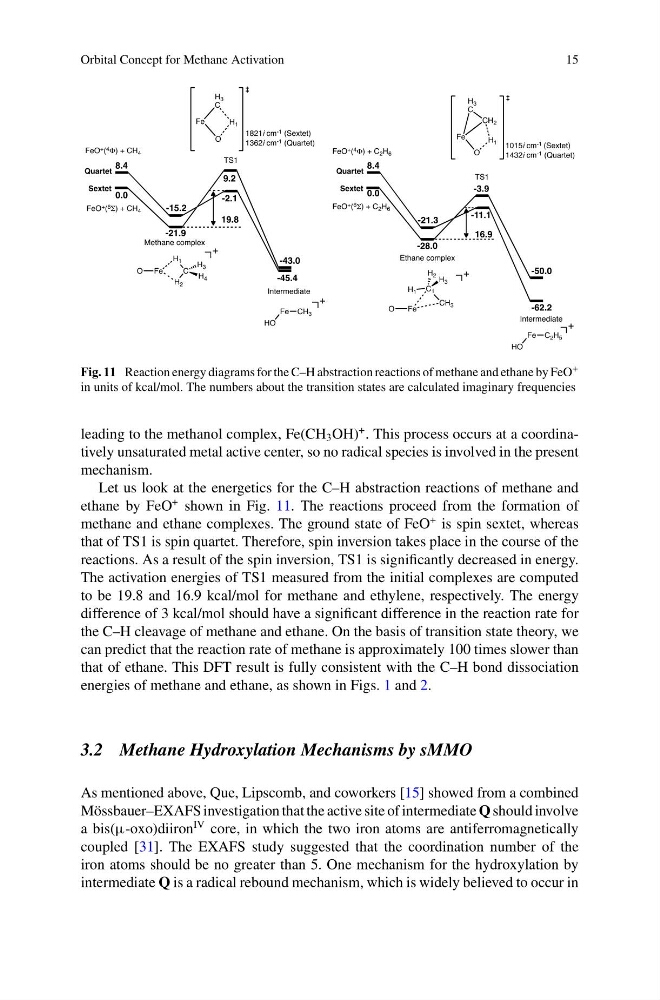
Fig. 11 Reaction energy diagrams for the C–H abstraction reactions of methane and ethane by FeO +
in units of kcal/mol. The numbers about the transition states are calculated imaginary frequencies
leading to the methanol complex, Fe(CH 3 OH)
+ . This process occurs at a coordinatively unsaturated metal active center, so no radical species is involved in the present
mechanism.
Let us look at the energetics for the C–H abstraction reactions of methane and
ethane by FeO
+ shown in Fig. 11. The reactions proceed from the formation of
methane and ethane complexes. The ground state of FeO
+ is spin sextet, whereas
that of TS1 is spin quartet. Therefore, spin inversion takes place in the course of the
reactions. As a result of the spin inversion, TS1 is significantly decreased in energy.
The activation energies of TS1 measured from the initial complexes are computed
to be 19.8 and 16.9 kcal/mol for methane and ethylene, respectively. The energy
difference of 3 kcal/mol should have a significant difference in the reaction rate for
the C–H cleavage of methane and ethane. On the basis of transition state theory, we
can predict that the reaction rate of methane is approximately 100 times slower than
that of ethane. This DFT result is fully consistent with the C–H bond dissociation
energies of methane and ethane, as shown in Figs. 1 and 2.
3.2 Methane Hydroxylation Mechanisms by sMMO
As mentioned above, Que, Lipscomb, and coworkers [15] showed from a combined
Mössbauer–EXAFS investigation that the active site of intermediate Q should involve
a bis(μ-oxo)diiron
IV core, in which the two iron atoms are antiferromagnetically
coupled [31]. The EXAFS study suggested that the coordination number of the
iron atoms should be no greater than 5. One mechanism for the hydroxylation by
intermediate Q is a radical rebound mechanism, which is widely believed to occur in
15
Fig. 11 Reaction energy diagrams for the C–H abstraction reactions of methane and ethane by FeO +
in units of kcal/mol. The numbers about the transition states are calculated imaginary frequencies
leading to the methanol complex, Fe(CH 3 OH)
+ . This process occurs at a coordinatively unsaturated metal active center, so no radical species is involved in the present
mechanism.
Let us look at the energetics for the C–H abstraction reactions of methane and
ethane by FeO
+ shown in Fig. 11. The reactions proceed from the formation of
methane and ethane complexes. The ground state of FeO
+ is spin sextet, whereas
that of TS1 is spin quartet. Therefore, spin inversion takes place in the course of the
reactions. As a result of the spin inversion, TS1 is significantly decreased in energy.
The activation energies of TS1 measured from the initial complexes are computed
to be 19.8 and 16.9 kcal/mol for methane and ethylene, respectively. The energy
difference of 3 kcal/mol should have a significant difference in the reaction rate for
the C–H cleavage of methane and ethane. On the basis of transition state theory, we
can predict that the reaction rate of methane is approximately 100 times slower than
that of ethane. This DFT result is fully consistent with the C–H bond dissociation
energies of methane and ethane, as shown in Figs. 1 and 2.
3.2 Methane Hydroxylation Mechanisms by sMMO
As mentioned above, Que, Lipscomb, and coworkers [15] showed from a combined
Mössbauer–EXAFS investigation that the active site of intermediate Q should involve
a bis(μ-oxo)diiron
IV core, in which the two iron atoms are antiferromagnetically
coupled [31]. The EXAFS study suggested that the coordination number of the
iron atoms should be no greater than 5. One mechanism for the hydroxylation by
intermediate Q is a radical rebound mechanism, which is widely believed to occur in