

14
K. Yoshizawa and M. Miyanishi
in prior to C–H bond activation. Direct or indirect observations have been made to
support the intermediacy of alkane complexes in C–H activation [30], but their direct
observation requires ultrafast spectroscopic techniques at very low temperature. The
initially formed methane complex FeO(CH 4 )
+ , which takes an η
2 -CH 4 coordination,
is transformed into hydroxo intermediate (HO–Fe–CH 3
+ ) and methoxy intermediate
(H–Fe–OCH 3
+ ) by an H-atom abstraction and methyl shift, respectively. The reaction
pathway via hydroxo intermediate is energetically more favorable than the other one
via methoxy intermediate [16]. This result is fully consistent with the experimental
prediction [8] that hydroxo intermediate should play a central role as an intermediate
in the gas-phase reaction between FeO
+ and methane. Hydroxo intermediate is then
transformed into the methanol complex as a result of the recombination of the OH
and CH 3 ligands at the metal center.
Detailed discussion about this reaction pathway is developed in Chapter “Theoretical Study of the Direct Conversion of Methane by First-Row Transition-Metal
Oxide Cations in the Gas Phase”. We show that the methane hydroxylation by the
FeO
+ species should take place in the sextet and quartet states along the reaction
pathway via the hydroxo intermediate [29]. Thus, this reaction can be viewed as a
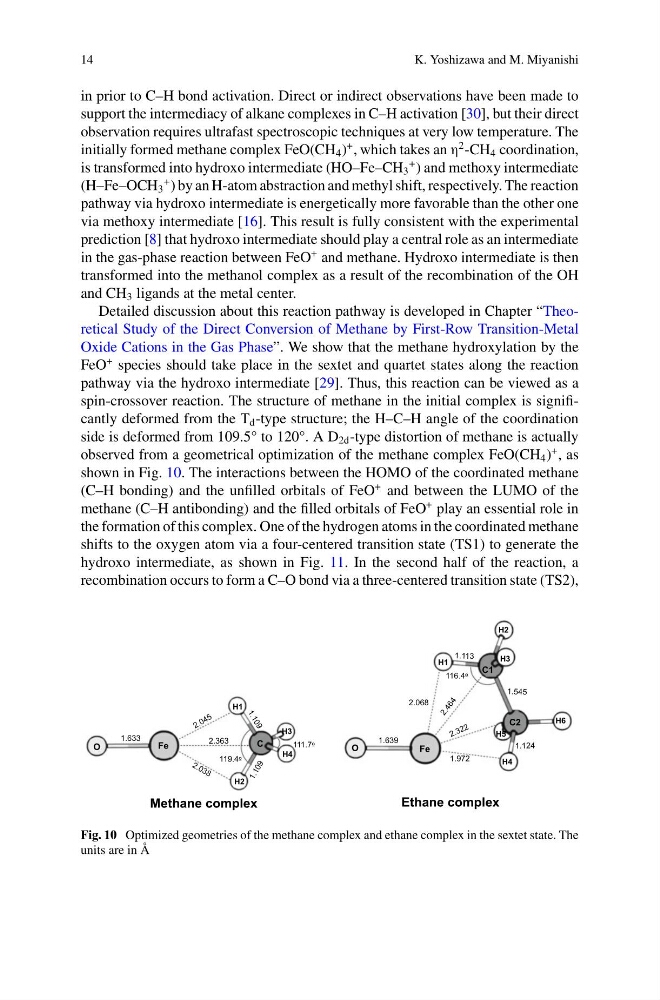
spin-crossover reaction. The structure of methane in the initial complex is significantly deformed from the T d -type structure; the H–C–H angle of the coordination
side is deformed from 109.5° to 120°. A D 2d -type distortion of methane is actually
observed from a geometrical optimization of the methane complex FeO(CH 4 )
+ , as
shown in Fig. 10. The interactions between the HOMO of the coordinated methane
(C–H bonding) and the unfilled orbitals of FeO
+ and between the LUMO of the
methane (C–H antibonding) and the filled orbitals of FeO
+ play an essential role in
the formation of this complex. One of the hydrogen atoms in the coordinated methane
shifts to the oxygen atom via a four-centered transition state (TS1) to generate the
hydroxo intermediate, as shown in Fig. 11. In the second half of the reaction, a
recombination occurs to form a C–O bond via a three-centered transition state (TS2),
1.633
1
.1
0
9
1 .1 0 9
2 .0 4 5
2.363
2 .0 3 8
119.4
111.7
Fe
O
C1
H2
H1
H3
C2
H4
H5
H6
1.113
1.639
2 .4
6 4
2 .3 2 2
1.972
2.068
116.4
1.124
Fe
O
H3
C
H4
H1
H2
1.545
Methane complex
Ethane complex
Fig. 10 Optimized geometries of the methane complex and ethane complex in the sextet state. The
units are in Å
K. Yoshizawa and M. Miyanishi
in prior to C–H bond activation. Direct or indirect observations have been made to
support the intermediacy of alkane complexes in C–H activation [30], but their direct
observation requires ultrafast spectroscopic techniques at very low temperature. The
initially formed methane complex FeO(CH 4 )
+ , which takes an η
2 -CH 4 coordination,
is transformed into hydroxo intermediate (HO–Fe–CH 3
+ ) and methoxy intermediate
(H–Fe–OCH 3
+ ) by an H-atom abstraction and methyl shift, respectively. The reaction
pathway via hydroxo intermediate is energetically more favorable than the other one
via methoxy intermediate [16]. This result is fully consistent with the experimental
prediction [8] that hydroxo intermediate should play a central role as an intermediate
in the gas-phase reaction between FeO
+ and methane. Hydroxo intermediate is then
transformed into the methanol complex as a result of the recombination of the OH
and CH 3 ligands at the metal center.
Detailed discussion about this reaction pathway is developed in Chapter “Theoretical Study of the Direct Conversion of Methane by First-Row Transition-Metal
Oxide Cations in the Gas Phase”. We show that the methane hydroxylation by the
FeO
+ species should take place in the sextet and quartet states along the reaction
pathway via the hydroxo intermediate [29]. Thus, this reaction can be viewed as a
spin-crossover reaction. The structure of methane in the initial complex is significantly deformed from the T d -type structure; the H–C–H angle of the coordination
side is deformed from 109.5° to 120°. A D 2d -type distortion of methane is actually
observed from a geometrical optimization of the methane complex FeO(CH 4 )
+ , as
shown in Fig. 10. The interactions between the HOMO of the coordinated methane
(C–H bonding) and the unfilled orbitals of FeO
+ and between the LUMO of the
methane (C–H antibonding) and the filled orbitals of FeO
+ play an essential role in
the formation of this complex. One of the hydrogen atoms in the coordinated methane
shifts to the oxygen atom via a four-centered transition state (TS1) to generate the
hydroxo intermediate, as shown in Fig. 11. In the second half of the reaction, a
recombination occurs to form a C–O bond via a three-centered transition state (TS2),
1.633
1
.1
0
9
1 .1 0 9
2 .0 4 5
2.363
2 .0 3 8
119.4
111.7
Fe
O
C1
H2
H1
H3
C2
H4
H5
H6
1.113
1.639
2 .4
6 4
2 .3 2 2
1.972
2.068
116.4
1.124
Fe
O
H3
C
H4
H1
H2
1.545
Methane complex
Ethane complex
Fig. 10 Optimized geometries of the methane complex and ethane complex in the sextet state. The
units are in Å