

Orbital Concept for Methane Activation
13
3 Reaction Mechanism for the Direct Hydroxylation
of Methane
3.1 Methane Hydroxylation by the FeO + Species
The transition-metal-oxide ions (MO
+ s) are excellent oxidants. Gas-phase reactions between MO
+ s and hydrocarbons are of particular interest since they can be
viewed as good model reactions for various oxidation reactions by catalytic and
enzymatic systems. Methane hydroxylation by MO
+ s in the gas phase under ioncyclotron-resonance conditions has been investigated by Schwarz and coworkers
[3, 8] and Armentrout and coworkers [19]. The catalytic activity of the bare MO
+
complexes toward methane is a key to the mechanistic aspects in the direct methane
hydroxylation [8, 19–27].
Schröder, Schwarz, and co-workers have systematically investigated the gas-phase
reactions of the first-row MO
+ complexes and methane using the Fourier-transformed
mass spectroscopic analysis under ion cyclotron resonance conditions [3, 8, 24–26].
They demonstrated that the late MO
+ complexes are able to activate methane while
the early ones are not. The reaction efficiency and the methanol branching ratio
are significantly dependent on metals. For example, FeO
+ efficiently reacts with
methane, forming methanol in 41% yield [8]. Although MnO
+ reacts with methane
very efficiently, the branching ratio to methanol is less than 1% [25]. CoO
+ exhibits
low reactivity toward methane, but the branching ratio to methanol is 100% [19]. Both
the reactivity and the methanol branching ratio are high in NiO
+ [3]. In contrast, the
early MO
+ complexes (ScO
+ , TiO
+ , and VO
+ ) exhibit no reactivity toward alkanes
and alkenes, due to their strong metal–oxo bonds. Interestingly, Sc
+ reacts with
methanol to yield ScO
+ and methane in the gas phase [28], which is precisely the
reverse reaction of methane hydroxylation.
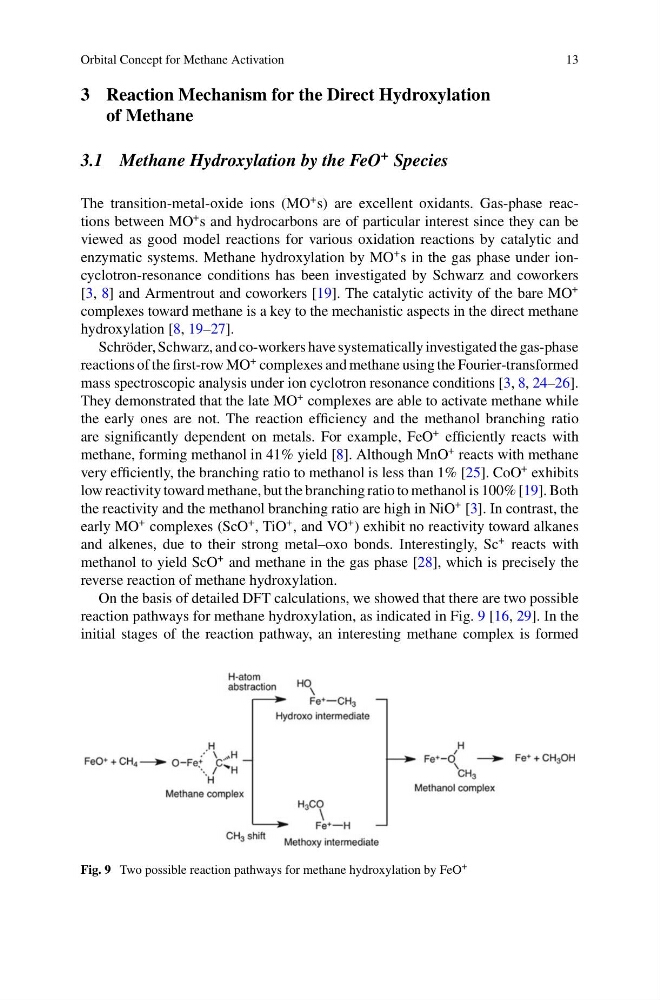
On the basis of detailed DFT calculations, we showed that there are two possible
reaction pathways for methane hydroxylation, as indicated in Fig. 9 [16, 29]. In the
initial stages of the reaction pathway, an interesting methane complex is formed
Fig. 9 Two possible reaction pathways for methane hydroxylation by FeO +
13
3 Reaction Mechanism for the Direct Hydroxylation
of Methane
3.1 Methane Hydroxylation by the FeO + Species
The transition-metal-oxide ions (MO
+ s) are excellent oxidants. Gas-phase reactions between MO
+ s and hydrocarbons are of particular interest since they can be
viewed as good model reactions for various oxidation reactions by catalytic and
enzymatic systems. Methane hydroxylation by MO
+ s in the gas phase under ioncyclotron-resonance conditions has been investigated by Schwarz and coworkers
[3, 8] and Armentrout and coworkers [19]. The catalytic activity of the bare MO
+
complexes toward methane is a key to the mechanistic aspects in the direct methane
hydroxylation [8, 19–27].
Schröder, Schwarz, and co-workers have systematically investigated the gas-phase
reactions of the first-row MO
+ complexes and methane using the Fourier-transformed
mass spectroscopic analysis under ion cyclotron resonance conditions [3, 8, 24–26].
They demonstrated that the late MO
+ complexes are able to activate methane while
the early ones are not. The reaction efficiency and the methanol branching ratio
are significantly dependent on metals. For example, FeO
+ efficiently reacts with
methane, forming methanol in 41% yield [8]. Although MnO
+ reacts with methane
very efficiently, the branching ratio to methanol is less than 1% [25]. CoO
+ exhibits
low reactivity toward methane, but the branching ratio to methanol is 100% [19]. Both
the reactivity and the methanol branching ratio are high in NiO
+ [3]. In contrast, the
early MO
+ complexes (ScO
+ , TiO
+ , and VO
+ ) exhibit no reactivity toward alkanes
and alkenes, due to their strong metal–oxo bonds. Interestingly, Sc
+ reacts with
methanol to yield ScO
+ and methane in the gas phase [28], which is precisely the
reverse reaction of methane hydroxylation.
On the basis of detailed DFT calculations, we showed that there are two possible
reaction pathways for methane hydroxylation, as indicated in Fig. 9 [16, 29]. In the
initial stages of the reaction pathway, an interesting methane complex is formed
Fig. 9 Two possible reaction pathways for methane hydroxylation by FeO +