

12
K. Yoshizawa and M. Miyanishi
methane) in Fig. 6. Methane can be thus bound at the five-coordinate iron center of
a model of intermediate Q both in the η
2 -binding mode as well as in the η
3 -binding
mode.
Thus, we think that a five-coordinate iron would activate methane in a similar
manner. The C–H bonds of methane are activated in these complexes because of
significant electron transfer from the methane t 2 HOMO (C–H bonding) to the
unfilled nonbonding d orbital of the model iron complex through interaction (1),
as shown in Fig. 5. In fact, the computed total charge of the methane is +0.18 in the
complex with an η
3 -binding mode in Fig. 6 (at L = 2.3 Å) and +0.28 in the complex
with an η
2 -binding mode in Fig. 7 (at L = 2.4 Å).
Our proposal argues differ from the so-called oxygen rebound mechanism widely
accepted in bioinorganic chemistry. For instance, in a proposed catalytic mechanism
for cytochrome P-450 (which is able to hydroxylate a variety of secondary (2°) and
tertiary (3°) C–H bonds of alkanes) [18], the O–O bond is cleaved at the heme iron to
produce a diatomic unit which may be written as Fe(III)–O
0 , Fe(IV)–O
– , or Fe(V)–
O
2– . The π system of the porphyrin ring may also be oxidized to a cation radical; as a
result, the so-called Compound I, with an Fe(III)–O
– or Fe(IV) = O
2– core structure,
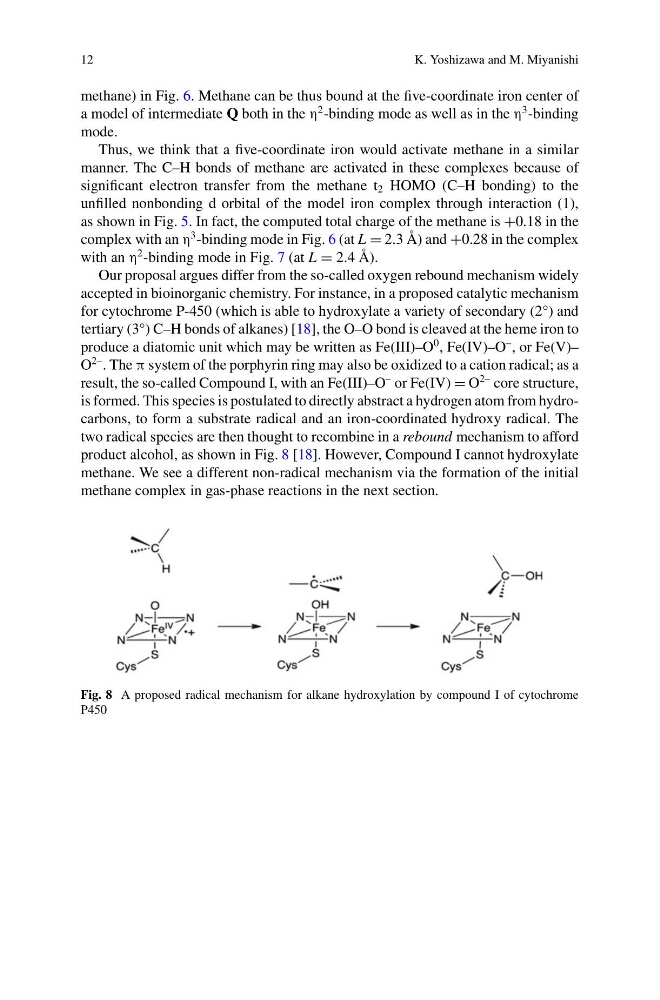
is formed. This species is postulated to directly abstract a hydrogen atom from hydrocarbons, to form a substrate radical and an iron-coordinated hydroxy radical. The
two radical species are then thought to recombine in a rebound mechanism to afford
product alcohol, as shown in Fig. 8 [18]. However, Compound I cannot hydroxylate
methane. We see a different non-radical mechanism via the formation of the initial
methane complex in gas-phase reactions in the next section.
Fig. 8 A proposed radical mechanism for alkane hydroxylation by compound I of cytochrome
P450
K. Yoshizawa and M. Miyanishi
methane) in Fig. 6. Methane can be thus bound at the five-coordinate iron center of
a model of intermediate Q both in the η
2 -binding mode as well as in the η
3 -binding
mode.
Thus, we think that a five-coordinate iron would activate methane in a similar
manner. The C–H bonds of methane are activated in these complexes because of
significant electron transfer from the methane t 2 HOMO (C–H bonding) to the
unfilled nonbonding d orbital of the model iron complex through interaction (1),
as shown in Fig. 5. In fact, the computed total charge of the methane is +0.18 in the
complex with an η
3 -binding mode in Fig. 6 (at L = 2.3 Å) and +0.28 in the complex
with an η
2 -binding mode in Fig. 7 (at L = 2.4 Å).
Our proposal argues differ from the so-called oxygen rebound mechanism widely
accepted in bioinorganic chemistry. For instance, in a proposed catalytic mechanism
for cytochrome P-450 (which is able to hydroxylate a variety of secondary (2°) and
tertiary (3°) C–H bonds of alkanes) [18], the O–O bond is cleaved at the heme iron to
produce a diatomic unit which may be written as Fe(III)–O
0 , Fe(IV)–O
– , or Fe(V)–
O
2– . The π system of the porphyrin ring may also be oxidized to a cation radical; as a
result, the so-called Compound I, with an Fe(III)–O
– or Fe(IV) = O
2– core structure,
is formed. This species is postulated to directly abstract a hydrogen atom from hydrocarbons, to form a substrate radical and an iron-coordinated hydroxy radical. The
two radical species are then thought to recombine in a rebound mechanism to afford
product alcohol, as shown in Fig. 8 [18]. However, Compound I cannot hydroxylate
methane. We see a different non-radical mechanism via the formation of the initial
methane complex in gas-phase reactions in the next section.
Fig. 8 A proposed radical mechanism for alkane hydroxylation by compound I of cytochrome
P450