

Orbital Concept for Methane Activation
11
active site of MMO, if that site has a five-coordinate iron active center in it. Our
proposals include a methane complex with an interesting Fe–CH 4 bond (Fig. 4, left)
in the initial stages of the catalytic reaction.
The coordination of a C 3v -distorted methane that we have discussed above is
one possibility, denoted as an η
3 -binding mode. There is another possible way of
coordination for methane, which we call an η
2 -binding mode, as shown in the right
of Fig. 4. The two binding modes were found in our more reliable calculations on
the FeO
+ (CH 4 ) complex, actually both minima on a potential energy surface from
DFT calculations [16, 17].
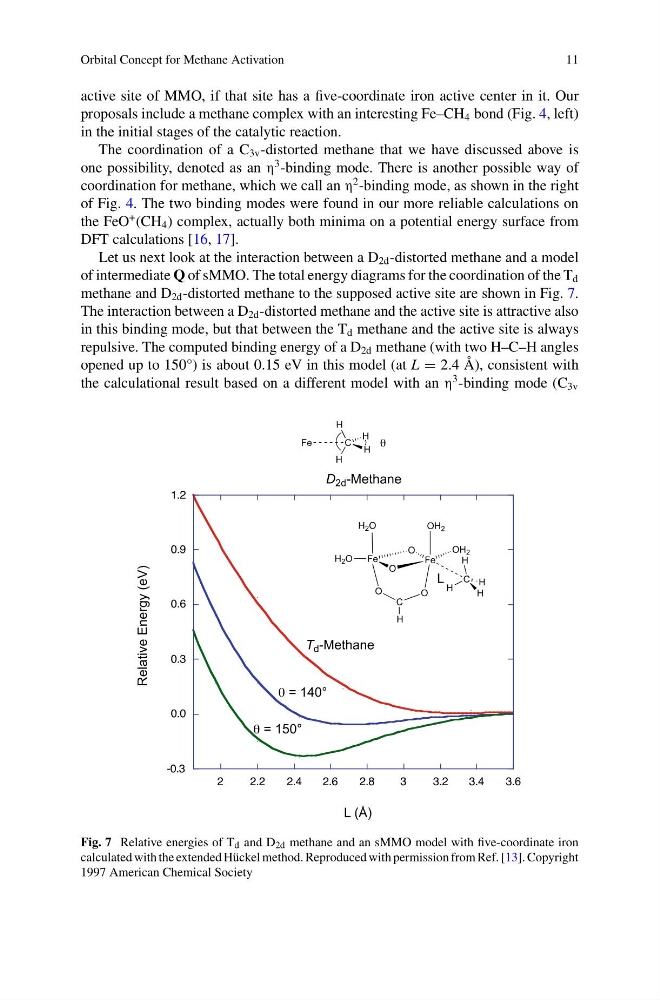
Let us next look at the interaction between a D 2d -distorted methane and a model
of intermediate Q of sMMO. The total energy diagrams for the coordination of the T d
methane and D 2d -distorted methane to the supposed active site are shown in Fig. 7.
The interaction between a D 2d -distorted methane and the active site is attractive also
in this binding mode, but that between the T d methane and the active site is always
repulsive. The computed binding energy of a D 2d methane (with two H–C–H angles
opened up to 150°) is about 0.15 eV in this model (at L = 2.4 Å), consistent with
the calculational result based on a different model with an η
3 -binding mode (C 3v
Fig. 7 Relative energies of T d and D 2d methane and an sMMO model with five-coordinate iron
calculated with the extended Hückel method. Reproduced with permission from Ref. [13]. Copyright
1997 American Chemical Society
11
active site of MMO, if that site has a five-coordinate iron active center in it. Our
proposals include a methane complex with an interesting Fe–CH 4 bond (Fig. 4, left)
in the initial stages of the catalytic reaction.
The coordination of a C 3v -distorted methane that we have discussed above is
one possibility, denoted as an η
3 -binding mode. There is another possible way of
coordination for methane, which we call an η
2 -binding mode, as shown in the right
of Fig. 4. The two binding modes were found in our more reliable calculations on
the FeO
+ (CH 4 ) complex, actually both minima on a potential energy surface from
DFT calculations [16, 17].
Let us next look at the interaction between a D 2d -distorted methane and a model
of intermediate Q of sMMO. The total energy diagrams for the coordination of the T d
methane and D 2d -distorted methane to the supposed active site are shown in Fig. 7.
The interaction between a D 2d -distorted methane and the active site is attractive also
in this binding mode, but that between the T d methane and the active site is always
repulsive. The computed binding energy of a D 2d methane (with two H–C–H angles
opened up to 150°) is about 0.15 eV in this model (at L = 2.4 Å), consistent with
the calculational result based on a different model with an η
3 -binding mode (C 3v
Fig. 7 Relative energies of T d and D 2d methane and an sMMO model with five-coordinate iron
calculated with the extended Hückel method. Reproduced with permission from Ref. [13]. Copyright
1997 American Chemical Society