

10
K. Yoshizawa and M. Miyanishi
structural and electronic features consistent with a high-valent Fe 2 (μ-O) 2 diamond
core structure. Intermediate Q was proposed to have an Fe 2 (μ-O) 2 diamond core,
and the two Fe(IV) centers are likely to have a coordination number no higher than
5. However, although the active site of sMMO has been widely believed to have
the bis(μ-oxo)Fe
IV
2 structure, its coordination sphere is still not clear at present. We
considered that a diiron(IV) model in which one of the two iron centers involve a five
coordinate iron. This is our model to see the formation of methane complex at the
initial stages of the reaction that converts methane to methanol under physiological
conditions.
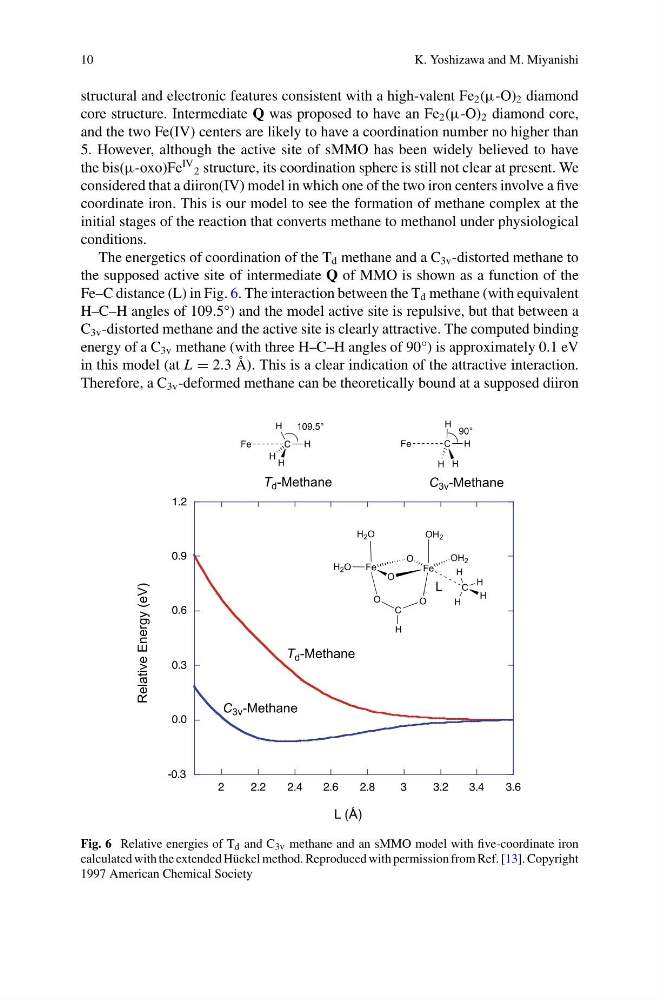
The energetics of coordination of the T d methane and a C 3v -distorted methane to
the supposed active site of intermediate Q of MMO is shown as a function of the
Fe–C distance (L) in Fig. 6. The interaction between the T d methane (with equivalent
H–C–H angles of 109.5°) and the model active site is repulsive, but that between a
C 3v -distorted methane and the active site is clearly attractive. The computed binding
energy of a C 3v methane (with three H–C–H angles of 90°) is approximately 0.1 eV
in this model (at L = 2.3 Å). This is a clear indication of the attractive interaction.
Therefore, a C 3v -deformed methane can be theoretically bound at a supposed diiron
Fig. 6 Relative energies of T d and C 3v methane and an sMMO model with five-coordinate iron
calculated with the extended Hückel method. Reproduced with permission from Ref. [13]. Copyright
1997 American Chemical Society
K. Yoshizawa and M. Miyanishi
structural and electronic features consistent with a high-valent Fe 2 (μ-O) 2 diamond
core structure. Intermediate Q was proposed to have an Fe 2 (μ-O) 2 diamond core,
and the two Fe(IV) centers are likely to have a coordination number no higher than
5. However, although the active site of sMMO has been widely believed to have
the bis(μ-oxo)Fe
IV
2 structure, its coordination sphere is still not clear at present. We
considered that a diiron(IV) model in which one of the two iron centers involve a five
coordinate iron. This is our model to see the formation of methane complex at the
initial stages of the reaction that converts methane to methanol under physiological
conditions.
The energetics of coordination of the T d methane and a C 3v -distorted methane to
the supposed active site of intermediate Q of MMO is shown as a function of the
Fe–C distance (L) in Fig. 6. The interaction between the T d methane (with equivalent
H–C–H angles of 109.5°) and the model active site is repulsive, but that between a
C 3v -distorted methane and the active site is clearly attractive. The computed binding
energy of a C 3v methane (with three H–C–H angles of 90°) is approximately 0.1 eV
in this model (at L = 2.3 Å). This is a clear indication of the attractive interaction.
Therefore, a C 3v -deformed methane can be theoretically bound at a supposed diiron
Fig. 6 Relative energies of T d and C 3v methane and an sMMO model with five-coordinate iron
calculated with the extended Hückel method. Reproduced with permission from Ref. [13]. Copyright
1997 American Chemical Society