

Orbital Concept for Methane Activation
9
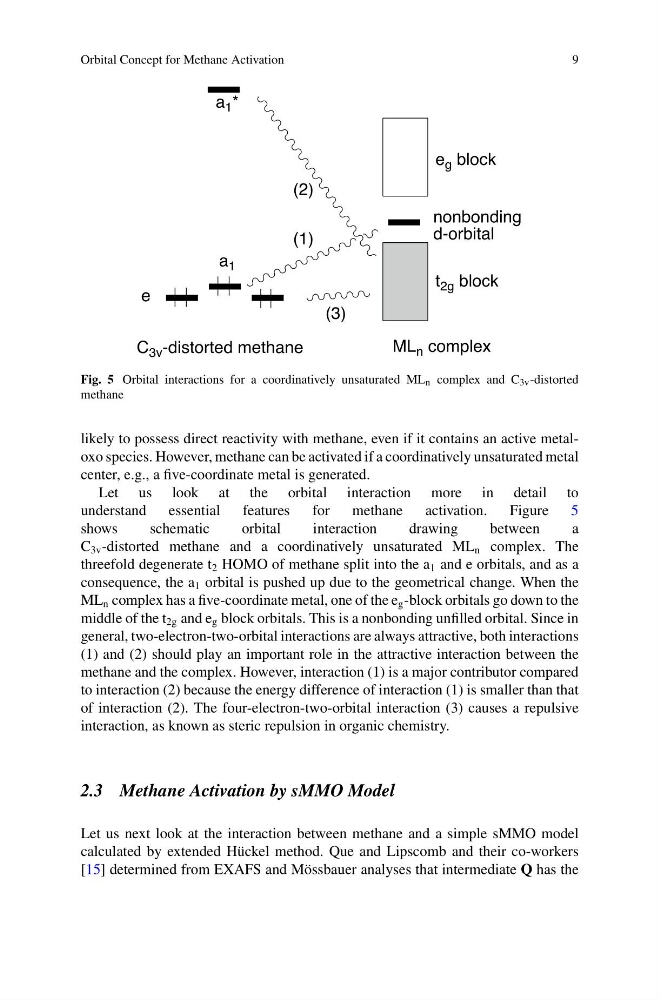
Fig. 5 Orbital interactions for a coordinatively unsaturated ML n complex and C 3v -distorted
methane
likely to possess direct reactivity with methane, even if it contains an active metaloxo species. However, methane can be activated if a coordinatively unsaturated metal
center, e.g., a five-coordinate metal is generated.
Let us look at the orbital interaction more in detail to
understand essential features for methane activation.
Figure 5
shows
schematic
orbital
interaction
drawing
between
a
C 3v -distorted methane and a coordinatively unsaturated ML n complex. The
threefold degenerate t 2 HOMO of methane split into the a 1 and e orbitals, and as a
consequence, the a 1 orbital is pushed up due to the geometrical change. When the
ML n complex has a five-coordinate metal, one of the e g -block orbitals go down to the
middle of the t 2g and e g block orbitals. This is a nonbonding unfilled orbital. Since in
general, two-electron-two-orbital interactions are always attractive, both interactions
(1) and (2) should play an important role in the attractive interaction between the
methane and the complex. However, interaction (1) is a major contributor compared
to interaction (2) because the energy difference of interaction (1) is smaller than that
of interaction (2). The four-electron-two-orbital interaction (3) causes a repulsive
interaction, as known as steric repulsion in organic chemistry.
2.3 Methane Activation by sMMO Model
Let us next look at the interaction between methane and a simple sMMO model
calculated by extended Hückel method. Que and Lipscomb and their co-workers
[15] determined from EXAFS and Mössbauer analyses that intermediate Q has the
9
Fig. 5 Orbital interactions for a coordinatively unsaturated ML n complex and C 3v -distorted
methane
likely to possess direct reactivity with methane, even if it contains an active metaloxo species. However, methane can be activated if a coordinatively unsaturated metal
center, e.g., a five-coordinate metal is generated.
Let us look at the orbital interaction more in detail to
understand essential features for methane activation.
Figure 5
shows
schematic
orbital
interaction
drawing
between
a
C 3v -distorted methane and a coordinatively unsaturated ML n complex. The
threefold degenerate t 2 HOMO of methane split into the a 1 and e orbitals, and as a
consequence, the a 1 orbital is pushed up due to the geometrical change. When the
ML n complex has a five-coordinate metal, one of the e g -block orbitals go down to the
middle of the t 2g and e g block orbitals. This is a nonbonding unfilled orbital. Since in
general, two-electron-two-orbital interactions are always attractive, both interactions
(1) and (2) should play an important role in the attractive interaction between the
methane and the complex. However, interaction (1) is a major contributor compared
to interaction (2) because the energy difference of interaction (1) is smaller than that
of interaction (2). The four-electron-two-orbital interaction (3) causes a repulsive
interaction, as known as steric repulsion in organic chemistry.
2.3 Methane Activation by sMMO Model
Let us next look at the interaction between methane and a simple sMMO model
calculated by extended Hückel method. Que and Lipscomb and their co-workers
[15] determined from EXAFS and Mössbauer analyses that intermediate Q has the