

8
K. Yoshizawa and M. Miyanishi
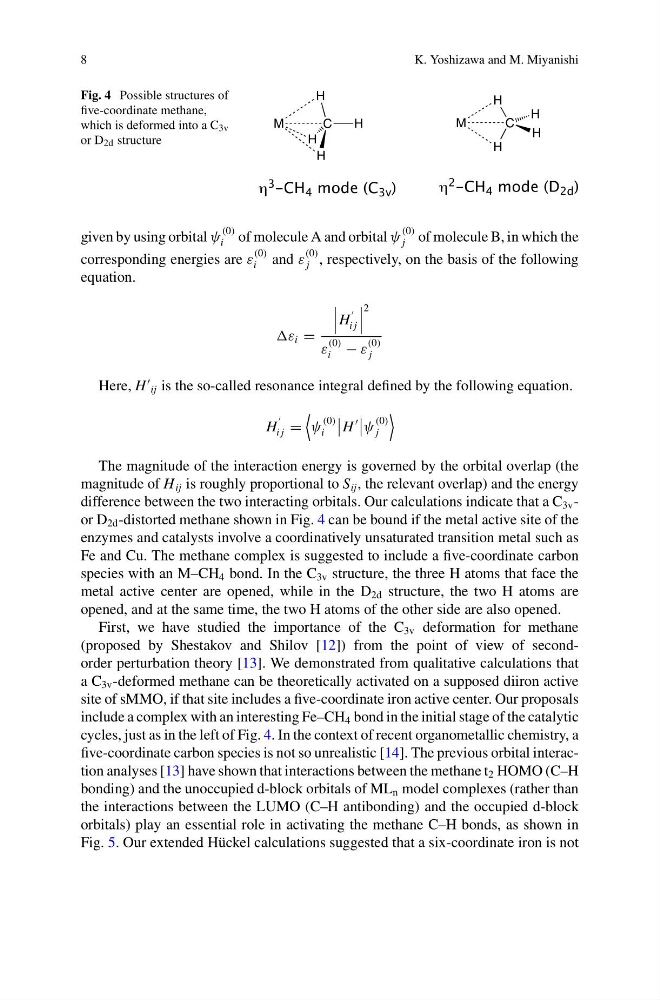
Fig. 4 Possible structures of
five-coordinate methane,
which is deformed into a C 3v
or D 2d structure
given by using orbital ψ
(0)
i of molecule A and orbital ψ
(0)
j of molecule B, in which the
corresponding energies are ε
(0)
i
and ε
(0)
j , respectively, on the basis of the following
equation.
i =
H
i j
2
ε
(0)
i − ε
(0)
j
Here, H
ij is the so-called resonance integral defined by the following equation.
H
i j =
ψ
(0)
i
H
ψ
(0)
j
The magnitude of the interaction energy is governed by the orbital overlap (the
magnitude of H ij is roughly proportional to S ij , the relevant overlap) and the energy
difference between the two interacting orbitals. Our calculations indicate that a C 3v -
or D 2d -distorted methane shown in Fig. 4 can be bound if the metal active site of the
enzymes and catalysts involve a coordinatively unsaturated transition metal such as
Fe and Cu. The methane complex is suggested to include a five-coordinate carbon
species with an M–CH 4 bond. In the C 3v structure, the three H atoms that face the
metal active center are opened, while in the D 2d structure, the two H atoms are
opened, and at the same time, the two H atoms of the other side are also opened.
First, we have studied the importance of the C 3v deformation for methane
(proposed by Shestakov and Shilov [12]) from the point of view of secondorder perturbation theory [13]. We demonstrated from qualitative calculations that
a C 3v -deformed methane can be theoretically activated on a supposed diiron active
site of sMMO, if that site includes a five-coordinate iron active center. Our proposals
include a complex with an interesting Fe–CH 4 bond in the initial stage of the catalytic
cycles, just as in the left of Fig. 4. In the context of recent organometallic chemistry, a
five-coordinate carbon species is not so unrealistic [14]. The previous orbital interaction analyses [13] have shown that interactions between the methane t 2 HOMO (C–H
bonding) and the unoccupied d-block orbitals of ML n model complexes (rather than
the interactions between the LUMO (C–H antibonding) and the occupied d-block
orbitals) play an essential role in activating the methane C–H bonds, as shown in
Fig. 5. Our extended Hückel calculations suggested that a six-coordinate iron is not
K. Yoshizawa and M. Miyanishi
Fig. 4 Possible structures of
five-coordinate methane,
which is deformed into a C 3v
or D 2d structure
given by using orbital ψ
(0)
i of molecule A and orbital ψ
(0)
j of molecule B, in which the
corresponding energies are ε
(0)
i
and ε
(0)
j , respectively, on the basis of the following
equation.
i =
H
i j
2
ε
(0)
i − ε
(0)
j
Here, H
ij is the so-called resonance integral defined by the following equation.
H
i j =
ψ
(0)
i
H
ψ
(0)
j
The magnitude of the interaction energy is governed by the orbital overlap (the
magnitude of H ij is roughly proportional to S ij , the relevant overlap) and the energy
difference between the two interacting orbitals. Our calculations indicate that a C 3v -
or D 2d -distorted methane shown in Fig. 4 can be bound if the metal active site of the
enzymes and catalysts involve a coordinatively unsaturated transition metal such as
Fe and Cu. The methane complex is suggested to include a five-coordinate carbon
species with an M–CH 4 bond. In the C 3v structure, the three H atoms that face the
metal active center are opened, while in the D 2d structure, the two H atoms are
opened, and at the same time, the two H atoms of the other side are also opened.
First, we have studied the importance of the C 3v deformation for methane
(proposed by Shestakov and Shilov [12]) from the point of view of secondorder perturbation theory [13]. We demonstrated from qualitative calculations that
a C 3v -deformed methane can be theoretically activated on a supposed diiron active
site of sMMO, if that site includes a five-coordinate iron active center. Our proposals
include a complex with an interesting Fe–CH 4 bond in the initial stage of the catalytic
cycles, just as in the left of Fig. 4. In the context of recent organometallic chemistry, a
five-coordinate carbon species is not so unrealistic [14]. The previous orbital interaction analyses [13] have shown that interactions between the methane t 2 HOMO (C–H
bonding) and the unoccupied d-block orbitals of ML n model complexes (rather than
the interactions between the LUMO (C–H antibonding) and the occupied d-block
orbitals) play an essential role in activating the methane C–H bonds, as shown in
Fig. 5. Our extended Hückel calculations suggested that a six-coordinate iron is not