

16
K. Yoshizawa and M. Miyanishi
the hydroxylation by cytochrome P450; see Fig. 8 [18]. However, Newcomb, Lippard,
and coworkers [32] demonstrated from radical clock experiments that a measured
lifetime of a putative radical species in the MMOH catalysis is shorter than ~150 fs,
which is not consistent with the formation of a radical species with a sufficiently long
lifetime. A short lifetime for a radical species was also observed in the hydroxylation
of chiral ethane on sMMO [33]. On the other hand, Lipscomb and coworkers [34]
proposed the formation of a radical intermediate in the reaction of methylcubane
with sMMO. Despite accumulated experimental findings, the mechanism of the C–H
activation of methane in the catalytic function of sMMO remains still unclear.
DFT calculations gave useful information on the veiled methane hydroxylation
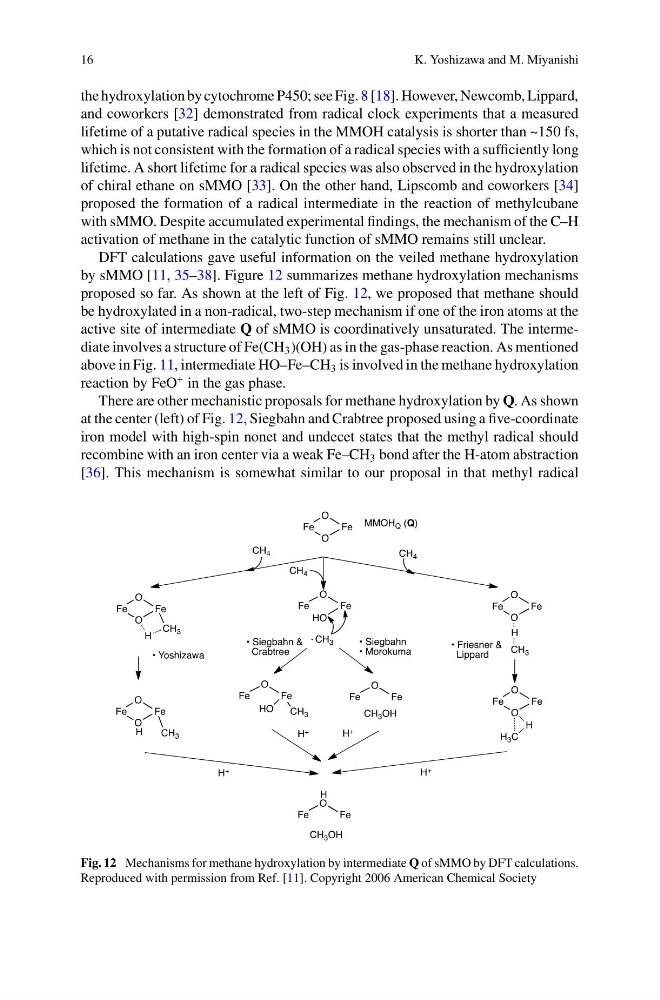
by sMMO [11, 35–38]. Figure 12 summarizes methane hydroxylation mechanisms
proposed so far. As shown at the left of Fig. 12, we proposed that methane should
be hydroxylated in a non-radical, two-step mechanism if one of the iron atoms at the
active site of intermediate Q of sMMO is coordinatively unsaturated. The intermediate involves a structure of Fe(CH 3 )(OH) as in the gas-phase reaction. As mentioned
above in Fig. 11, intermediate HO–Fe–CH 3 is involved in the methane hydroxylation
reaction by FeO
+ in the gas phase.
There are other mechanistic proposals for methane hydroxylation by Q. As shown
at the center (left) of Fig. 12, Siegbahn and Crabtree proposed using a five-coordinate
iron model with high-spin nonet and undecet states that the methyl radical should
recombine with an iron center via a weak Fe–CH 3 bond after the H-atom abstraction
[36]. This mechanism is somewhat similar to our proposal in that methyl radical
Fig. 12 Mechanisms for methane hydroxylation by intermediate Q of sMMO by DFT calculations.
Reproduced with permission from Ref. [11]. Copyright 2006 American Chemical Society
K. Yoshizawa and M. Miyanishi
the hydroxylation by cytochrome P450; see Fig. 8 [18]. However, Newcomb, Lippard,
and coworkers [32] demonstrated from radical clock experiments that a measured
lifetime of a putative radical species in the MMOH catalysis is shorter than ~150 fs,
which is not consistent with the formation of a radical species with a sufficiently long
lifetime. A short lifetime for a radical species was also observed in the hydroxylation
of chiral ethane on sMMO [33]. On the other hand, Lipscomb and coworkers [34]
proposed the formation of a radical intermediate in the reaction of methylcubane
with sMMO. Despite accumulated experimental findings, the mechanism of the C–H
activation of methane in the catalytic function of sMMO remains still unclear.
DFT calculations gave useful information on the veiled methane hydroxylation
by sMMO [11, 35–38]. Figure 12 summarizes methane hydroxylation mechanisms
proposed so far. As shown at the left of Fig. 12, we proposed that methane should
be hydroxylated in a non-radical, two-step mechanism if one of the iron atoms at the
active site of intermediate Q of sMMO is coordinatively unsaturated. The intermediate involves a structure of Fe(CH 3 )(OH) as in the gas-phase reaction. As mentioned
above in Fig. 11, intermediate HO–Fe–CH 3 is involved in the methane hydroxylation
reaction by FeO
+ in the gas phase.
There are other mechanistic proposals for methane hydroxylation by Q. As shown
at the center (left) of Fig. 12, Siegbahn and Crabtree proposed using a five-coordinate
iron model with high-spin nonet and undecet states that the methyl radical should
recombine with an iron center via a weak Fe–CH 3 bond after the H-atom abstraction
[36]. This mechanism is somewhat similar to our proposal in that methyl radical
Fig. 12 Mechanisms for methane hydroxylation by intermediate Q of sMMO by DFT calculations.
Reproduced with permission from Ref. [11]. Copyright 2006 American Chemical Society