

160
Y. Hori and T. Abe
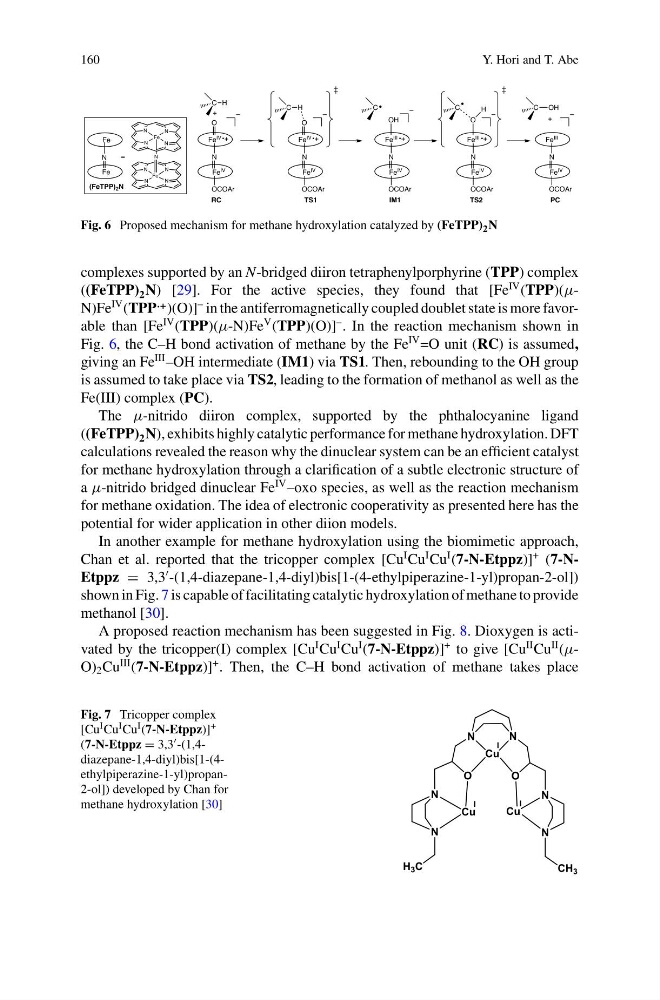
Fig. 6 Proposed mechanism for methane hydroxylation catalyzed by (FeTPP) 2 N
complexes supported by an N-bridged diiron tetraphenylporphyrine (TPP) complex
((FeTPP) 2 N) [29]. For the active species, they found that [Fe
IV (TPP)(μN)Fe
IV (TPP ·+ )(O)]
– in the antiferromagnetically coupled doublet state is more favorable than [Fe
IV (TPP)(μ-N)Fe
V (TPP)(O)]
– . In the reaction mechanism shown in
Fig. 6, the C–H bond activation of methane by the Fe
IV =O unit (RC) is assumed,
giving an Fe
III –OH intermediate (IM1) via TS1. Then, rebounding to the OH group
is assumed to take place via TS2, leading to the formation of methanol as well as the
Fe(III) complex (PC).
The μ-nitrido diiron complex, supported by the phthalocyanine ligand
((FeTPP) 2 N), exhibits highly catalytic performance for methane hydroxylation. DFT
calculations revealed the reason why the dinuclear system can be an efficient catalyst
for methane hydroxylation through a clarification of a subtle electronic structure of
a μ-nitrido bridged dinuclear Fe
IV –oxo species, as well as the reaction mechanism
for methane oxidation. The idea of electronic cooperativity as presented here has the
potential for wider application in other diion models.
In another example for methane hydroxylation using the biomimetic approach,
Chan et al. reported that the tricopper complex [Cu
I Cu
I Cu
I (7-N-Etppz)]
+ (7-NEtppz = 3,3
-(1,4-diazepane-1,4-diyl)bis[1-(4-ethylpiperazine-1-yl)propan-2-ol])
shown in Fig. 7 is capable of facilitating catalytic hydroxylation of methane to provide
methanol [30].
A proposed reaction mechanism has been suggested in Fig. 8. Dioxygen is activated by the tricopper(I) complex [Cu
I Cu
I Cu
I (7-N-Etppz)]
+ to give [Cu
II Cu
II (μO) 2 Cu
III (7-N-Etppz)]
+ . Then, the C–H bond activation of methane takes place
Fig. 7 Tricopper complex
[Cu I Cu I Cu I (7-N-Etppz)] +
ethylpiperazine-1-yl)propan2-ol]) developed by Chan for
methane hydroxylation [30]
N
N
O
O
N
N
N
N
H 3 C
CH 3
Cu
I
Cu
I
Cu
I
Y. Hori and T. Abe
Fig. 6 Proposed mechanism for methane hydroxylation catalyzed by (FeTPP) 2 N
complexes supported by an N-bridged diiron tetraphenylporphyrine (TPP) complex
((FeTPP) 2 N) [29]. For the active species, they found that [Fe
IV (TPP)(μN)Fe
IV (TPP ·+ )(O)]
– in the antiferromagnetically coupled doublet state is more favorable than [Fe
IV (TPP)(μ-N)Fe
V (TPP)(O)]
– . In the reaction mechanism shown in
Fig. 6, the C–H bond activation of methane by the Fe
IV =O unit (RC) is assumed,
giving an Fe
III –OH intermediate (IM1) via TS1. Then, rebounding to the OH group
is assumed to take place via TS2, leading to the formation of methanol as well as the
Fe(III) complex (PC).
The μ-nitrido diiron complex, supported by the phthalocyanine ligand
((FeTPP) 2 N), exhibits highly catalytic performance for methane hydroxylation. DFT
calculations revealed the reason why the dinuclear system can be an efficient catalyst
for methane hydroxylation through a clarification of a subtle electronic structure of
a μ-nitrido bridged dinuclear Fe
IV –oxo species, as well as the reaction mechanism
for methane oxidation. The idea of electronic cooperativity as presented here has the
potential for wider application in other diion models.
In another example for methane hydroxylation using the biomimetic approach,
Chan et al. reported that the tricopper complex [Cu
I Cu
I Cu
I (7-N-Etppz)]
+ (7-NEtppz = 3,3
-(1,4-diazepane-1,4-diyl)bis[1-(4-ethylpiperazine-1-yl)propan-2-ol])
shown in Fig. 7 is capable of facilitating catalytic hydroxylation of methane to provide
methanol [30].
A proposed reaction mechanism has been suggested in Fig. 8. Dioxygen is activated by the tricopper(I) complex [Cu
I Cu
I Cu
I (7-N-Etppz)]
+ to give [Cu
II Cu
II (μO) 2 Cu
III (7-N-Etppz)]
+ . Then, the C–H bond activation of methane takes place
Fig. 7 Tricopper complex
[Cu I Cu I Cu I (7-N-Etppz)] +
ethylpiperazine-1-yl)propan2-ol]) developed by Chan for
methane hydroxylation [30]
N
N
O
O
N
N
N
N
H 3 C
CH 3
Cu
I
Cu
I
Cu
I