

Theoretical Approach to Homogeneous Catalyst of Methane …
159
Table 1 Oxidation of methane by H 2 O 2 in water catalyzed by (FePc t Bu 4 ) 2 N a
Run T (°C) [HCOOH] (mM) TON HCOOH [HCHO] (mM) TON HCHO Total TON b
1
25
6.0
13.0
0
0
39.0
2
40
8.6
18.6
4.8
10.4
76.6
3
50
9.2
21.0
4.7
10.7
84.4
4
60
10.5
22.8
1.5
3.2
74.8
5
70
11.7
25.2
0.8
1.7
79.0
6
80
12.8
27.3
0.5
1.1
84.1
7 c
60
69.0 (34.1)
134.6 (72.8) 7.6
16.5
436.8
a Conditions: 32 bar CH 4 ; 2 mL H 2 O; catalyst, 0.925 mmol (0.875 mmol for run 3); 678 mmol
H 2 O 2 ; reaction time 20 h (48 h for run 1)
b Total TON was calculated 3 × HCOOH/catalyst + 2 × CH 2 (OH) 2 /catalyst
c In 0.1 M H 2 SO 4 , 678 mmol H 2 O 2 were added at reaction times 0 and 16 h. Values in parentheses
were measured before the second addition of H 2 O 2
catalyst were oxidized to useful products. This activity is far higher than that of most
published systems, operating via methane activation [9, 15, 25–28].
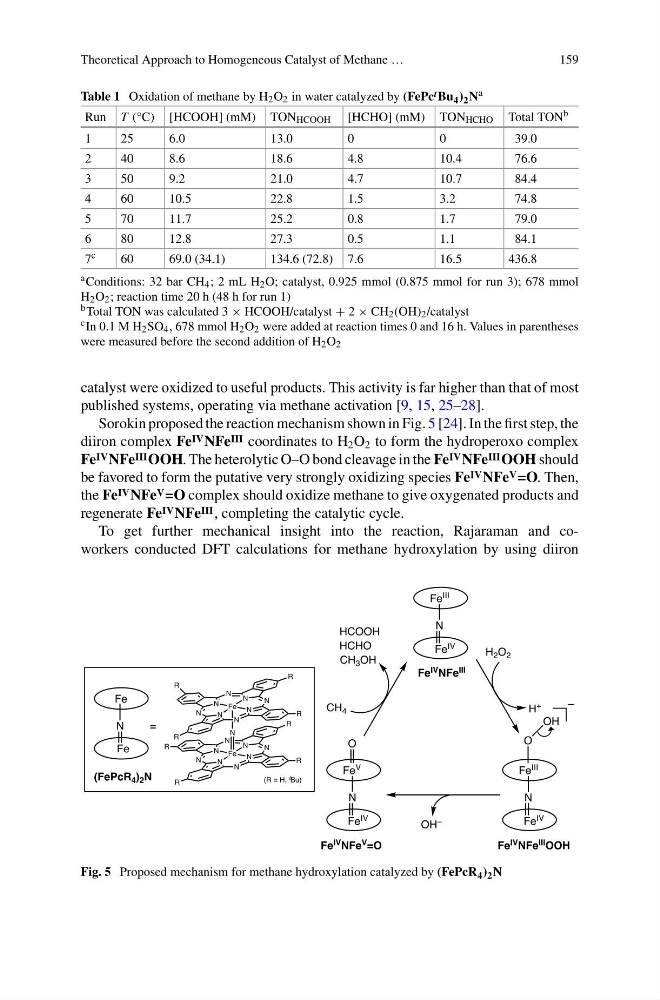
Sorokin proposed the reaction mechanism shown in Fig. 5 [24]. In the first step, the
diiron complex Fe IV NFe III coordinates to H 2 O 2 to form the hydroperoxo complex
Fe IV NFe III OOH. The heterolytic O–O bond cleavage in the Fe IV NFe III OOH should
be favored to form the putative very strongly oxidizing species Fe IV NFe V =O. Then,
the Fe IV NFe V =O complex should oxidize methane to give oxygenated products and
regenerate Fe IV NFe III , completing the catalytic cycle.
To get further mechanical insight into the reaction, Rajaraman and coworkers conducted DFT calculations for methane hydroxylation by using diiron
Fig. 5 Proposed mechanism for methane hydroxylation catalyzed by (FePcR 4 ) 2 N
159
Table 1 Oxidation of methane by H 2 O 2 in water catalyzed by (FePc t Bu 4 ) 2 N a
Run T (°C) [HCOOH] (mM) TON HCOOH [HCHO] (mM) TON HCHO Total TON b
1
25
6.0
13.0
0
0
39.0
2
40
8.6
18.6
4.8
10.4
76.6
3
50
9.2
21.0
4.7
10.7
84.4
4
60
10.5
22.8
1.5
3.2
74.8
5
70
11.7
25.2
0.8
1.7
79.0
6
80
12.8
27.3
0.5
1.1
84.1
7 c
60
69.0 (34.1)
134.6 (72.8) 7.6
16.5
436.8
a Conditions: 32 bar CH 4 ; 2 mL H 2 O; catalyst, 0.925 mmol (0.875 mmol for run 3); 678 mmol
H 2 O 2 ; reaction time 20 h (48 h for run 1)
b Total TON was calculated 3 × HCOOH/catalyst + 2 × CH 2 (OH) 2 /catalyst
c In 0.1 M H 2 SO 4 , 678 mmol H 2 O 2 were added at reaction times 0 and 16 h. Values in parentheses
were measured before the second addition of H 2 O 2
catalyst were oxidized to useful products. This activity is far higher than that of most
published systems, operating via methane activation [9, 15, 25–28].
Sorokin proposed the reaction mechanism shown in Fig. 5 [24]. In the first step, the
diiron complex Fe IV NFe III coordinates to H 2 O 2 to form the hydroperoxo complex
Fe IV NFe III OOH. The heterolytic O–O bond cleavage in the Fe IV NFe III OOH should
be favored to form the putative very strongly oxidizing species Fe IV NFe V =O. Then,
the Fe IV NFe V =O complex should oxidize methane to give oxygenated products and
regenerate Fe IV NFe III , completing the catalytic cycle.
To get further mechanical insight into the reaction, Rajaraman and coworkers conducted DFT calculations for methane hydroxylation by using diiron
Fig. 5 Proposed mechanism for methane hydroxylation catalyzed by (FePcR 4 ) 2 N