

158
Y. Hori and T. Abe
4 Biomimetic Approaches
An important aspect of catalyst design for methane hydroxylation is the inspiration from biology. Bio-inspired catalysts exploit basic principles and motifs present
in naturally occurring biological systems. Methane monooxygenase (MMO), an
enzyme found in methanotrophic bacteria, naturally catalyzes the selective oxidation
of methane to methanol in water at ambient or physiological conditions by using
O 2 as an oxidant [19, 20]. This enzyme has two different forms: (i) cytoplasmicsoluble MMO (sMMO) and (ii) membrane-bound particulate MMO (pMMO) [21–
23]. Consequently, it is a rational initiative for the catalyst design of methane
hydroxylation to focus on the MMO active site.
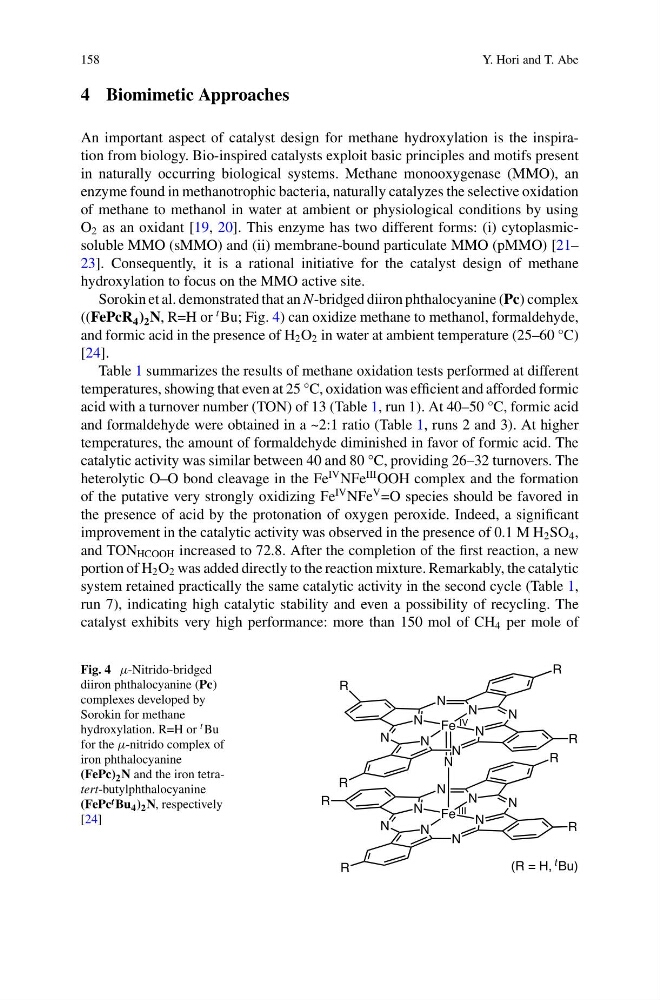
Sorokin et al. demonstrated that an N-bridged diiron phthalocyanine (Pc) complex
((FePcR 4 ) 2 N, R=H or
t Bu; Fig. 4) can oxidize methane to methanol, formaldehyde,
and formic acid in the presence of H 2 O 2 in water at ambient temperature (25–60 °C)
[24].
Table 1 summarizes the results of methane oxidation tests performed at different
temperatures, showing that even at 25 °C, oxidation was efficient and afforded formic
acid with a turnover number (TON) of 13 (Table 1, run 1). At 40–50 °C, formic acid
and formaldehyde were obtained in a ~2:1 ratio (Table 1, runs 2 and 3). At higher
temperatures, the amount of formaldehyde diminished in favor of formic acid. The
catalytic activity was similar between 40 and 80 °C, providing 26–32 turnovers. The
heterolytic O–O bond cleavage in the Fe
IV NFe
III OOH complex and the formation
of the putative very strongly oxidizing Fe
IV NFe
V =O species should be favored in
the presence of acid by the protonation of oxygen peroxide. Indeed, a significant
improvement in the catalytic activity was observed in the presence of 0.1 M H 2 SO 4 ,
and TON HCOOH increased to 72.8. After the completion of the first reaction, a new
portion of H 2 O 2 was added directly to the reaction mixture. Remarkably, the catalytic
system retained practically the same catalytic activity in the second cycle (Table 1,
run 7), indicating high catalytic stability and even a possibility of recycling. The
catalyst exhibits very high performance: more than 150 mol of CH 4 per mole of
Fig. 4 μ-Nitrido-bridged
diiron phthalocyanine (Pc)
complexes developed by
Sorokin for methane
hydroxylation. R=H or t Bu
for the μ-nitrido complex of
iron phthalocyanine
(FePc) 2 N and the iron tetratert-butylphthalocyanine
(FePc t Bu 4 ) 2 N, respectively
[24]
Y. Hori and T. Abe
4 Biomimetic Approaches
An important aspect of catalyst design for methane hydroxylation is the inspiration from biology. Bio-inspired catalysts exploit basic principles and motifs present
in naturally occurring biological systems. Methane monooxygenase (MMO), an
enzyme found in methanotrophic bacteria, naturally catalyzes the selective oxidation
of methane to methanol in water at ambient or physiological conditions by using
O 2 as an oxidant [19, 20]. This enzyme has two different forms: (i) cytoplasmicsoluble MMO (sMMO) and (ii) membrane-bound particulate MMO (pMMO) [21–
23]. Consequently, it is a rational initiative for the catalyst design of methane
hydroxylation to focus on the MMO active site.
Sorokin et al. demonstrated that an N-bridged diiron phthalocyanine (Pc) complex
((FePcR 4 ) 2 N, R=H or
t Bu; Fig. 4) can oxidize methane to methanol, formaldehyde,
and formic acid in the presence of H 2 O 2 in water at ambient temperature (25–60 °C)
[24].
Table 1 summarizes the results of methane oxidation tests performed at different
temperatures, showing that even at 25 °C, oxidation was efficient and afforded formic
acid with a turnover number (TON) of 13 (Table 1, run 1). At 40–50 °C, formic acid
and formaldehyde were obtained in a ~2:1 ratio (Table 1, runs 2 and 3). At higher
temperatures, the amount of formaldehyde diminished in favor of formic acid. The
catalytic activity was similar between 40 and 80 °C, providing 26–32 turnovers. The
heterolytic O–O bond cleavage in the Fe
IV NFe
III OOH complex and the formation
of the putative very strongly oxidizing Fe
IV NFe
V =O species should be favored in
the presence of acid by the protonation of oxygen peroxide. Indeed, a significant
improvement in the catalytic activity was observed in the presence of 0.1 M H 2 SO 4 ,
and TON HCOOH increased to 72.8. After the completion of the first reaction, a new
portion of H 2 O 2 was added directly to the reaction mixture. Remarkably, the catalytic
system retained practically the same catalytic activity in the second cycle (Table 1,
run 7), indicating high catalytic stability and even a possibility of recycling. The
catalyst exhibits very high performance: more than 150 mol of CH 4 per mole of
Fig. 4 μ-Nitrido-bridged
diiron phthalocyanine (Pc)
complexes developed by
Sorokin for methane
hydroxylation. R=H or t Bu
for the μ-nitrido complex of
iron phthalocyanine
(FePc) 2 N and the iron tetratert-butylphthalocyanine
(FePc t Bu 4 ) 2 N, respectively
[24]