

Theoretical Approach to Homogeneous Catalyst of Methane …
157
Pt
N
N
Cl
N
N
CH4
Pt
N
N
Cl
N
N
CH3
H
Pt
N
N
Cl
N
N
CH3
H
0.0
-14.5
-4.5
-9.5
Pt
N
N
Cl
N
N
CH3
H
Pt
N
N
O
N
N
CH4
0.0
-20.6
-11.7
-17.3
O
S
O
OH
Pt
N
N
O
N
N
O
S
O
OH
-31.4
11.6
Pt
N
N
O
N
N
O
S O
OH
H
CH3
Pt
N
N
O
N
N
O
S O
OH
H
H3C
Pt
N
N
O
N
N
O
S O
OH
H
CH3
Pt
N
N
N
N
CH3
H2CO4
(a)
(b)
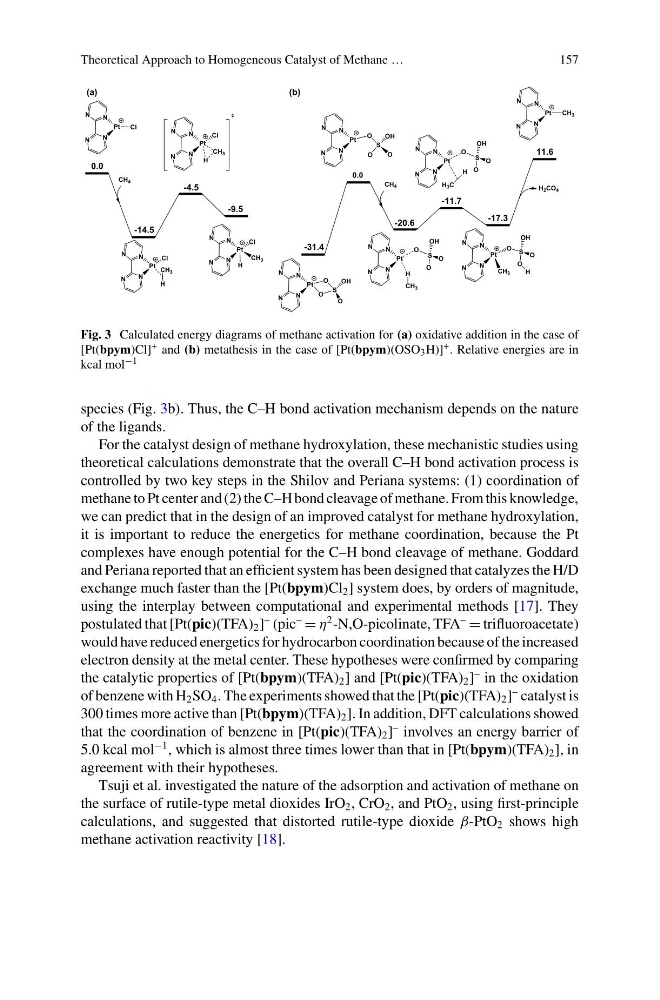
Fig. 3 Calculated energy diagrams of methane activation for (a) oxidative addition in the case of
[Pt(bpym)Cl] + and (b) metathesis in the case of [Pt(bpym)(OSO 3 H)] + . Relative energies are in
kcal mol −1
species (Fig. 3b). Thus, the C–H bond activation mechanism depends on the nature
of the ligands.
For the catalyst design of methane hydroxylation, these mechanistic studies using
theoretical calculations demonstrate that the overall C–H bond activation process is
controlled by two key steps in the Shilov and Periana systems: (1) coordination of
methane to Pt center and (2) the C–H bond cleavage of methane. From this knowledge,
we can predict that in the design of an improved catalyst for methane hydroxylation,
it is important to reduce the energetics for methane coordination, because the Pt
complexes have enough potential for the C–H bond cleavage of methane. Goddard
and Periana reported that an efficient system has been designed that catalyzes the H/D
exchange much faster than the [Pt(bpym)Cl 2 ] system does, by orders of magnitude,
using the interplay between computational and experimental methods [17]. They
postulated that [Pt(pic)(TFA) 2 ]
– (pic
–
= η
2 -N,O-picolinate, TFA
–
= trifluoroacetate)
would have reduced energetics for hydrocarbon coordination because of the increased
electron density at the metal center. These hypotheses were confirmed by comparing
the catalytic properties of [Pt(bpym)(TFA) 2 ] and [Pt(pic)(TFA) 2 ]
– in the oxidation
of benzene with H 2 SO 4 . The experiments showed that the [Pt(pic)(TFA) 2 ]
– catalyst is
300 times more active than [Pt(bpym)(TFA) 2 ]. In addition, DFT calculations showed
that the coordination of benzene in [Pt(pic)(TFA) 2 ]
– involves an energy barrier of
5.0 kcal mol
−1 , which is almost three times lower than that in [Pt(bpym)(TFA) 2 ], in
agreement with their hypotheses.
Tsuji et al. investigated the nature of the adsorption and activation of methane on
the surface of rutile-type metal dioxides IrO 2 , CrO 2 , and PtO 2 , using first-principle
calculations, and suggested that distorted rutile-type dioxide β-PtO 2 shows high
methane activation reactivity [18].
157
Pt
N
N
Cl
N
N
CH4
Pt
N
N
Cl
N
N
CH3
H
Pt
N
N
Cl
N
N
CH3
H
0.0
-14.5
-4.5
-9.5
Pt
N
N
Cl
N
N
CH3
H
Pt
N
N
O
N
N
CH4
0.0
-20.6
-11.7
-17.3
O
S
O
OH
Pt
N
N
O
N
N
O
S
O
OH
-31.4
11.6
Pt
N
N
O
N
N
O
S O
OH
H
CH3
Pt
N
N
O
N
N
O
S O
OH
H
H3C
Pt
N
N
O
N
N
O
S O
OH
H
CH3
Pt
N
N
N
N
CH3
H2CO4
(a)
(b)
Fig. 3 Calculated energy diagrams of methane activation for (a) oxidative addition in the case of
[Pt(bpym)Cl] + and (b) metathesis in the case of [Pt(bpym)(OSO 3 H)] + . Relative energies are in
kcal mol −1
species (Fig. 3b). Thus, the C–H bond activation mechanism depends on the nature
of the ligands.
For the catalyst design of methane hydroxylation, these mechanistic studies using
theoretical calculations demonstrate that the overall C–H bond activation process is
controlled by two key steps in the Shilov and Periana systems: (1) coordination of
methane to Pt center and (2) the C–H bond cleavage of methane. From this knowledge,
we can predict that in the design of an improved catalyst for methane hydroxylation,
it is important to reduce the energetics for methane coordination, because the Pt
complexes have enough potential for the C–H bond cleavage of methane. Goddard
and Periana reported that an efficient system has been designed that catalyzes the H/D
exchange much faster than the [Pt(bpym)Cl 2 ] system does, by orders of magnitude,
using the interplay between computational and experimental methods [17]. They
postulated that [Pt(pic)(TFA) 2 ]
– (pic
–
= η
2 -N,O-picolinate, TFA
–
= trifluoroacetate)
would have reduced energetics for hydrocarbon coordination because of the increased
electron density at the metal center. These hypotheses were confirmed by comparing
the catalytic properties of [Pt(bpym)(TFA) 2 ] and [Pt(pic)(TFA) 2 ]
– in the oxidation
of benzene with H 2 SO 4 . The experiments showed that the [Pt(pic)(TFA) 2 ]
– catalyst is
300 times more active than [Pt(bpym)(TFA) 2 ]. In addition, DFT calculations showed
that the coordination of benzene in [Pt(pic)(TFA) 2 ]
– involves an energy barrier of
5.0 kcal mol
−1 , which is almost three times lower than that in [Pt(bpym)(TFA) 2 ], in
agreement with their hypotheses.
Tsuji et al. investigated the nature of the adsorption and activation of methane on
the surface of rutile-type metal dioxides IrO 2 , CrO 2 , and PtO 2 , using first-principle
calculations, and suggested that distorted rutile-type dioxide β-PtO 2 shows high
methane activation reactivity [18].