

156
Y. Hori and T. Abe
like σ-bond metathesis with an energy barrier of 16.5 kcal mol
−1 , in which the transformation of an H atom in CH 4 to a Cl ligand affords HCl and a Pt–CH 3 bond. The
overall activation energy including the initial substitution step is about 27 kcal mol
−1 ,
in agreement with the experimental value of 28 kcal mol
−1 [14, 15]. In the final step,
intramolecular proton transfer to one of the H 2 O molecules, which involves a swing
of the HCl hydrogen, yields the [PtCl 2 (CH 3 )(H 5 O 2 )] complex with a very small
energy barrier, stabilizing the system with 12.6 kcal mol
−1 .
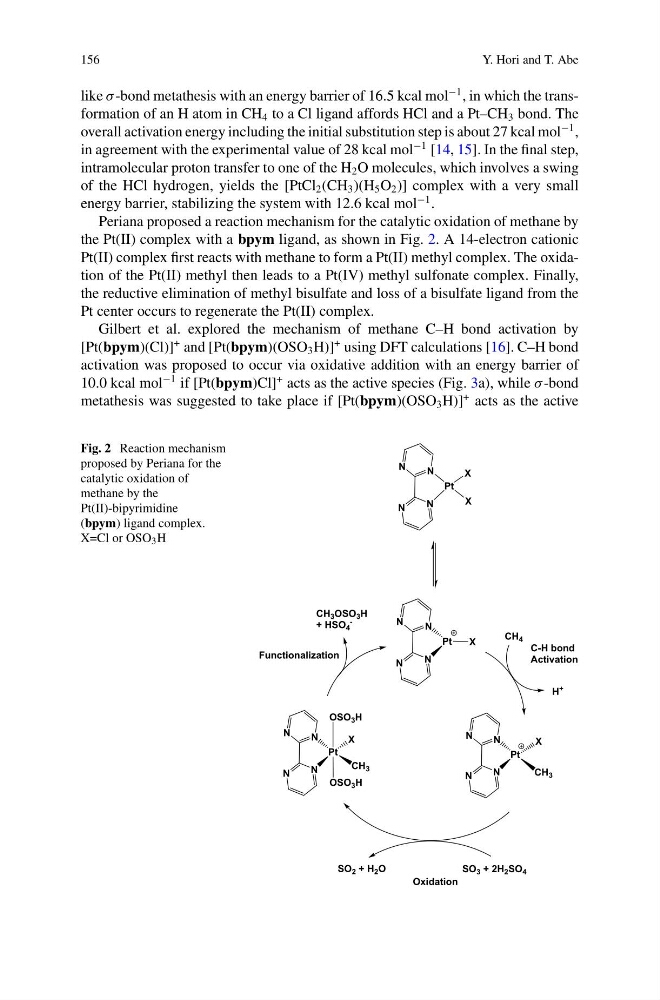
Periana proposed a reaction mechanism for the catalytic oxidation of methane by
the Pt(II) complex with a bpym ligand, as shown in Fig. 2. A 14-electron cationic
Pt(II) complex first reacts with methane to form a Pt(II) methyl complex. The oxidation of the Pt(II) methyl then leads to a Pt(IV) methyl sulfonate complex. Finally,
the reductive elimination of methyl bisulfate and loss of a bisulfate ligand from the
Pt center occurs to regenerate the Pt(II) complex.
Gilbert et al. explored the mechanism of methane C–H bond activation by
[Pt(bpym)(Cl)]
+ and [Pt(bpym)(OSO 3 H)]
+ using DFT calculations [16]. C–H bond
activation was proposed to occur via oxidative addition with an energy barrier of
10.0 kcal mol
−1 if [Pt(bpym)Cl]
+ acts as the active species (Fig. 3a), while σ-bond
metathesis was suggested to take place if [Pt(bpym)(OSO 3 H)]
+ acts as the active
Fig. 2 Reaction mechanism
proposed by Periana for the
catalytic oxidation of
methane by the
Pt(II)-bipyrimidine
(bpym) ligand complex.
X=Cl or OSO 3 H
Pt
N
N
X
X
N
N
Pt
N
N
N
N
CH 3
Pt
N
N
X
N
N
CH 3 OSO 3 H
+ HSO 4
-
CH 4
H
+
C-H bond
Activation
SO 3 + 2H 2 SO 4
Functionalization
Pt
N
N
X
N
N
CH 3
OSO 3 H
OSO 3 H
SO 2 + H 2 O
Oxidation
X
Y. Hori and T. Abe
like σ-bond metathesis with an energy barrier of 16.5 kcal mol
−1 , in which the transformation of an H atom in CH 4 to a Cl ligand affords HCl and a Pt–CH 3 bond. The
overall activation energy including the initial substitution step is about 27 kcal mol
−1 ,
in agreement with the experimental value of 28 kcal mol
−1 [14, 15]. In the final step,
intramolecular proton transfer to one of the H 2 O molecules, which involves a swing
of the HCl hydrogen, yields the [PtCl 2 (CH 3 )(H 5 O 2 )] complex with a very small
energy barrier, stabilizing the system with 12.6 kcal mol
−1 .
Periana proposed a reaction mechanism for the catalytic oxidation of methane by
the Pt(II) complex with a bpym ligand, as shown in Fig. 2. A 14-electron cationic
Pt(II) complex first reacts with methane to form a Pt(II) methyl complex. The oxidation of the Pt(II) methyl then leads to a Pt(IV) methyl sulfonate complex. Finally,
the reductive elimination of methyl bisulfate and loss of a bisulfate ligand from the
Pt center occurs to regenerate the Pt(II) complex.
Gilbert et al. explored the mechanism of methane C–H bond activation by
[Pt(bpym)(Cl)]
+ and [Pt(bpym)(OSO 3 H)]
+ using DFT calculations [16]. C–H bond
activation was proposed to occur via oxidative addition with an energy barrier of
10.0 kcal mol
−1 if [Pt(bpym)Cl]
+ acts as the active species (Fig. 3a), while σ-bond
metathesis was suggested to take place if [Pt(bpym)(OSO 3 H)]
+ acts as the active
Fig. 2 Reaction mechanism
proposed by Periana for the
catalytic oxidation of
methane by the
Pt(II)-bipyrimidine
(bpym) ligand complex.
X=Cl or OSO 3 H
Pt
N
N
X
X
N
N
Pt
N
N
N
N
CH 3
Pt
N
N
X
N
N
CH 3 OSO 3 H
+ HSO 4
-
CH 4
H
+
C-H bond
Activation
SO 3 + 2H 2 SO 4
Functionalization
Pt
N
N
X
N
N
CH 3
OSO 3 H
OSO 3 H
SO 2 + H 2 O
Oxidation
X