

Theoretical Approach to Homogeneous Catalyst of Methane …
155
from sulfuric acid used as a solvent system, need for expensive corrosion-resistant
materials due to the corrosive nature, and periodic regeneration of the acid [11].
Mechanistic studies have been conducted on both Shilov oxidations and related
oxidations reported by Periana to develop an optimal methane hydroxylation catalyst
[12]. These oxidations typically start with the C–H bond activation of methane,
which results in the formation of a Pt(II) methyl complex from a Pt(II) halide or
hydroxide complex. The Pt(II) methyl complex is then oxidized to a Pt(IV) methyl
complex by transfer of the halide from the Pt(IV) to the Pt(II) complex. Finally, a
carbon–halogen bond-forming step by attack of water, hydroxide, sulfonate, or halide
on the resulting Pt(IV) methyl complex generates the methanol or methyl halide
product and regenerates the starting Pt(II) complex. The most extensive studies on
the detailed mechanism of this process focused on how the C–H bond activation of
methane occurs. Several theoretical studies have been performed for the mechanism
of the Shilov and Periana reactions, as summarized in the review of Eisenstein and
co-workers [13].
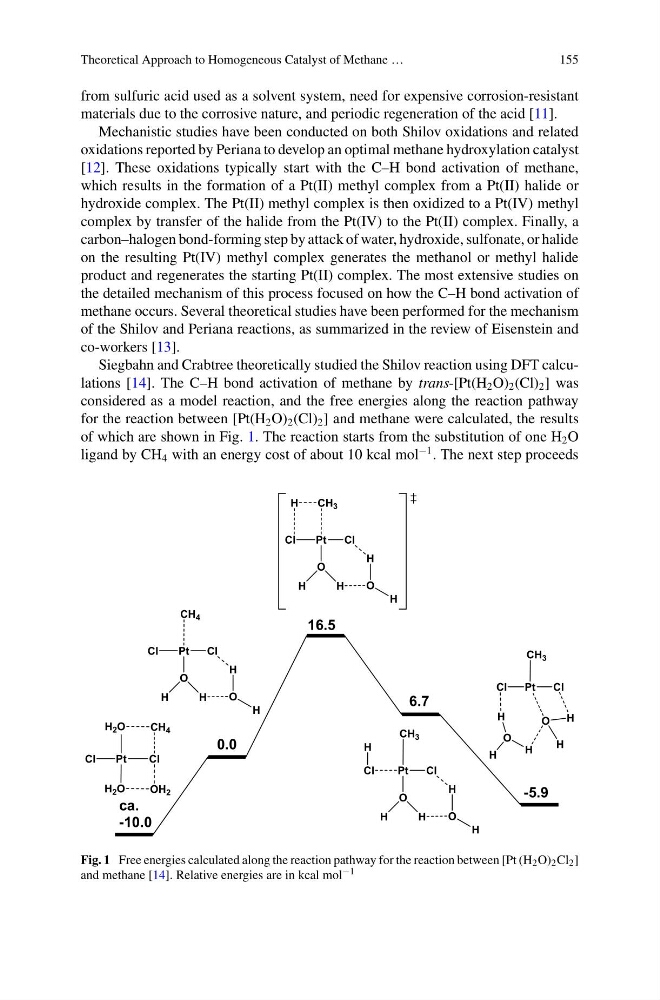
Siegbahn and Crabtree theoretically studied the Shilov reaction using DFT calculations [14]. The C–H bond activation of methane by trans-[Pt(H 2 O) 2 (Cl) 2 ] was
considered as a model reaction, and the free energies along the reaction pathway
for the reaction between [Pt(H 2 O) 2 (Cl) 2 ] and methane were calculated, the results
of which are shown in Fig. 1. The reaction starts from the substitution of one H 2 O
ligand by CH 4 with an energy cost of about 10 kcal mol
−1 . The next step proceeds
0.0
16.5
6.7
-5.9
Pt
O
Cl
Cl
H
H
CH 4
O
H
H
Pt
O
Cl
Cl
H
H
CH 3
O
H
H
H
Pt
O
Cl
Cl
H
H
CH 3
O
H
H
H
Pt
O
Cl
Cl
H
H
CH 3
O
H
H
H
ca.
-10.0
Pt
H 2 O
H 2 O
Cl
Cl
CH 4
OH 2
Fig. 1 Free energies calculated along the reaction pathway for the reaction between [Pt (H 2 O) 2 Cl 2 ]
and methane [14]. Relative energies are in kcal mol −1
155
from sulfuric acid used as a solvent system, need for expensive corrosion-resistant
materials due to the corrosive nature, and periodic regeneration of the acid [11].
Mechanistic studies have been conducted on both Shilov oxidations and related
oxidations reported by Periana to develop an optimal methane hydroxylation catalyst
[12]. These oxidations typically start with the C–H bond activation of methane,
which results in the formation of a Pt(II) methyl complex from a Pt(II) halide or
hydroxide complex. The Pt(II) methyl complex is then oxidized to a Pt(IV) methyl
complex by transfer of the halide from the Pt(IV) to the Pt(II) complex. Finally, a
carbon–halogen bond-forming step by attack of water, hydroxide, sulfonate, or halide
on the resulting Pt(IV) methyl complex generates the methanol or methyl halide
product and regenerates the starting Pt(II) complex. The most extensive studies on
the detailed mechanism of this process focused on how the C–H bond activation of
methane occurs. Several theoretical studies have been performed for the mechanism
of the Shilov and Periana reactions, as summarized in the review of Eisenstein and
co-workers [13].
Siegbahn and Crabtree theoretically studied the Shilov reaction using DFT calculations [14]. The C–H bond activation of methane by trans-[Pt(H 2 O) 2 (Cl) 2 ] was
considered as a model reaction, and the free energies along the reaction pathway
for the reaction between [Pt(H 2 O) 2 (Cl) 2 ] and methane were calculated, the results
of which are shown in Fig. 1. The reaction starts from the substitution of one H 2 O
ligand by CH 4 with an energy cost of about 10 kcal mol
−1 . The next step proceeds
0.0
16.5
6.7
-5.9
Pt
O
Cl
Cl
H
H
CH 4
O
H
H
Pt
O
Cl
Cl
H
H
CH 3
O
H
H
H
Pt
O
Cl
Cl
H
H
CH 3
O
H
H
H
Pt
O
Cl
Cl
H
H
CH 3
O
H
H
H
ca.
-10.0
Pt
H 2 O
H 2 O
Cl
Cl
CH 4
OH 2
Fig. 1 Free energies calculated along the reaction pathway for the reaction between [Pt (H 2 O) 2 Cl 2 ]
and methane [14]. Relative energies are in kcal mol −1