

Theoretical Approach to Homogeneous Catalyst of Methane …
161
Fig. 8 Proposed reaction
mechanism of the
hydroxylation of methane
catalyzed by tricopper
complex
[Cu I Cu I Cu I (7-N-Etppz)] +
to give methanol as well as [Cu
I Cu
II (μ-O)Cu
II (7-N-Etppz)]
+ . Hydrogen peroxide
can regenerate the tricopper(I) complex [Cu
I Cu
I Cu
I (7-N-Etppz)]
+ , completing the
catalytic cycle.
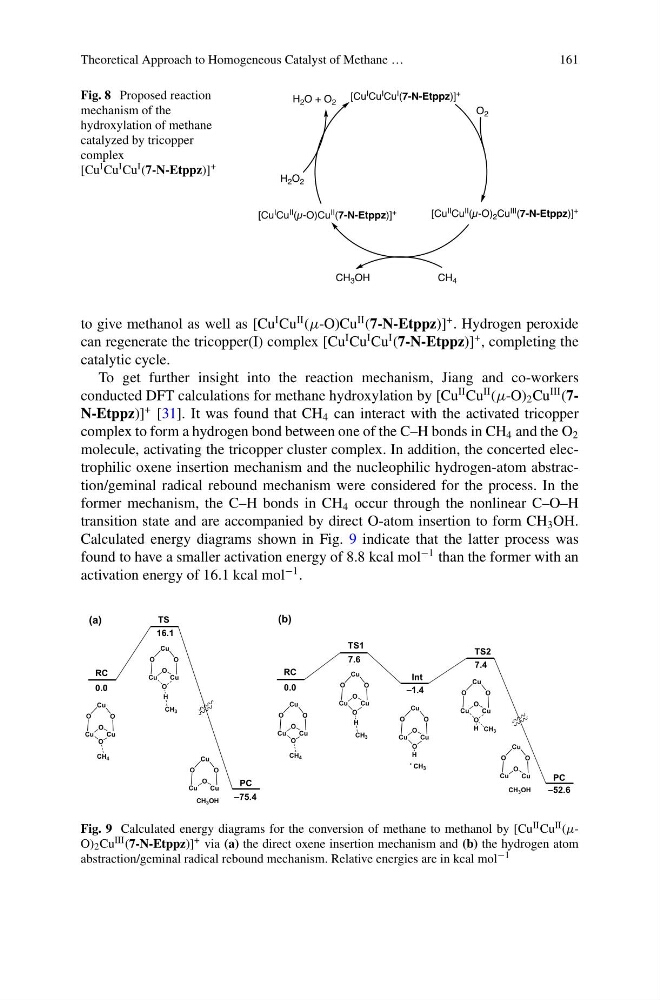
To get further insight into the reaction mechanism, Jiang and co-workers
conducted DFT calculations for methane hydroxylation by [Cu
II Cu
II (μ-O) 2 Cu
III (7N-Etppz)]
+ [31]. It was found that CH 4 can interact with the activated tricopper
complex to form a hydrogen bond between one of the C–H bonds in CH 4 and the O 2
molecule, activating the tricopper cluster complex. In addition, the concerted electrophilic oxene insertion mechanism and the nucleophilic hydrogen-atom abstraction/geminal radical rebound mechanism were considered for the process. In the
former mechanism, the C–H bonds in CH 4 occur through the nonlinear C–O–H
transition state and are accompanied by direct O-atom insertion to form CH 3 OH.
Calculated energy diagrams shown in Fig. 9 indicate that the latter process was
found to have a smaller activation energy of 8.8 kcal mol
−1 than the former with an
activation energy of 16.1 kcal mol
−1 .
0.0
O
O
Cu
Cu
Cu
O
O
CH4
O
O
Cu
Cu
Cu
O
O
CH3
H
7.6
—1.4
O
O
Cu
Cu
Cu
O
O
• CH3
H
7.4
O
O
Cu
Cu
Cu
O
O
CH3
H
—52.6
O
O
Cu
Cu
Cu
O
CH3OH
0.0
O
O
Cu
Cu
Cu
O
O
CH4
O
O
Cu
Cu
Cu
O
O
CH3
H
16.1
—75.4
O
O
Cu
Cu
Cu
O
CH3OH
TS1
TS2
PC
Int
RC
RC
TS
PC
(a)
(b)
Fig. 9 Calculated energy diagrams for the conversion of methane to methanol by [Cu II Cu II (μO) 2 Cu III (7-N-Etppz)] + via (a) the direct oxene insertion mechanism and (b) the hydrogen atom
abstraction/geminal radical rebound mechanism. Relative energies are in kcal mol −1
161
Fig. 8 Proposed reaction
mechanism of the
hydroxylation of methane
catalyzed by tricopper
complex
[Cu I Cu I Cu I (7-N-Etppz)] +
to give methanol as well as [Cu
I Cu
II (μ-O)Cu
II (7-N-Etppz)]
+ . Hydrogen peroxide
can regenerate the tricopper(I) complex [Cu
I Cu
I Cu
I (7-N-Etppz)]
+ , completing the
catalytic cycle.
To get further insight into the reaction mechanism, Jiang and co-workers
conducted DFT calculations for methane hydroxylation by [Cu
II Cu
II (μ-O) 2 Cu
III (7N-Etppz)]
+ [31]. It was found that CH 4 can interact with the activated tricopper
complex to form a hydrogen bond between one of the C–H bonds in CH 4 and the O 2
molecule, activating the tricopper cluster complex. In addition, the concerted electrophilic oxene insertion mechanism and the nucleophilic hydrogen-atom abstraction/geminal radical rebound mechanism were considered for the process. In the
former mechanism, the C–H bonds in CH 4 occur through the nonlinear C–O–H
transition state and are accompanied by direct O-atom insertion to form CH 3 OH.
Calculated energy diagrams shown in Fig. 9 indicate that the latter process was
found to have a smaller activation energy of 8.8 kcal mol
−1 than the former with an
activation energy of 16.1 kcal mol
−1 .
0.0
O
O
Cu
Cu
Cu
O
O
CH4
O
O
Cu
Cu
Cu
O
O
CH3
H
7.6
—1.4
O
O
Cu
Cu
Cu
O
O
• CH3
H
7.4
O
O
Cu
Cu
Cu
O
O
CH3
H
—52.6
O
O
Cu
Cu
Cu
O
CH3OH
0.0
O
O
Cu
Cu
Cu
O
O
CH4
O
O
Cu
Cu
Cu
O
O
CH3
H
16.1
—75.4
O
O
Cu
Cu
Cu
O
CH3OH
TS1
TS2
PC
Int
RC
RC
TS
PC
(a)
(b)
Fig. 9 Calculated energy diagrams for the conversion of methane to methanol by [Cu II Cu II (μO) 2 Cu III (7-N-Etppz)] + via (a) the direct oxene insertion mechanism and (b) the hydrogen atom
abstraction/geminal radical rebound mechanism. Relative energies are in kcal mol −1