

Machine Learning Predictions of Adsorption Energies …
145
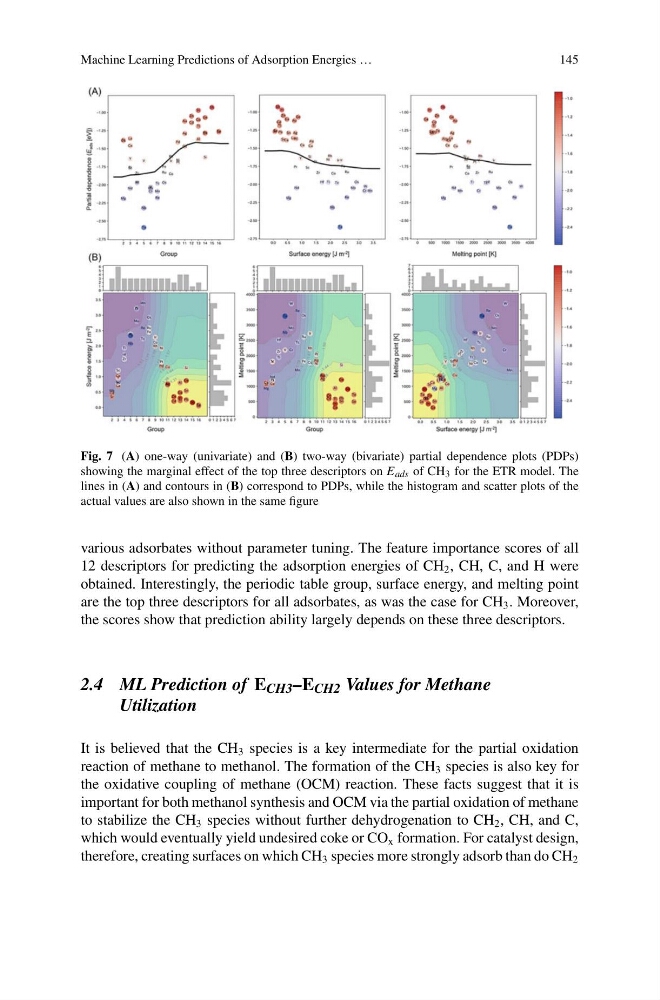
Fig. 7 (A) one-way (univariate) and (B) two-way (bivariate) partial dependence plots (PDPs)
showing the marginal effect of the top three descriptors on E ads of CH 3 for the ETR model. The
lines in (A) and contours in (B) correspond to PDPs, while the histogram and scatter plots of the
actual values are also shown in the same figure
various adsorbates without parameter tuning. The feature importance scores of all
12 descriptors for predicting the adsorption energies of CH 2 , CH, C, and H were
obtained. Interestingly, the periodic table group, surface energy, and melting point
are the top three descriptors for all adsorbates, as was the case for CH 3 . Moreover,
the scores show that prediction ability largely depends on these three descriptors.
2.4 ML Prediction of E CH3 –E CH2 Values for Methane
Utilization
It is believed that the CH 3 species is a key intermediate for the partial oxidation
reaction of methane to methanol. The formation of the CH 3 species is also key for
the oxidative coupling of methane (OCM) reaction. These facts suggest that it is
important for both methanol synthesis and OCM via the partial oxidation of methane
to stabilize the CH 3 species without further dehydrogenation to CH 2 , CH, and C,
which would eventually yield undesired coke or CO x formation. For catalyst design,
therefore, creating surfaces on which CH 3 species more strongly adsorb than do CH 2
145
Fig. 7 (A) one-way (univariate) and (B) two-way (bivariate) partial dependence plots (PDPs)
showing the marginal effect of the top three descriptors on E ads of CH 3 for the ETR model. The
lines in (A) and contours in (B) correspond to PDPs, while the histogram and scatter plots of the
actual values are also shown in the same figure
various adsorbates without parameter tuning. The feature importance scores of all
12 descriptors for predicting the adsorption energies of CH 2 , CH, C, and H were
obtained. Interestingly, the periodic table group, surface energy, and melting point
are the top three descriptors for all adsorbates, as was the case for CH 3 . Moreover,
the scores show that prediction ability largely depends on these three descriptors.
2.4 ML Prediction of E CH3 –E CH2 Values for Methane
Utilization
It is believed that the CH 3 species is a key intermediate for the partial oxidation
reaction of methane to methanol. The formation of the CH 3 species is also key for
the oxidative coupling of methane (OCM) reaction. These facts suggest that it is
important for both methanol synthesis and OCM via the partial oxidation of methane
to stabilize the CH 3 species without further dehydrogenation to CH 2 , CH, and C,
which would eventually yield undesired coke or CO x formation. For catalyst design,
therefore, creating surfaces on which CH 3 species more strongly adsorb than do CH 2