

146
T. Toyao et al.
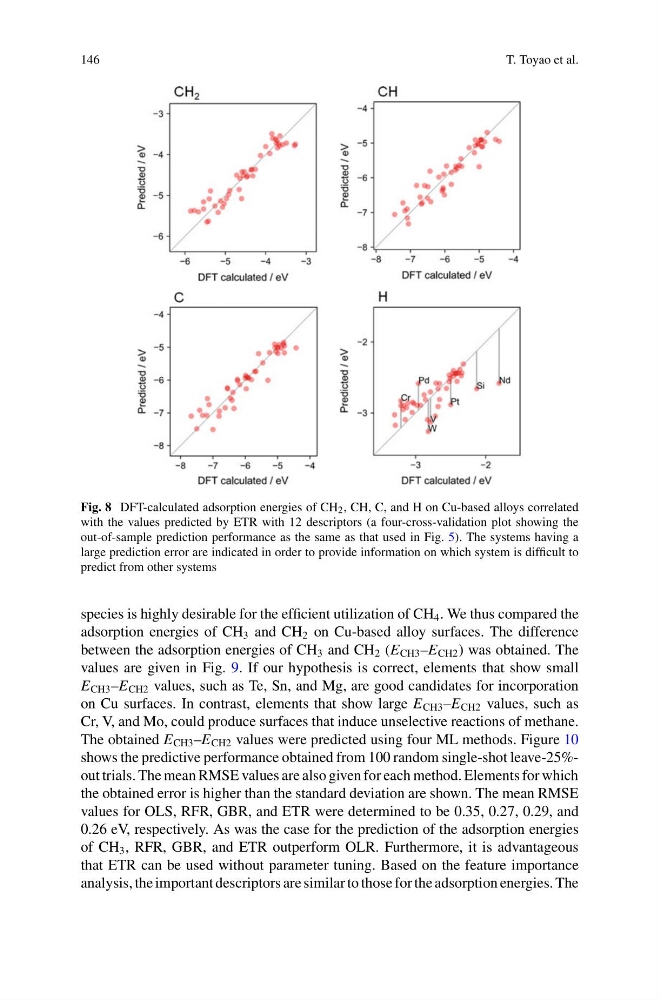
Fig. 8 DFT-calculated adsorption energies of CH 2 , CH, C, and H on Cu-based alloys correlated
with the values predicted by ETR with 12 descriptors (a four-cross-validation plot showing the
out-of-sample prediction performance as the same as that used in Fig. 5). The systems having a
large prediction error are indicated in order to provide information on which system is difficult to
predict from other systems
species is highly desirable for the efficient utilization of CH 4 . We thus compared the
adsorption energies of CH 3 and CH 2 on Cu-based alloy surfaces. The difference
between the adsorption energies of CH 3 and CH 2 (E CH3 –E CH2 ) was obtained. The
values are given in Fig. 9. If our hypothesis is correct, elements that show small
E CH3 –E CH2 values, such as Te, Sn, and Mg, are good candidates for incorporation
on Cu surfaces. In contrast, elements that show large E CH3 –E CH2 values, such as
Cr, V, and Mo, could produce surfaces that induce unselective reactions of methane.
The obtained E CH3 –E CH2 values were predicted using four ML methods. Figure 10
shows the predictive performance obtained from 100 random single-shot leave-25%out trials. The mean RMSE values are also given for each method. Elements for which
the obtained error is higher than the standard deviation are shown. The mean RMSE
values for OLS, RFR, GBR, and ETR were determined to be 0.35, 0.27, 0.29, and
0.26 eV, respectively. As was the case for the prediction of the adsorption energies
of CH 3 , RFR, GBR, and ETR outperform OLR. Furthermore, it is advantageous
that ETR can be used without parameter tuning. Based on the feature importance
analysis, the important descriptors are similar to those for the adsorption energies. The
T. Toyao et al.
Fig. 8 DFT-calculated adsorption energies of CH 2 , CH, C, and H on Cu-based alloys correlated
with the values predicted by ETR with 12 descriptors (a four-cross-validation plot showing the
out-of-sample prediction performance as the same as that used in Fig. 5). The systems having a
large prediction error are indicated in order to provide information on which system is difficult to
predict from other systems
species is highly desirable for the efficient utilization of CH 4 . We thus compared the
adsorption energies of CH 3 and CH 2 on Cu-based alloy surfaces. The difference
between the adsorption energies of CH 3 and CH 2 (E CH3 –E CH2 ) was obtained. The
values are given in Fig. 9. If our hypothesis is correct, elements that show small
E CH3 –E CH2 values, such as Te, Sn, and Mg, are good candidates for incorporation
on Cu surfaces. In contrast, elements that show large E CH3 –E CH2 values, such as
Cr, V, and Mo, could produce surfaces that induce unselective reactions of methane.
The obtained E CH3 –E CH2 values were predicted using four ML methods. Figure 10
shows the predictive performance obtained from 100 random single-shot leave-25%out trials. The mean RMSE values are also given for each method. Elements for which
the obtained error is higher than the standard deviation are shown. The mean RMSE
values for OLS, RFR, GBR, and ETR were determined to be 0.35, 0.27, 0.29, and
0.26 eV, respectively. As was the case for the prediction of the adsorption energies
of CH 3 , RFR, GBR, and ETR outperform OLR. Furthermore, it is advantageous
that ETR can be used without parameter tuning. Based on the feature importance
analysis, the important descriptors are similar to those for the adsorption energies. The