

144
T. Toyao et al.
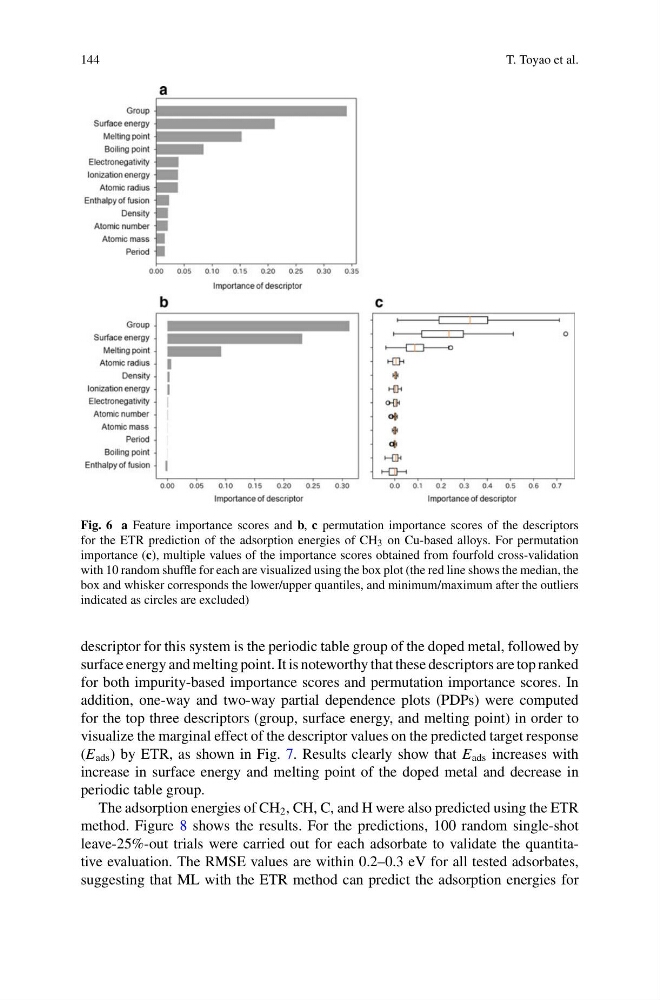
Fig. 6 a Feature importance scores and b, c permutation importance scores of the descriptors
for the ETR prediction of the adsorption energies of CH 3 on Cu-based alloys. For permutation
importance (c), multiple values of the importance scores obtained from fourfold cross-validation
with 10 random shuffle for each are visualized using the box plot (the red line shows the median, the
box and whisker corresponds the lower/upper quantiles, and minimum/maximum after the outliers
indicated as circles are excluded)
descriptor for this system is the periodic table group of the doped metal, followed by
surface energy and melting point. It is noteworthy that these descriptors are top ranked
for both impurity-based importance scores and permutation importance scores. In
addition, one-way and two-way partial dependence plots (PDPs) were computed
for the top three descriptors (group, surface energy, and melting point) in order to
visualize the marginal effect of the descriptor values on the predicted target response
(E ads ) by ETR, as shown in Fig. 7. Results clearly show that E ads increases with
increase in surface energy and melting point of the doped metal and decrease in
periodic table group.
The adsorption energies of CH 2 , CH, C, and H were also predicted using the ETR
method. Figure 8 shows the results. For the predictions, 100 random single-shot
leave-25%-out trials were carried out for each adsorbate to validate the quantitative evaluation. The RMSE values are within 0.2–0.3 eV for all tested adsorbates,
suggesting that ML with the ETR method can predict the adsorption energies for
T. Toyao et al.
Fig. 6 a Feature importance scores and b, c permutation importance scores of the descriptors
for the ETR prediction of the adsorption energies of CH 3 on Cu-based alloys. For permutation
importance (c), multiple values of the importance scores obtained from fourfold cross-validation
with 10 random shuffle for each are visualized using the box plot (the red line shows the median, the
box and whisker corresponds the lower/upper quantiles, and minimum/maximum after the outliers
indicated as circles are excluded)
descriptor for this system is the periodic table group of the doped metal, followed by
surface energy and melting point. It is noteworthy that these descriptors are top ranked
for both impurity-based importance scores and permutation importance scores. In
addition, one-way and two-way partial dependence plots (PDPs) were computed
for the top three descriptors (group, surface energy, and melting point) in order to
visualize the marginal effect of the descriptor values on the predicted target response
(E ads ) by ETR, as shown in Fig. 7. Results clearly show that E ads increases with
increase in surface energy and melting point of the doped metal and decrease in
periodic table group.
The adsorption energies of CH 2 , CH, C, and H were also predicted using the ETR
method. Figure 8 shows the results. For the predictions, 100 random single-shot
leave-25%-out trials were carried out for each adsorbate to validate the quantitative evaluation. The RMSE values are within 0.2–0.3 eV for all tested adsorbates,
suggesting that ML with the ETR method can predict the adsorption energies for