

Dynamics and Energetics of Methane …
117
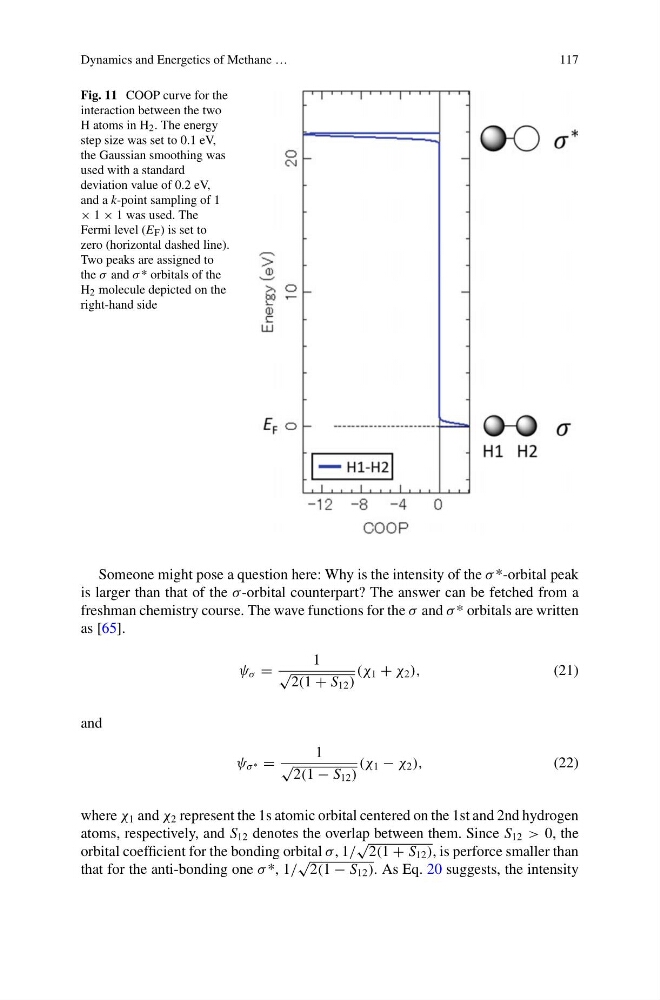
Fig. 11 COOP curve for the
interaction between the two
H atoms in H 2 . The energy
step size was set to 0.1 eV,
the Gaussian smoothing was
used with a standard
deviation value of 0.2 eV,
and a k-point sampling of 1
× 1 × 1 was used. The
Fermi level (E F ) is set to
zero (horizontal dashed line).
Two peaks are assigned to
the σ and σ * orbitals of the
H 2 molecule depicted on the
right-hand side
Someone might pose a question here: Why is the intensity of the σ *-orbital peak
is larger than that of the σ-orbital counterpart? The answer can be fetched from a
freshman chemistry course. The wave functions for the σ and σ * orbitals are written
as [65].
ψ σ =
1
√
2(1 + S 12 )
(χ 1 + χ 2 ),
(21)
and
ψ σ ∗ =
1
√
2(1 − S 12 )
(χ 1 − χ 2 ),
(22)
where χ 1 and χ 2 represent the 1s atomic orbital centered on the 1st and 2nd hydrogen
atoms, respectively, and S 12 denotes the overlap between them. Since S 12 > 0, the
orbital coefficient for the bonding orbital σ, 1/
√
2(1 + S 12 ), is perforce smaller than
that for the anti-bonding one σ *, 1/
√
2(1 − S 12 ). As Eq. 20 suggests, the intensity
117
Fig. 11 COOP curve for the
interaction between the two
H atoms in H 2 . The energy
step size was set to 0.1 eV,
the Gaussian smoothing was
used with a standard
deviation value of 0.2 eV,
and a k-point sampling of 1
× 1 × 1 was used. The
Fermi level (E F ) is set to
zero (horizontal dashed line).
Two peaks are assigned to
the σ and σ * orbitals of the
H 2 molecule depicted on the
right-hand side
Someone might pose a question here: Why is the intensity of the σ *-orbital peak
is larger than that of the σ-orbital counterpart? The answer can be fetched from a
freshman chemistry course. The wave functions for the σ and σ * orbitals are written
as [65].
ψ σ =
1
√
2(1 + S 12 )
(χ 1 + χ 2 ),
(21)
and
ψ σ ∗ =
1
√
2(1 − S 12 )
(χ 1 − χ 2 ),
(22)
where χ 1 and χ 2 represent the 1s atomic orbital centered on the 1st and 2nd hydrogen
atoms, respectively, and S 12 denotes the overlap between them. Since S 12 > 0, the
orbital coefficient for the bonding orbital σ, 1/
√
2(1 + S 12 ), is perforce smaller than
that for the anti-bonding one σ *, 1/
√
2(1 − S 12 ). As Eq. 20 suggests, the intensity