

116
Y. Tsuji et al.
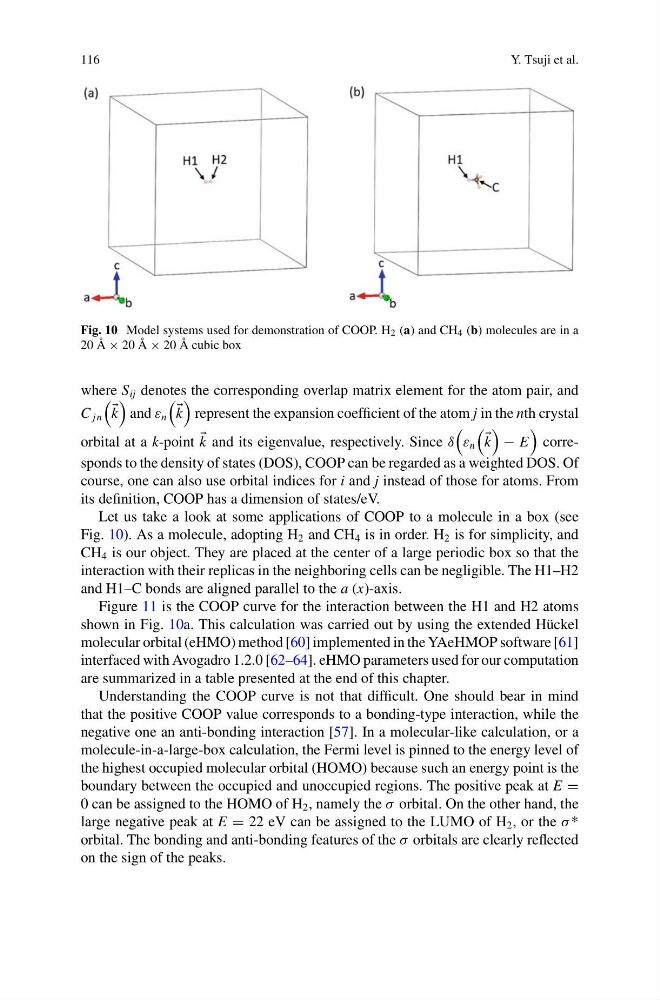
Fig. 10 Model systems used for demonstration of COOP. H 2 (a) and CH 4 (b) molecules are in a
20 Å × 20 Å × 20 Å cubic box
where S ij denotes the corresponding overlap matrix element for the atom pair, and
C jn
k
and ε n
k
represent the expansion coefficient of the atom j in the nth crystal
orbital at a k-point
k and its eigenvalue, respectively. Since δ
ε n
k
− E
corresponds to the density of states (DOS), COOP can be regarded as a weighted DOS. Of
course, one can also use orbital indices for i and j instead of those for atoms. From
its definition, COOP has a dimension of states/eV.
Let us take a look at some applications of COOP to a molecule in a box (see
Fig. 10). As a molecule, adopting H 2 and CH 4 is in order. H 2 is for simplicity, and
CH 4 is our object. They are placed at the center of a large periodic box so that the
interaction with their replicas in the neighboring cells can be negligible. The H1–H2
and H1–C bonds are aligned parallel to the a (x)-axis.
Figure 11 is the COOP curve for the interaction between the H1 and H2 atoms
shown in Fig. 10a. This calculation was carried out by using the extended Hückel
molecular orbital (eHMO) method [60] implemented in the YAeHMOP software [61]
interfaced with Avogadro 1.2.0 [62–64]. eHMO parameters used for our computation
are summarized in a table presented at the end of this chapter.
Understanding the COOP curve is not that difficult. One should bear in mind
that the positive COOP value corresponds to a bonding-type interaction, while the
negative one an anti-bonding interaction [57]. In a molecular-like calculation, or a
molecule-in-a-large-box calculation, the Fermi level is pinned to the energy level of
the highest occupied molecular orbital (HOMO) because such an energy point is the
boundary between the occupied and unoccupied regions. The positive peak at E =
0 can be assigned to the HOMO of H 2 , namely the σ orbital. On the other hand, the
large negative peak at E = 22 eV can be assigned to the LUMO of H 2 , or the σ *
orbital. The bonding and anti-bonding features of the σ orbitals are clearly reflected
on the sign of the peaks.
Y. Tsuji et al.
Fig. 10 Model systems used for demonstration of COOP. H 2 (a) and CH 4 (b) molecules are in a
20 Å × 20 Å × 20 Å cubic box
where S ij denotes the corresponding overlap matrix element for the atom pair, and
C jn
k
and ε n
k
represent the expansion coefficient of the atom j in the nth crystal
orbital at a k-point
k and its eigenvalue, respectively. Since δ
ε n
k
− E
corresponds to the density of states (DOS), COOP can be regarded as a weighted DOS. Of
course, one can also use orbital indices for i and j instead of those for atoms. From
its definition, COOP has a dimension of states/eV.
Let us take a look at some applications of COOP to a molecule in a box (see
Fig. 10). As a molecule, adopting H 2 and CH 4 is in order. H 2 is for simplicity, and
CH 4 is our object. They are placed at the center of a large periodic box so that the
interaction with their replicas in the neighboring cells can be negligible. The H1–H2
and H1–C bonds are aligned parallel to the a (x)-axis.
Figure 11 is the COOP curve for the interaction between the H1 and H2 atoms
shown in Fig. 10a. This calculation was carried out by using the extended Hückel
molecular orbital (eHMO) method [60] implemented in the YAeHMOP software [61]
interfaced with Avogadro 1.2.0 [62–64]. eHMO parameters used for our computation
are summarized in a table presented at the end of this chapter.
Understanding the COOP curve is not that difficult. One should bear in mind
that the positive COOP value corresponds to a bonding-type interaction, while the
negative one an anti-bonding interaction [57]. In a molecular-like calculation, or a
molecule-in-a-large-box calculation, the Fermi level is pinned to the energy level of
the highest occupied molecular orbital (HOMO) because such an energy point is the
boundary between the occupied and unoccupied regions. The positive peak at E =
0 can be assigned to the HOMO of H 2 , namely the σ orbital. On the other hand, the
large negative peak at E = 22 eV can be assigned to the LUMO of H 2 , or the σ *
orbital. The bonding and anti-bonding features of the σ orbitals are clearly reflected
on the sign of the peaks.