

Dynamics and Energetics of Methane …
115
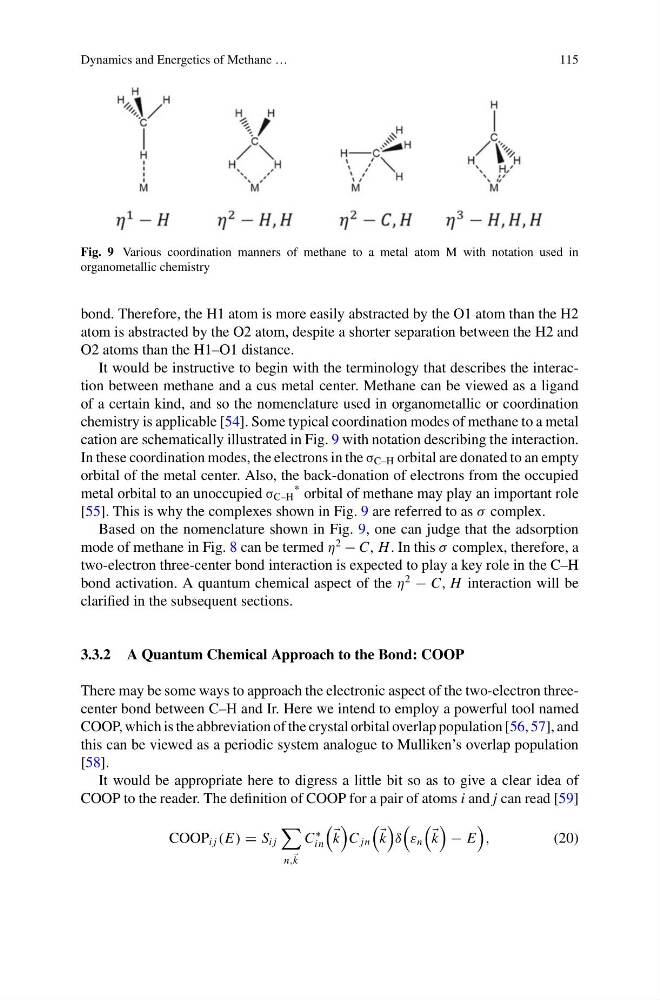
Fig. 9 Various coordination manners of methane to a metal atom M with notation used in
organometallic chemistry
bond. Therefore, the H1 atom is more easily abstracted by the O1 atom than the H2
atom is abstracted by the O2 atom, despite a shorter separation between the H2 and
O2 atoms than the H1–O1 distance.
It would be instructive to begin with the terminology that describes the interaction between methane and a cus metal center. Methane can be viewed as a ligand
of a certain kind, and so the nomenclature used in organometallic or coordination
chemistry is applicable [54]. Some typical coordination modes of methane to a metal
cation are schematically illustrated in Fig. 9 with notation describing the interaction.
In these coordination modes, the electrons in the σ C–H orbital are donated to an empty
orbital of the metal center. Also, the back-donation of electrons from the occupied
metal orbital to an unoccupied σ C–H
* orbital of methane may play an important role
[55]. This is why the complexes shown in Fig. 9 are referred to as σ complex.
Based on the nomenclature shown in Fig. 9, one can judge that the adsorption
mode of methane in Fig. 8 can be termed η
2
− C, H . In this σ complex, therefore, a
two-electron three-center bond interaction is expected to play a key role in the C–H
bond activation. A quantum chemical aspect of the η
2
− C, H interaction will be
clarified in the subsequent sections.
3.3.2 A Quantum Chemical Approach to the Bond: COOP
There may be some ways to approach the electronic aspect of the two-electron threecenter bond between C–H and Ir. Here we intend to employ a powerful tool named
COOP, which is the abbreviation of the crystal orbital overlap population [56, 57], and
this can be viewed as a periodic system analogue to Mulliken’s overlap population
[58].
It would be appropriate here to digress a little bit so as to give a clear idea of
COOP to the reader. The definition of COOP for a pair of atoms i and j can read [59]
COOP i j (E) = S i j
n,
k
C
∗
in
k
C jn
k
δ
ε n
k
− E
,
(20)
115
Fig. 9 Various coordination manners of methane to a metal atom M with notation used in
organometallic chemistry
bond. Therefore, the H1 atom is more easily abstracted by the O1 atom than the H2
atom is abstracted by the O2 atom, despite a shorter separation between the H2 and
O2 atoms than the H1–O1 distance.
It would be instructive to begin with the terminology that describes the interaction between methane and a cus metal center. Methane can be viewed as a ligand
of a certain kind, and so the nomenclature used in organometallic or coordination
chemistry is applicable [54]. Some typical coordination modes of methane to a metal
cation are schematically illustrated in Fig. 9 with notation describing the interaction.
In these coordination modes, the electrons in the σ C–H orbital are donated to an empty
orbital of the metal center. Also, the back-donation of electrons from the occupied
metal orbital to an unoccupied σ C–H
* orbital of methane may play an important role
[55]. This is why the complexes shown in Fig. 9 are referred to as σ complex.
Based on the nomenclature shown in Fig. 9, one can judge that the adsorption
mode of methane in Fig. 8 can be termed η
2
− C, H . In this σ complex, therefore, a
two-electron three-center bond interaction is expected to play a key role in the C–H
bond activation. A quantum chemical aspect of the η
2
− C, H interaction will be
clarified in the subsequent sections.
3.3.2 A Quantum Chemical Approach to the Bond: COOP
There may be some ways to approach the electronic aspect of the two-electron threecenter bond between C–H and Ir. Here we intend to employ a powerful tool named
COOP, which is the abbreviation of the crystal orbital overlap population [56, 57], and
this can be viewed as a periodic system analogue to Mulliken’s overlap population
[58].
It would be appropriate here to digress a little bit so as to give a clear idea of
COOP to the reader. The definition of COOP for a pair of atoms i and j can read [59]
COOP i j (E) = S i j
n,
k
C
∗
in
k
C jn
k
δ
ε n
k
− E
,
(20)