

114
Y. Tsuji et al.
Fig. 7 Structures of the stable stoichiometric IrO 2 /RuO 2 surfaces: IrO 2 /RuO 2 (110) surface
(a) and IrO 2 /RuO 2 (100) surface (b). Threefold-coordinated O atoms are denoted as 3f–O,
twofold-coordinated bridging O atoms, br–O, and fivefold-coordinated Ir or Ru atoms, 5f–Ir/Ru
as low as 150 K. Thus, in this section, taking the IrO 2 surface as an example, we
shall take a closer look at the adsorption and activation of methane on that surface.
3.3.1 Adsorption Geometry of CH 4 on the IrO 2 (110) Surface
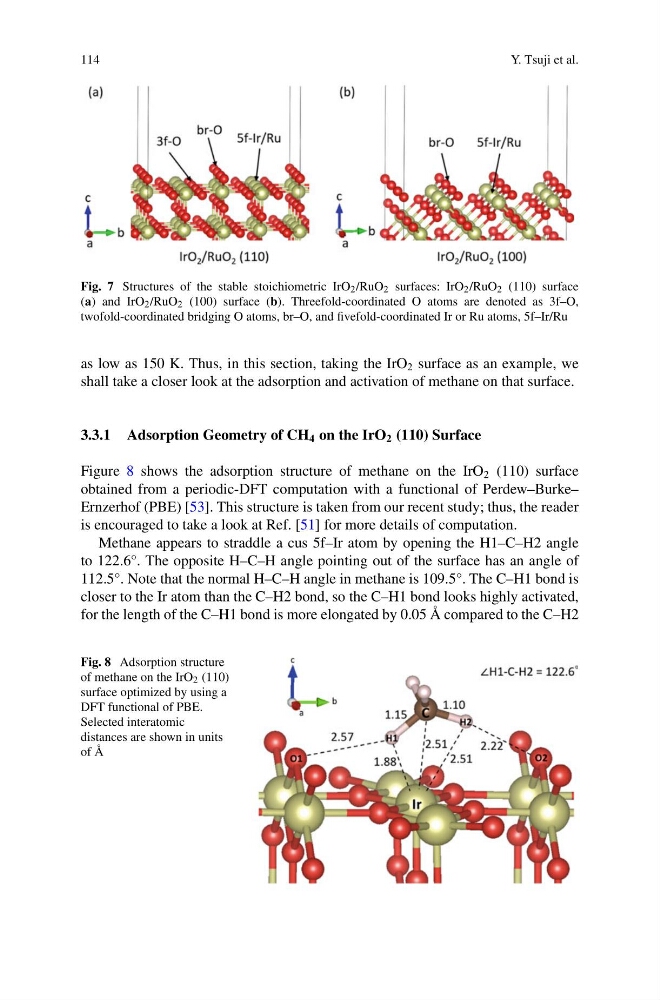
Figure 8 shows the adsorption structure of methane on the IrO 2 (110) surface
obtained from a periodic-DFT computation with a functional of Perdew–Burke–
Ernzerhof (PBE) [53]. This structure is taken from our recent study; thus, the reader
is encouraged to take a look at Ref. [51] for more details of computation.
Methane appears to straddle a cus 5f–Ir atom by opening the H1–C–H2 angle
to 122.6°. The opposite H–C–H angle pointing out of the surface has an angle of
112.5°. Note that the normal H–C–H angle in methane is 109.5°. The C–H1 bond is
closer to the Ir atom than the C–H2 bond, so the C–H1 bond looks highly activated,
for the length of the C–H1 bond is more elongated by 0.05 Å compared to the C–H2
Fig. 8 Adsorption structure
of methane on the IrO 2 (110)
surface optimized by using a
DFT functional of PBE.
Selected interatomic
distances are shown in units
of Å
Y. Tsuji et al.
Fig. 7 Structures of the stable stoichiometric IrO 2 /RuO 2 surfaces: IrO 2 /RuO 2 (110) surface
(a) and IrO 2 /RuO 2 (100) surface (b). Threefold-coordinated O atoms are denoted as 3f–O,
twofold-coordinated bridging O atoms, br–O, and fivefold-coordinated Ir or Ru atoms, 5f–Ir/Ru
as low as 150 K. Thus, in this section, taking the IrO 2 surface as an example, we
shall take a closer look at the adsorption and activation of methane on that surface.
3.3.1 Adsorption Geometry of CH 4 on the IrO 2 (110) Surface
Figure 8 shows the adsorption structure of methane on the IrO 2 (110) surface
obtained from a periodic-DFT computation with a functional of Perdew–Burke–
Ernzerhof (PBE) [53]. This structure is taken from our recent study; thus, the reader
is encouraged to take a look at Ref. [51] for more details of computation.
Methane appears to straddle a cus 5f–Ir atom by opening the H1–C–H2 angle
to 122.6°. The opposite H–C–H angle pointing out of the surface has an angle of
112.5°. Note that the normal H–C–H angle in methane is 109.5°. The C–H1 bond is
closer to the Ir atom than the C–H2 bond, so the C–H1 bond looks highly activated,
for the length of the C–H1 bond is more elongated by 0.05 Å compared to the C–H2
Fig. 8 Adsorption structure
of methane on the IrO 2 (110)
surface optimized by using a
DFT functional of PBE.
Selected interatomic
distances are shown in units
of Å