

110
Y. Tsuji et al.
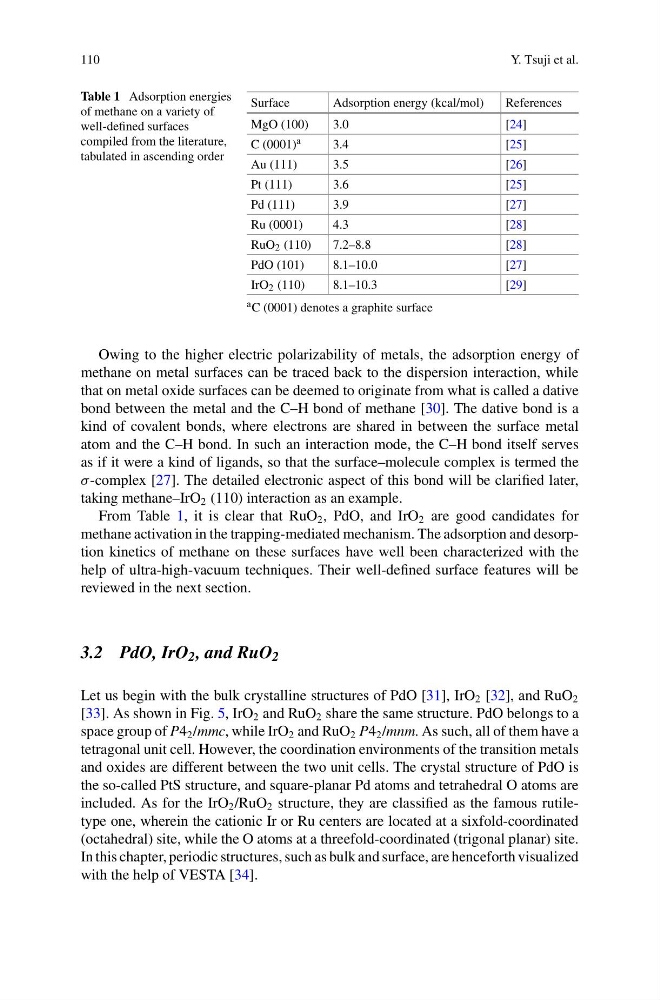
Table 1 Adsorption energies
of methane on a variety of
well-defined surfaces
compiled from the literature,
tabulated in ascending order
Surface
Adsorption energy (kcal/mol)
References
MgO (100)
3.0
[24]
C (0001) a
3.4
[25]
Au (111)
3.5
[26]
Pt (111)
3.6
[25]
Pd (111)
3.9
[27]
Ru (0001)
4.3
[28]
RuO 2 (110)
7.2–8.8
[28]
PdO (101)
8.1–10.0
[27]
IrO 2 (110)
8.1–10.3
[29]
a C (0001) denotes a graphite surface
Owing to the higher electric polarizability of metals, the adsorption energy of
methane on metal surfaces can be traced back to the dispersion interaction, while
that on metal oxide surfaces can be deemed to originate from what is called a dative
bond between the metal and the C–H bond of methane [30]. The dative bond is a
kind of covalent bonds, where electrons are shared in between the surface metal
atom and the C–H bond. In such an interaction mode, the C–H bond itself serves
as if it were a kind of ligands, so that the surface–molecule complex is termed the
σ-complex [27]. The detailed electronic aspect of this bond will be clarified later,
taking methane–IrO 2 (110) interaction as an example.
From Table 1, it is clear that RuO 2 , PdO, and IrO 2 are good candidates for
methane activation in the trapping-mediated mechanism. The adsorption and desorption kinetics of methane on these surfaces have well been characterized with the
help of ultra-high-vacuum techniques. Their well-defined surface features will be
reviewed in the next section.
3.2 PdO, IrO 2 , and RuO 2
Let us begin with the bulk crystalline structures of PdO [31], IrO 2 [32], and RuO 2
[33]. As shown in Fig. 5, IrO 2 and RuO 2 share the same structure. PdO belongs to a
space group of P4 2 /mmc, while IrO 2 and RuO 2 P4 2 /mnm. As such, all of them have a
tetragonal unit cell. However, the coordination environments of the transition metals
and oxides are different between the two unit cells. The crystal structure of PdO is
the so-called PtS structure, and square-planar Pd atoms and tetrahedral O atoms are
included. As for the IrO 2 /RuO 2 structure, they are classified as the famous rutiletype one, wherein the cationic Ir or Ru centers are located at a sixfold-coordinated
(octahedral) site, while the O atoms at a threefold-coordinated (trigonal planar) site.
In this chapter, periodic structures, such as bulk and surface, are henceforth visualized
with the help of VESTA [34].
Y. Tsuji et al.
Table 1 Adsorption energies
of methane on a variety of
well-defined surfaces
compiled from the literature,
tabulated in ascending order
Surface
Adsorption energy (kcal/mol)
References
MgO (100)
3.0
[24]
C (0001) a
3.4
[25]
Au (111)
3.5
[26]
Pt (111)
3.6
[25]
Pd (111)
3.9
[27]
Ru (0001)
4.3
[28]
RuO 2 (110)
7.2–8.8
[28]
PdO (101)
8.1–10.0
[27]
IrO 2 (110)
8.1–10.3
[29]
a C (0001) denotes a graphite surface
Owing to the higher electric polarizability of metals, the adsorption energy of
methane on metal surfaces can be traced back to the dispersion interaction, while
that on metal oxide surfaces can be deemed to originate from what is called a dative
bond between the metal and the C–H bond of methane [30]. The dative bond is a
kind of covalent bonds, where electrons are shared in between the surface metal
atom and the C–H bond. In such an interaction mode, the C–H bond itself serves
as if it were a kind of ligands, so that the surface–molecule complex is termed the
σ-complex [27]. The detailed electronic aspect of this bond will be clarified later,
taking methane–IrO 2 (110) interaction as an example.
From Table 1, it is clear that RuO 2 , PdO, and IrO 2 are good candidates for
methane activation in the trapping-mediated mechanism. The adsorption and desorption kinetics of methane on these surfaces have well been characterized with the
help of ultra-high-vacuum techniques. Their well-defined surface features will be
reviewed in the next section.
3.2 PdO, IrO 2 , and RuO 2
Let us begin with the bulk crystalline structures of PdO [31], IrO 2 [32], and RuO 2
[33]. As shown in Fig. 5, IrO 2 and RuO 2 share the same structure. PdO belongs to a
space group of P4 2 /mmc, while IrO 2 and RuO 2 P4 2 /mnm. As such, all of them have a
tetragonal unit cell. However, the coordination environments of the transition metals
and oxides are different between the two unit cells. The crystal structure of PdO is
the so-called PtS structure, and square-planar Pd atoms and tetrahedral O atoms are
included. As for the IrO 2 /RuO 2 structure, they are classified as the famous rutiletype one, wherein the cationic Ir or Ru centers are located at a sixfold-coordinated
(octahedral) site, while the O atoms at a threefold-coordinated (trigonal planar) site.
In this chapter, periodic structures, such as bulk and surface, are henceforth visualized
with the help of VESTA [34].