

Dynamics and Energetics of Methane …
111
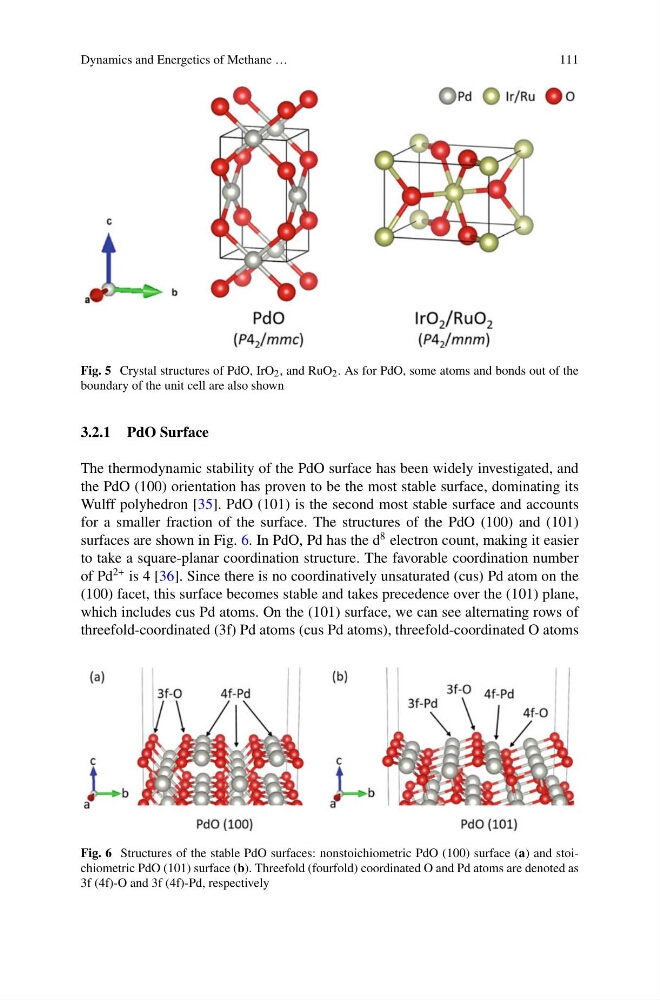
Fig. 5 Crystal structures of PdO, IrO 2 , and RuO 2 . As for PdO, some atoms and bonds out of the
boundary of the unit cell are also shown
3.2.1 PdO Surface
The thermodynamic stability of the PdO surface has been widely investigated, and
the PdO (100) orientation has proven to be the most stable surface, dominating its
Wulff polyhedron [35]. PdO (101) is the second most stable surface and accounts
for a smaller fraction of the surface. The structures of the PdO (100) and (101)
surfaces are shown in Fig. 6. In PdO, Pd has the d
8 electron count, making it easier
to take a square-planar coordination structure. The favorable coordination number
of Pd
2+ is 4 [36]. Since there is no coordinatively unsaturated (cus) Pd atom on the
(100) facet, this surface becomes stable and takes precedence over the (101) plane,
which includes cus Pd atoms. On the (101) surface, we can see alternating rows of
threefold-coordinated (3f) Pd atoms (cus Pd atoms), threefold-coordinated O atoms
Fig. 6 Structures of the stable PdO surfaces: nonstoichiometric PdO (100) surface (a) and stoichiometric PdO (101) surface (b). Threefold (fourfold) coordinated O and Pd atoms are denoted as
3f (4f)-O and 3f (4f)-Pd, respectively
111
Fig. 5 Crystal structures of PdO, IrO 2 , and RuO 2 . As for PdO, some atoms and bonds out of the
boundary of the unit cell are also shown
3.2.1 PdO Surface
The thermodynamic stability of the PdO surface has been widely investigated, and
the PdO (100) orientation has proven to be the most stable surface, dominating its
Wulff polyhedron [35]. PdO (101) is the second most stable surface and accounts
for a smaller fraction of the surface. The structures of the PdO (100) and (101)
surfaces are shown in Fig. 6. In PdO, Pd has the d
8 electron count, making it easier
to take a square-planar coordination structure. The favorable coordination number
of Pd
2+ is 4 [36]. Since there is no coordinatively unsaturated (cus) Pd atom on the
(100) facet, this surface becomes stable and takes precedence over the (101) plane,
which includes cus Pd atoms. On the (101) surface, we can see alternating rows of
threefold-coordinated (3f) Pd atoms (cus Pd atoms), threefold-coordinated O atoms
Fig. 6 Structures of the stable PdO surfaces: nonstoichiometric PdO (100) surface (a) and stoichiometric PdO (101) surface (b). Threefold (fourfold) coordinated O and Pd atoms are denoted as
3f (4f)-O and 3f (4f)-Pd, respectively