

106
Y. Tsuji et al.
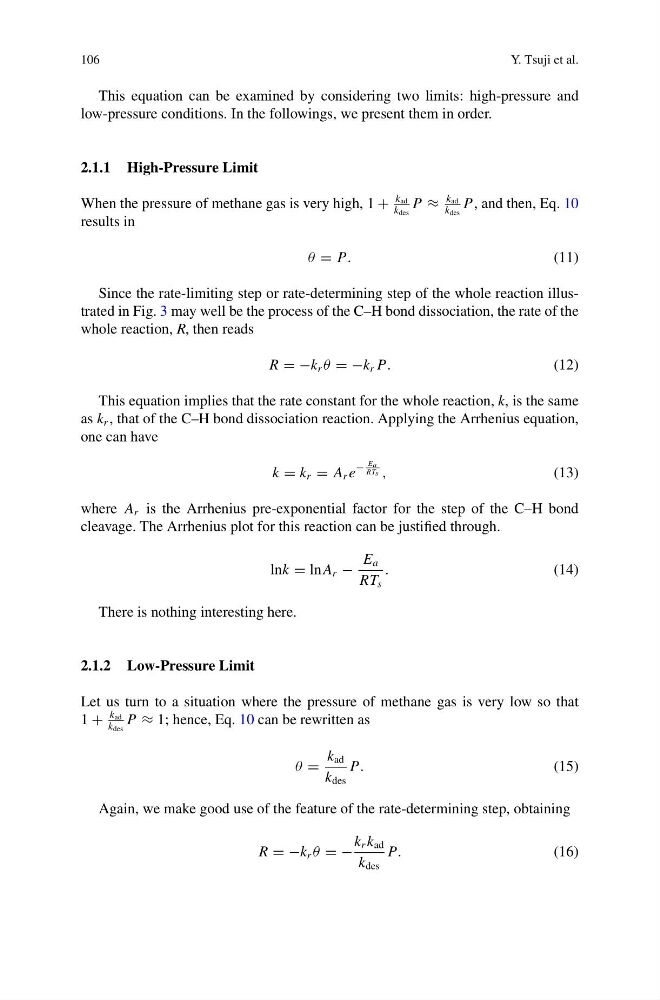
This equation can be examined by considering two limits: high-pressure and
low-pressure conditions. In the followings, we present them in order.
2.1.1 High-Pressure Limit
When the pressure of methane gas is very high, 1 +
k ad
k des
P ≈
k ad
k des
P, and then, Eq. 10
results in
θ = P.
(11)
Since the rate-limiting step or rate-determining step of the whole reaction illustrated in Fig. 3 may well be the process of the C–H bond dissociation, the rate of the
whole reaction, R, then reads
R = −k r θ = −k r P.
(12)
This equation implies that the rate constant for the whole reaction, k, is the same
as k r , that of the C–H bond dissociation reaction. Applying the Arrhenius equation,
one can have
k = k r = A r e
−
Ea
RTs ,
(13)
where A r is the Arrhenius pre-exponential factor for the step of the C–H bond
cleavage. The Arrhenius plot for this reaction can be justified through.
lnk = ln A r −
E a
RT s
.
(14)
There is nothing interesting here.
2.1.2 Low-Pressure Limit
Let us turn to a situation where the pressure of methane gas is very low so that
1 +
k ad
k des
P ≈ 1; hence, Eq. 10 can be rewritten as
θ =
k ad
k des
P.
(15)
Again, we make good use of the feature of the rate-determining step, obtaining
R = −k r θ = −
k r k ad
k des
P.
(16)
Y. Tsuji et al.
This equation can be examined by considering two limits: high-pressure and
low-pressure conditions. In the followings, we present them in order.
2.1.1 High-Pressure Limit
When the pressure of methane gas is very high, 1 +
k ad
k des
P ≈
k ad
k des
P, and then, Eq. 10
results in
θ = P.
(11)
Since the rate-limiting step or rate-determining step of the whole reaction illustrated in Fig. 3 may well be the process of the C–H bond dissociation, the rate of the
whole reaction, R, then reads
R = −k r θ = −k r P.
(12)
This equation implies that the rate constant for the whole reaction, k, is the same
as k r , that of the C–H bond dissociation reaction. Applying the Arrhenius equation,
one can have
k = k r = A r e
−
Ea
RTs ,
(13)
where A r is the Arrhenius pre-exponential factor for the step of the C–H bond
cleavage. The Arrhenius plot for this reaction can be justified through.
lnk = ln A r −
E a
RT s
.
(14)
There is nothing interesting here.
2.1.2 Low-Pressure Limit
Let us turn to a situation where the pressure of methane gas is very low so that
1 +
k ad
k des
P ≈ 1; hence, Eq. 10 can be rewritten as
θ =
k ad
k des
P.
(15)
Again, we make good use of the feature of the rate-determining step, obtaining
R = −k r θ = −
k r k ad
k des
P.
(16)