

Dynamics and Energetics of Methane …
107
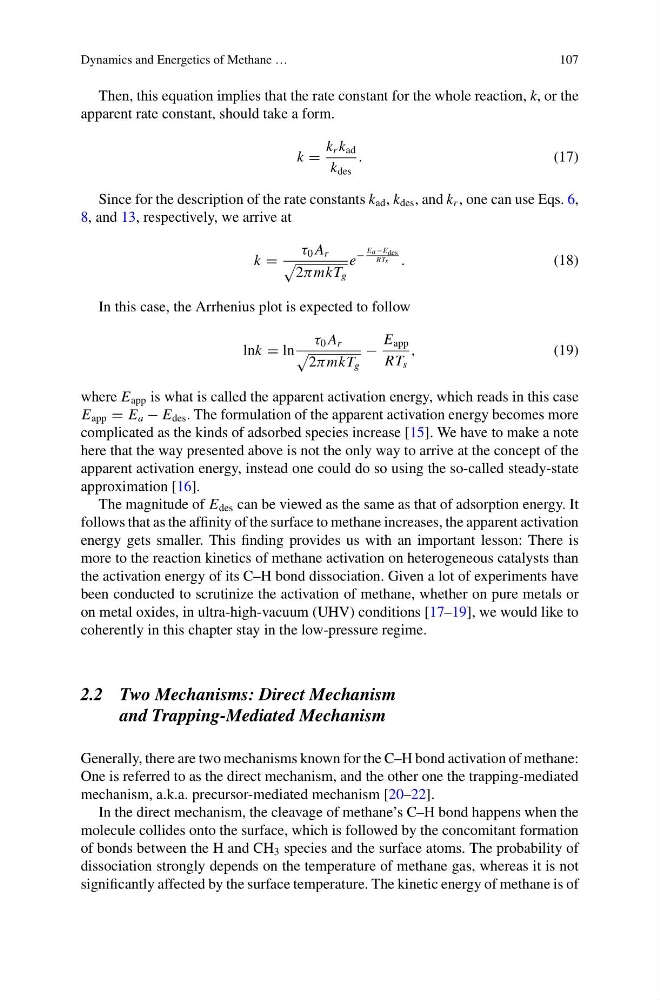
Then, this equation implies that the rate constant for the whole reaction, k, or the
apparent rate constant, should take a form.
k =
k r k ad
k des
.
(17)
Since for the description of the rate constants k ad , k des , and k r , one can use Eqs. 6,
8, and 13, respectively, we arrive at
k =
τ 0 A r
2π mkT g
e
−
Ea −E des
RTs
.
(18)
In this case, the Arrhenius plot is expected to follow
lnk = ln
τ 0 A r
2π mkT g
−
E app
RT s
,
(19)
where E app is what is called the apparent activation energy, which reads in this case
E app = E a − E des . The formulation of the apparent activation energy becomes more
complicated as the kinds of adsorbed species increase [15]. We have to make a note
here that the way presented above is not the only way to arrive at the concept of the
apparent activation energy, instead one could do so using the so-called steady-state
approximation [16].
The magnitude of E des can be viewed as the same as that of adsorption energy. It
follows that as the affinity of the surface to methane increases, the apparent activation
energy gets smaller. This finding provides us with an important lesson: There is
more to the reaction kinetics of methane activation on heterogeneous catalysts than
the activation energy of its C–H bond dissociation. Given a lot of experiments have
been conducted to scrutinize the activation of methane, whether on pure metals or
on metal oxides, in ultra-high-vacuum (UHV) conditions [17–19], we would like to
coherently in this chapter stay in the low-pressure regime.
2.2 Two Mechanisms: Direct Mechanism
and Trapping-Mediated Mechanism
Generally, there are two mechanisms known for the C–H bond activation of methane:
One is referred to as the direct mechanism, and the other one the trapping-mediated
mechanism, a.k.a. precursor-mediated mechanism [20–22].
In the direct mechanism, the cleavage of methane’s C–H bond happens when the
molecule collides onto the surface, which is followed by the concomitant formation
of bonds between the H and CH 3 species and the surface atoms. The probability of
dissociation strongly depends on the temperature of methane gas, whereas it is not
significantly affected by the surface temperature. The kinetic energy of methane is of
107
Then, this equation implies that the rate constant for the whole reaction, k, or the
apparent rate constant, should take a form.
k =
k r k ad
k des
.
(17)
Since for the description of the rate constants k ad , k des , and k r , one can use Eqs. 6,
8, and 13, respectively, we arrive at
k =
τ 0 A r
2π mkT g
e
−
Ea −E des
RTs
.
(18)
In this case, the Arrhenius plot is expected to follow
lnk = ln
τ 0 A r
2π mkT g
−
E app
RT s
,
(19)
where E app is what is called the apparent activation energy, which reads in this case
E app = E a − E des . The formulation of the apparent activation energy becomes more
complicated as the kinds of adsorbed species increase [15]. We have to make a note
here that the way presented above is not the only way to arrive at the concept of the
apparent activation energy, instead one could do so using the so-called steady-state
approximation [16].
The magnitude of E des can be viewed as the same as that of adsorption energy. It
follows that as the affinity of the surface to methane increases, the apparent activation
energy gets smaller. This finding provides us with an important lesson: There is
more to the reaction kinetics of methane activation on heterogeneous catalysts than
the activation energy of its C–H bond dissociation. Given a lot of experiments have
been conducted to scrutinize the activation of methane, whether on pure metals or
on metal oxides, in ultra-high-vacuum (UHV) conditions [17–19], we would like to
coherently in this chapter stay in the low-pressure regime.
2.2 Two Mechanisms: Direct Mechanism
and Trapping-Mediated Mechanism
Generally, there are two mechanisms known for the C–H bond activation of methane:
One is referred to as the direct mechanism, and the other one the trapping-mediated
mechanism, a.k.a. precursor-mediated mechanism [20–22].
In the direct mechanism, the cleavage of methane’s C–H bond happens when the
molecule collides onto the surface, which is followed by the concomitant formation
of bonds between the H and CH 3 species and the surface atoms. The probability of
dissociation strongly depends on the temperature of methane gas, whereas it is not
significantly affected by the surface temperature. The kinetic energy of methane is of