

104
Y. Tsuji et al.
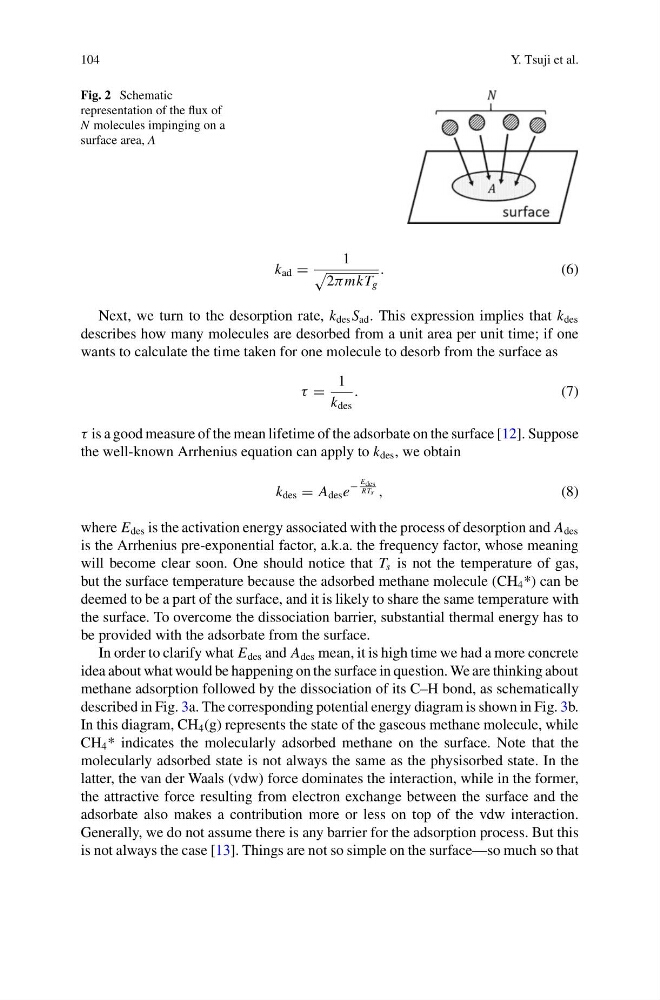
Fig. 2 Schematic
representation of the flux of
N molecules impinging on a
surface area, A
k ad =
1
2π mkT g
.
(6)
Next, we turn to the desorption rate, k des S ad . This expression implies that k des
describes how many molecules are desorbed from a unit area per unit time; if one
wants to calculate the time taken for one molecule to desorb from the surface as
τ =
1
k des
.
(7)
τ is a good measure of the mean lifetime of the adsorbate on the surface [12]. Suppose
the well-known Arrhenius equation can apply to k des , we obtain
k des = A des e
−
E des
RTs ,
(8)
where E des is the activation energy associated with the process of desorption and A des
is the Arrhenius pre-exponential factor, a.k.a. the frequency factor, whose meaning
will become clear soon. One should notice that T s is not the temperature of gas,
but the surface temperature because the adsorbed methane molecule (CH 4 *) can be
deemed to be a part of the surface, and it is likely to share the same temperature with
the surface. To overcome the dissociation barrier, substantial thermal energy has to
be provided with the adsorbate from the surface.
In order to clarify what E des and A des mean, it is high time we had a more concrete
idea about what would be happening on the surface in question. We are thinking about
methane adsorption followed by the dissociation of its C–H bond, as schematically
described in Fig. 3a. The corresponding potential energy diagram is shown in Fig. 3b.
In this diagram, CH 4 (g) represents the state of the gaseous methane molecule, while
CH 4 * indicates the molecularly adsorbed methane on the surface. Note that the
molecularly adsorbed state is not always the same as the physisorbed state. In the
latter, the van der Waals (vdw) force dominates the interaction, while in the former,
the attractive force resulting from electron exchange between the surface and the
adsorbate also makes a contribution more or less on top of the vdw interaction.
Generally, we do not assume there is any barrier for the adsorption process. But this
is not always the case [13]. Things are not so simple on the surface—so much so that
Y. Tsuji et al.
Fig. 2 Schematic
representation of the flux of
N molecules impinging on a
surface area, A
k ad =
1
2π mkT g
.
(6)
Next, we turn to the desorption rate, k des S ad . This expression implies that k des
describes how many molecules are desorbed from a unit area per unit time; if one
wants to calculate the time taken for one molecule to desorb from the surface as
τ =
1
k des
.
(7)
τ is a good measure of the mean lifetime of the adsorbate on the surface [12]. Suppose
the well-known Arrhenius equation can apply to k des , we obtain
k des = A des e
−
E des
RTs ,
(8)
where E des is the activation energy associated with the process of desorption and A des
is the Arrhenius pre-exponential factor, a.k.a. the frequency factor, whose meaning
will become clear soon. One should notice that T s is not the temperature of gas,
but the surface temperature because the adsorbed methane molecule (CH 4 *) can be
deemed to be a part of the surface, and it is likely to share the same temperature with
the surface. To overcome the dissociation barrier, substantial thermal energy has to
be provided with the adsorbate from the surface.
In order to clarify what E des and A des mean, it is high time we had a more concrete
idea about what would be happening on the surface in question. We are thinking about
methane adsorption followed by the dissociation of its C–H bond, as schematically
described in Fig. 3a. The corresponding potential energy diagram is shown in Fig. 3b.
In this diagram, CH 4 (g) represents the state of the gaseous methane molecule, while
CH 4 * indicates the molecularly adsorbed methane on the surface. Note that the
molecularly adsorbed state is not always the same as the physisorbed state. In the
latter, the van der Waals (vdw) force dominates the interaction, while in the former,
the attractive force resulting from electron exchange between the surface and the
adsorbate also makes a contribution more or less on top of the vdw interaction.
Generally, we do not assume there is any barrier for the adsorption process. But this
is not always the case [13]. Things are not so simple on the surface—so much so that