

Dynamics and Energetics of Methane …
103
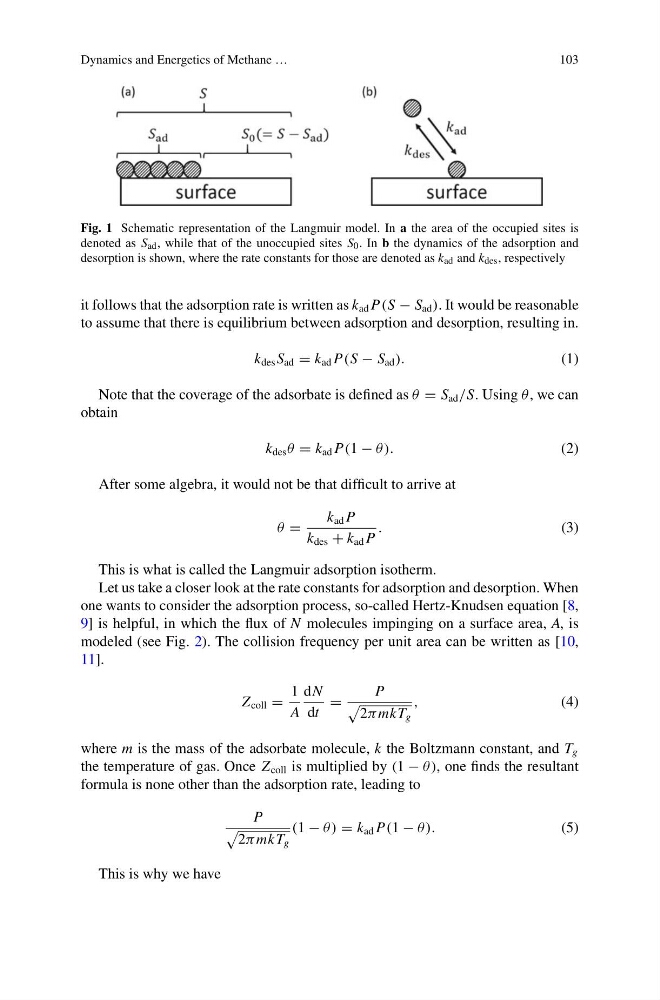
Fig. 1 Schematic representation of the Langmuir model. In a the area of the occupied sites is
denoted as S ad , while that of the unoccupied sites S 0 . In b the dynamics of the adsorption and
desorption is shown, where the rate constants for those are denoted as k ad and k des , respectively
it follows that the adsorption rate is written as k ad P(S − S ad ). It would be reasonable
to assume that there is equilibrium between adsorption and desorption, resulting in.
k des S ad = k ad P(S − S ad ).
(1)
Note that the coverage of the adsorbate is defined as θ = S ad /S. Using θ , we can
obtain
k des θ = k ad P(1 − θ ).
(2)
After some algebra, it would not be that difficult to arrive at
θ =
k ad P
k des + k ad P
.
(3)
This is what is called the Langmuir adsorption isotherm.
Let us take a closer look at the rate constants for adsorption and desorption. When
one wants to consider the adsorption process, so-called Hertz-Knudsen equation [8,
9] is helpful, in which the flux of N molecules impinging on a surface area, A, is
modeled (see Fig. 2). The collision frequency per unit area can be written as [10,
11].
Z coll =
1
A
dN
dt
=
P
2π mkT g
,
(4)
where m is the mass of the adsorbate molecule, k the Boltzmann constant, and T g
the temperature of gas. Once Z coll is multiplied by (1 − θ ), one finds the resultant
formula is none other than the adsorption rate, leading to
P
2π mkT g
(1 − θ ) = k ad P(1 − θ).
(5)
This is why we have
103
Fig. 1 Schematic representation of the Langmuir model. In a the area of the occupied sites is
denoted as S ad , while that of the unoccupied sites S 0 . In b the dynamics of the adsorption and
desorption is shown, where the rate constants for those are denoted as k ad and k des , respectively
it follows that the adsorption rate is written as k ad P(S − S ad ). It would be reasonable
to assume that there is equilibrium between adsorption and desorption, resulting in.
k des S ad = k ad P(S − S ad ).
(1)
Note that the coverage of the adsorbate is defined as θ = S ad /S. Using θ , we can
obtain
k des θ = k ad P(1 − θ ).
(2)
After some algebra, it would not be that difficult to arrive at
θ =
k ad P
k des + k ad P
.
(3)
This is what is called the Langmuir adsorption isotherm.
Let us take a closer look at the rate constants for adsorption and desorption. When
one wants to consider the adsorption process, so-called Hertz-Knudsen equation [8,
9] is helpful, in which the flux of N molecules impinging on a surface area, A, is
modeled (see Fig. 2). The collision frequency per unit area can be written as [10,
11].
Z coll =
1
A
dN
dt
=
P
2π mkT g
,
(4)
where m is the mass of the adsorbate molecule, k the Boltzmann constant, and T g
the temperature of gas. Once Z coll is multiplied by (1 − θ ), one finds the resultant
formula is none other than the adsorption rate, leading to
P
2π mkT g
(1 − θ ) = k ad P(1 − θ).
(5)
This is why we have