

appreciate Bergman’s work, as the chemical symbols in the table appear in a
random order, and not according to Bergman’s theory. Bergman must have noted
this.
There is a second painting in the national Swedish portrait gallery at Nationalmuseum in Stockholm (Fig. 3.5), painted by Pasch’s sister, Ulrika Pasch (1735–
1796) in 1779. This painting was acquired by Nationalmuseum in 1989.
A third, undated, portrait was painted by the Per Krafft the younger (1724–
1793), also one of the most appreciated Swedish portrait painters of the late
eighteenth century. This painting was donated to the Royal Swedish Academy of
Sciences in 1789 by Bergman’s brother, Carl Fredric, after his death. It seems
therefore that the painting had likely been private property in Bergman’s family.
Perhaps Carl Fredric inherited the painting after Bergman’s death? The painting,
which perhaps is the most aesthetic of the Bergman portraits, is hanging in the
Session Hall of the Academy, the hall where the Nobel Prizes in chemistry and
physics are announced every year.
There is also a contemporary plaster medallion (Fig. 3.6) sculptured by the
Swedish neoclassical sculptor Tobias Sergel (1740–1814). It belongs to the collections at the national Swedish portrait gallery at Nationalmuseum in Stockholm
and is a number in a series of similar medallions made by Sergel. In 1782,
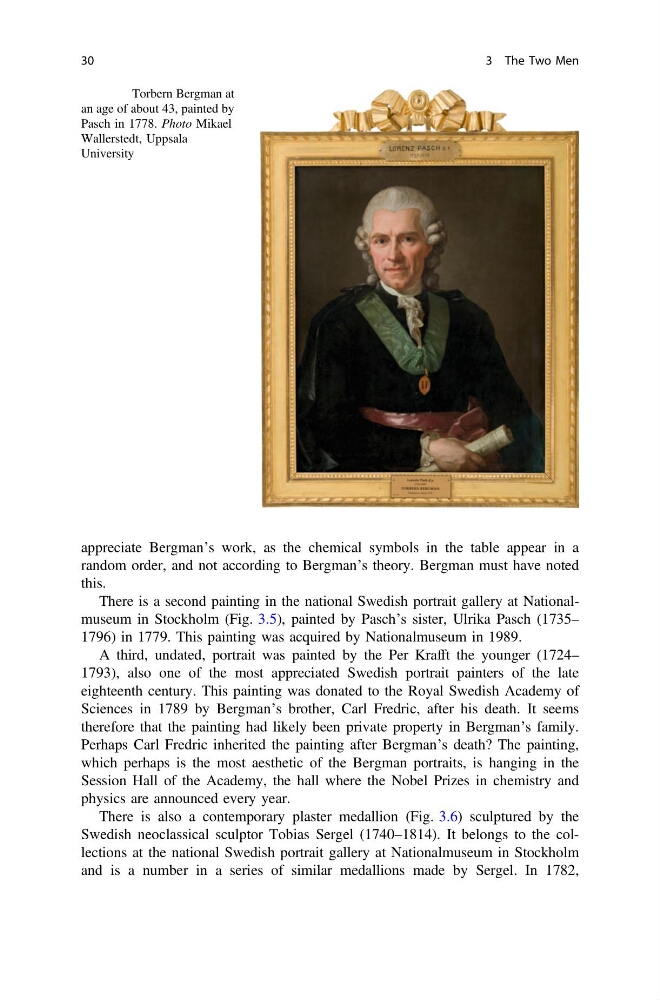
Fig. 3.4 Torbern Bergman at
an age of about 43, painted by
Pasch in 1778. Photo Mikael
Wallerstedt, Uppsala
University
30
3 The Two Men
random order, and not according to Bergman’s theory. Bergman must have noted
this.
There is a second painting in the national Swedish portrait gallery at Nationalmuseum in Stockholm (Fig. 3.5), painted by Pasch’s sister, Ulrika Pasch (1735–
1796) in 1779. This painting was acquired by Nationalmuseum in 1989.
A third, undated, portrait was painted by the Per Krafft the younger (1724–
1793), also one of the most appreciated Swedish portrait painters of the late
eighteenth century. This painting was donated to the Royal Swedish Academy of
Sciences in 1789 by Bergman’s brother, Carl Fredric, after his death. It seems
therefore that the painting had likely been private property in Bergman’s family.
Perhaps Carl Fredric inherited the painting after Bergman’s death? The painting,
which perhaps is the most aesthetic of the Bergman portraits, is hanging in the
Session Hall of the Academy, the hall where the Nobel Prizes in chemistry and
physics are announced every year.
There is also a contemporary plaster medallion (Fig. 3.6) sculptured by the
Swedish neoclassical sculptor Tobias Sergel (1740–1814). It belongs to the collections at the national Swedish portrait gallery at Nationalmuseum in Stockholm
and is a number in a series of similar medallions made by Sergel. In 1782,
Fig. 3.4 Torbern Bergman at
an age of about 43, painted by
Pasch in 1778. Photo Mikael
Wallerstedt, Uppsala
University
30
3 The Two Men