

3.3 Portraits of Bergman
Although we now slightly more about Scheele’s private life compared with
Bergman’s, we actually do not know what Scheele looked like. Scheele’s interest
was chemistry, and he was rather uninterested in fame and public recognition. For
Bergman, on the other hand, such things were important. Bergman wanted a place
in the history books and it is not surprising that we have several portraits of
Bergman by some of the most celebrated artists of his time.
There are three contemporary paintings of Bergman; one from 1778 (Fig. 3.4) at
Uppsala University painted by Lorens Pasch the younger (1733–1805), one of the
most appreciated Swedish portrait painters of the time. Viewing the painting, is it
clear that every detail had been planned by Bergman. In this painting, Bergman
wears the so-called national costume, introduced by King Gustav III in 1778 as a
standard costume for the nobility and burghers to limit the import of luxury items.
The costume was mandatory in his court, and by wearing the costume in the
painting, Bergman probably wanted to express his loyalty to the King, who had
helped him to the chair in chemistry (Sect. 9.3). Bergman is wearing the Order of
Wasa in its green silk ribbon around the neck and is holding a scroll in his hand.
The scroll is an attraction table (Chap. 20), which Bergman considered his most
important contribution to science. Interestingly enough, the painter did not fully
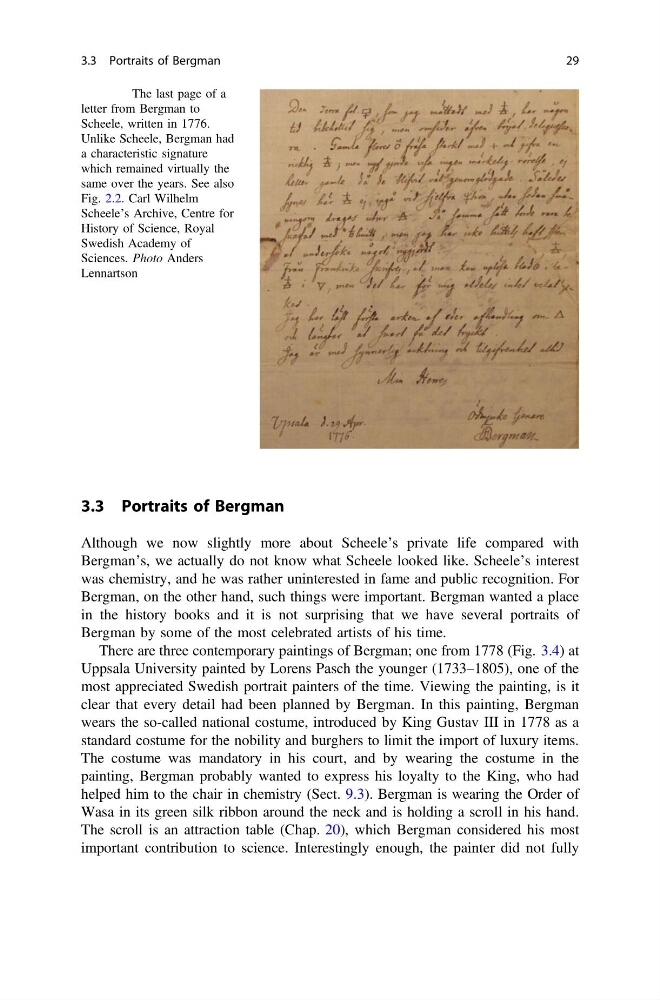
Fig. 3.3 The last page of a
letter from Bergman to
Scheele, written in 1776.
Unlike Scheele, Bergman had
a characteristic signature
which remained virtually the
same over the years. See also
Fig. 2.2. Carl Wilhelm
Scheele’s Archive, Centre for
History of Science, Royal
Swedish Academy of
Sciences. Photo Anders
Lennartson
3.3 Portraits of Bergman
29
Although we now slightly more about Scheele’s private life compared with
Bergman’s, we actually do not know what Scheele looked like. Scheele’s interest
was chemistry, and he was rather uninterested in fame and public recognition. For
Bergman, on the other hand, such things were important. Bergman wanted a place
in the history books and it is not surprising that we have several portraits of
Bergman by some of the most celebrated artists of his time.
There are three contemporary paintings of Bergman; one from 1778 (Fig. 3.4) at
Uppsala University painted by Lorens Pasch the younger (1733–1805), one of the
most appreciated Swedish portrait painters of the time. Viewing the painting, is it
clear that every detail had been planned by Bergman. In this painting, Bergman
wears the so-called national costume, introduced by King Gustav III in 1778 as a
standard costume for the nobility and burghers to limit the import of luxury items.
The costume was mandatory in his court, and by wearing the costume in the
painting, Bergman probably wanted to express his loyalty to the King, who had
helped him to the chair in chemistry (Sect. 9.3). Bergman is wearing the Order of
Wasa in its green silk ribbon around the neck and is holding a scroll in his hand.
The scroll is an attraction table (Chap. 20), which Bergman considered his most
important contribution to science. Interestingly enough, the painter did not fully
Fig. 3.3 The last page of a
letter from Bergman to
Scheele, written in 1776.
Unlike Scheele, Bergman had
a characteristic signature
which remained virtually the
same over the years. See also
Fig. 2.2. Carl Wilhelm
Scheele’s Archive, Centre for
History of Science, Royal
Swedish Academy of
Sciences. Photo Anders
Lennartson
3.3 Portraits of Bergman
29