

Bergman’s friend Schwediauer in London asked Bergman for a portrait, as he
wished to order a medallion from the Wedgwood firm [17], famous for their
porcelain (Jaspar ware) medallions in white relief against blue background. Not
until January 1784, Bergman sent a copy of the Sergel medallion to Schwediauer,
and the Wedgewood medallion was not finished until after Bergman’s death that
summer (Fig. 3.7). Copies of this medallion are now presented to the winners of the
Torbern Bergman Medal in analytical chemistry by the Swedish Chemical Society
(Sect. 28.8).
There are two contemporary engravings depicting Bergman, one
(12.1 Â 8.1 cm; Fig. 7.5) made by engraver Johan Fredrik Martin (1755–1816)
(Fig. 3.8). Variants of this engraving were used by Gustav Georg Endner (1754–
1824) to create the frontispiece for the first volume of Allgemines Journal der
Chemie in 1798 and by K. Mackenzie in 1801 to illustrate a biographical paper on
Bergman in Philosophical Magazine [18].
Another engraving (Fig. 3.9), enface, was made by engraver Fredrik Akrel
(1748–1804), who worked for, e.g., the Royal Academy of Sciences and probably
made illustrations for some of Bergman’s and Scheele’s works. Several latter
engravings from the nineteenth century were used to illustrate, e.g., encyclopedias
and lithographic magazines.
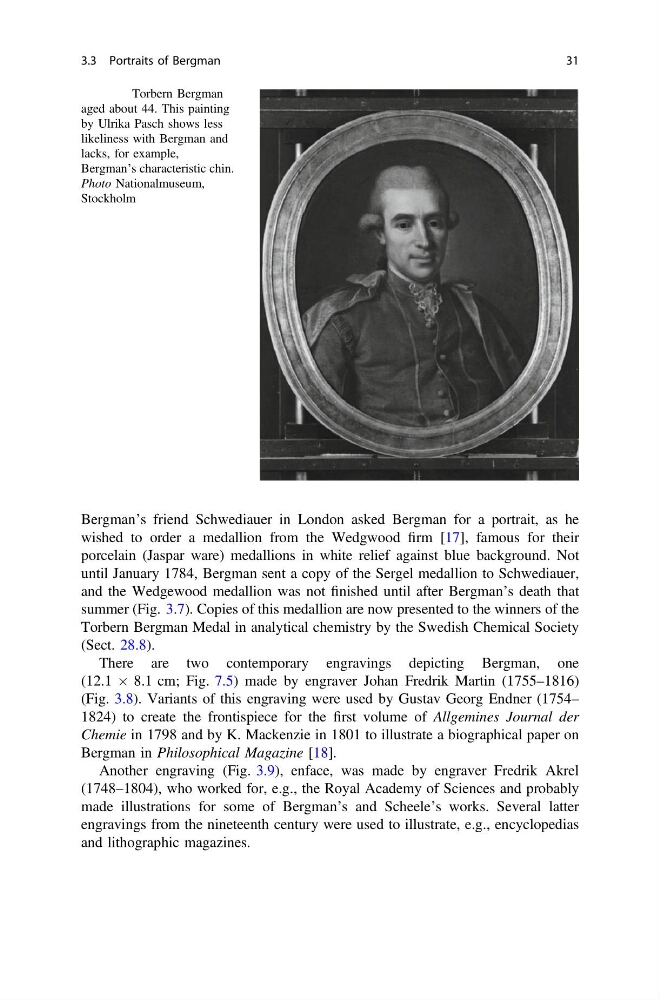
Fig. 3.5 Torbern Bergman
aged about 44. This painting
by Ulrika Pasch shows less
likeliness with Bergman and
lacks, for example,
Bergman’s characteristic chin.
Photo Nationalmuseum,
Stockholm
3.3 Portraits of Bergman
31
wished to order a medallion from the Wedgwood firm [17], famous for their
porcelain (Jaspar ware) medallions in white relief against blue background. Not
until January 1784, Bergman sent a copy of the Sergel medallion to Schwediauer,
and the Wedgewood medallion was not finished until after Bergman’s death that
summer (Fig. 3.7). Copies of this medallion are now presented to the winners of the
Torbern Bergman Medal in analytical chemistry by the Swedish Chemical Society
(Sect. 28.8).
There are two contemporary engravings depicting Bergman, one
(12.1 Â 8.1 cm; Fig. 7.5) made by engraver Johan Fredrik Martin (1755–1816)
(Fig. 3.8). Variants of this engraving were used by Gustav Georg Endner (1754–
1824) to create the frontispiece for the first volume of Allgemines Journal der
Chemie in 1798 and by K. Mackenzie in 1801 to illustrate a biographical paper on
Bergman in Philosophical Magazine [18].
Another engraving (Fig. 3.9), enface, was made by engraver Fredrik Akrel
(1748–1804), who worked for, e.g., the Royal Academy of Sciences and probably
made illustrations for some of Bergman’s and Scheele’s works. Several latter
engravings from the nineteenth century were used to illustrate, e.g., encyclopedias
and lithographic magazines.
Fig. 3.5 Torbern Bergman
aged about 44. This painting
by Ulrika Pasch shows less
likeliness with Bergman and
lacks, for example,
Bergman’s characteristic chin.
Photo Nationalmuseum,
Stockholm
3.3 Portraits of Bergman
31