

pyrolysis of gallic acid, Scheele obtained pyrogallol (Fig. 24.10), which a century
later found use as a reducing agent for developing photographic plates.
24.7 The Discovery of Glycerol
In his shop, Scheele prepared common salve (Emplastrum simplex), a paste used to
treat wounds and which was obtained by heating vegetable oil with lead(II) oxide
(litharge) and water. The salve consisted of the water-insoluble antiseptic lead salts
of fatty acids. Scheele realised the similarity of the salve with soap, which is a
mixture of the corresponding sodium salts of fatty acids.
It was in the aqueous residue from the salve production that Scheele discovered
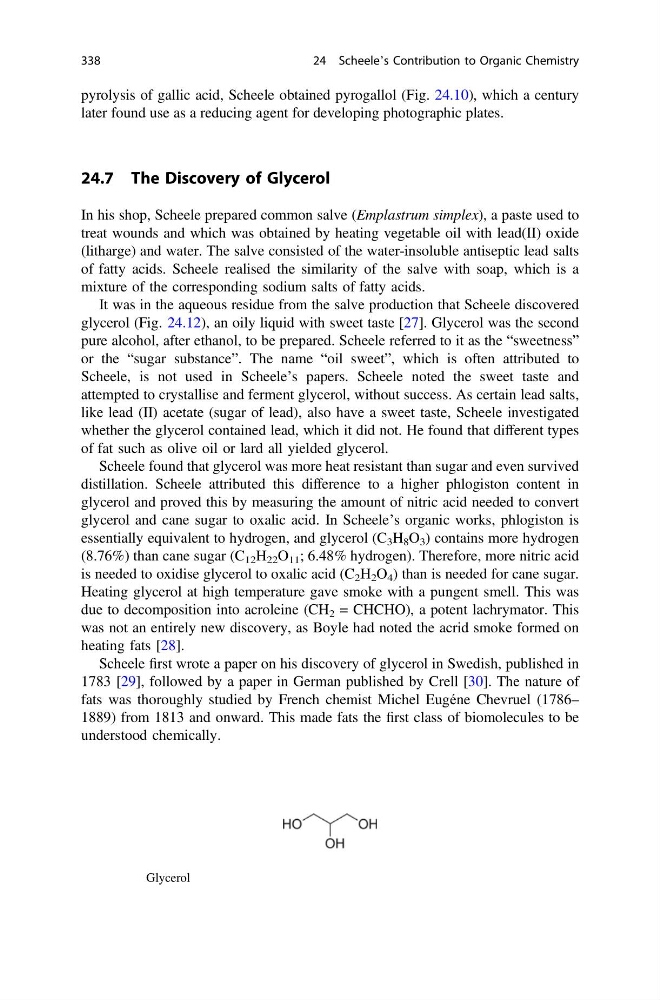
glycerol (Fig. 24.12), an oily liquid with sweet taste [27]. Glycerol was the second
pure alcohol, after ethanol, to be prepared. Scheele referred to it as the “sweetness”
or the “sugar substance”. The name “oil sweet”, which is often attributed to
Scheele, is not used in Scheele’s papers. Scheele noted the sweet taste and
attempted to crystallise and ferment glycerol, without success. As certain lead salts,
like lead (II) acetate (sugar of lead), also have a sweet taste, Scheele investigated
whether the glycerol contained lead, which it did not. He found that different types
of fat such as olive oil or lard all yielded glycerol.
Scheele found that glycerol was more heat resistant than sugar and even survived
distillation. Scheele attributed this difference to a higher phlogiston content in
glycerol and proved this by measuring the amount of nitric acid needed to convert
glycerol and cane sugar to oxalic acid. In Scheele’s organic works, phlogiston is
essentially equivalent to hydrogen, and glycerol (C 3 H 8 O 3 ) contains more hydrogen
(8.76%) than cane sugar (C 12 H 22 O 11 ; 6.48% hydrogen). Therefore, more nitric acid
is needed to oxidise glycerol to oxalic acid (C 2 H 2 O 4 ) than is needed for cane sugar.
Heating glycerol at high temperature gave smoke with a pungent smell. This was
due to decomposition into acroleine (CH 2 = CHCHO), a potent lachrymator. This
was not an entirely new discovery, as Boyle had noted the acrid smoke formed on
heating fats [28].
Scheele first wrote a paper on his discovery of glycerol in Swedish, published in
1783 [29], followed by a paper in German published by Crell [30]. The nature of
fats was thoroughly studied by French chemist Michel Eugéne Chevruel (1786–
1889) from 1813 and onward. This made fats the first class of biomolecules to be
understood chemically.
Fig. 24.12 Glycerol
338
24 Scheele’s Contribution to Organic Chemistry
later found use as a reducing agent for developing photographic plates.
24.7 The Discovery of Glycerol
In his shop, Scheele prepared common salve (Emplastrum simplex), a paste used to
treat wounds and which was obtained by heating vegetable oil with lead(II) oxide
(litharge) and water. The salve consisted of the water-insoluble antiseptic lead salts
of fatty acids. Scheele realised the similarity of the salve with soap, which is a
mixture of the corresponding sodium salts of fatty acids.
It was in the aqueous residue from the salve production that Scheele discovered
glycerol (Fig. 24.12), an oily liquid with sweet taste [27]. Glycerol was the second
pure alcohol, after ethanol, to be prepared. Scheele referred to it as the “sweetness”
or the “sugar substance”. The name “oil sweet”, which is often attributed to
Scheele, is not used in Scheele’s papers. Scheele noted the sweet taste and
attempted to crystallise and ferment glycerol, without success. As certain lead salts,
like lead (II) acetate (sugar of lead), also have a sweet taste, Scheele investigated
whether the glycerol contained lead, which it did not. He found that different types
of fat such as olive oil or lard all yielded glycerol.
Scheele found that glycerol was more heat resistant than sugar and even survived
distillation. Scheele attributed this difference to a higher phlogiston content in
glycerol and proved this by measuring the amount of nitric acid needed to convert
glycerol and cane sugar to oxalic acid. In Scheele’s organic works, phlogiston is
essentially equivalent to hydrogen, and glycerol (C 3 H 8 O 3 ) contains more hydrogen
(8.76%) than cane sugar (C 12 H 22 O 11 ; 6.48% hydrogen). Therefore, more nitric acid
is needed to oxidise glycerol to oxalic acid (C 2 H 2 O 4 ) than is needed for cane sugar.
Heating glycerol at high temperature gave smoke with a pungent smell. This was
due to decomposition into acroleine (CH 2 = CHCHO), a potent lachrymator. This
was not an entirely new discovery, as Boyle had noted the acrid smoke formed on
heating fats [28].
Scheele first wrote a paper on his discovery of glycerol in Swedish, published in
1783 [29], followed by a paper in German published by Crell [30]. The nature of
fats was thoroughly studied by French chemist Michel Eugéne Chevruel (1786–
1889) from 1813 and onward. This made fats the first class of biomolecules to be
understood chemically.
Fig. 24.12 Glycerol
338
24 Scheele’s Contribution to Organic Chemistry